

Why do our best ideas arrive when we’re doing something else? You can spend hours wrestling with a problem, getting absolutely nowhere, only for the answer to appear while you’re having a shower, walking the dog or making a cup of tea.
It is almost as though our brains deliberately wait until we have stopped wrestling with the problem before revealing an answer that suddenly seems obvious.
But there is a fascinating psychological explanation for this apparent contradiction.
Our brains do not necessarily stop working on problems when we turn our attention elsewhere. Sometimes, stepping away creates the conditions in which fresh ideas can emerge.
And, as I have discovered over the years, having a brilliant idea is not necessarily the same as doing something with it!
The Incubation Effect in Creative Problem-Solving
Psychologists use the term incubation effect to describe improvements in problem-solving that can occur after taking a break from a difficult task.
The break may be most useful when we have already worked on the problem and reached an impasse.
Imagine trying to solve a crossword clue. You examine every possible interpretation, but nothing fits.
Eventually, you give up and make a cup of tea.
Ten minutes later, the answer suddenly appears. You feel rather pleased with yourself — followed almost immediately by the irritating realisation that it was there to be found all along.
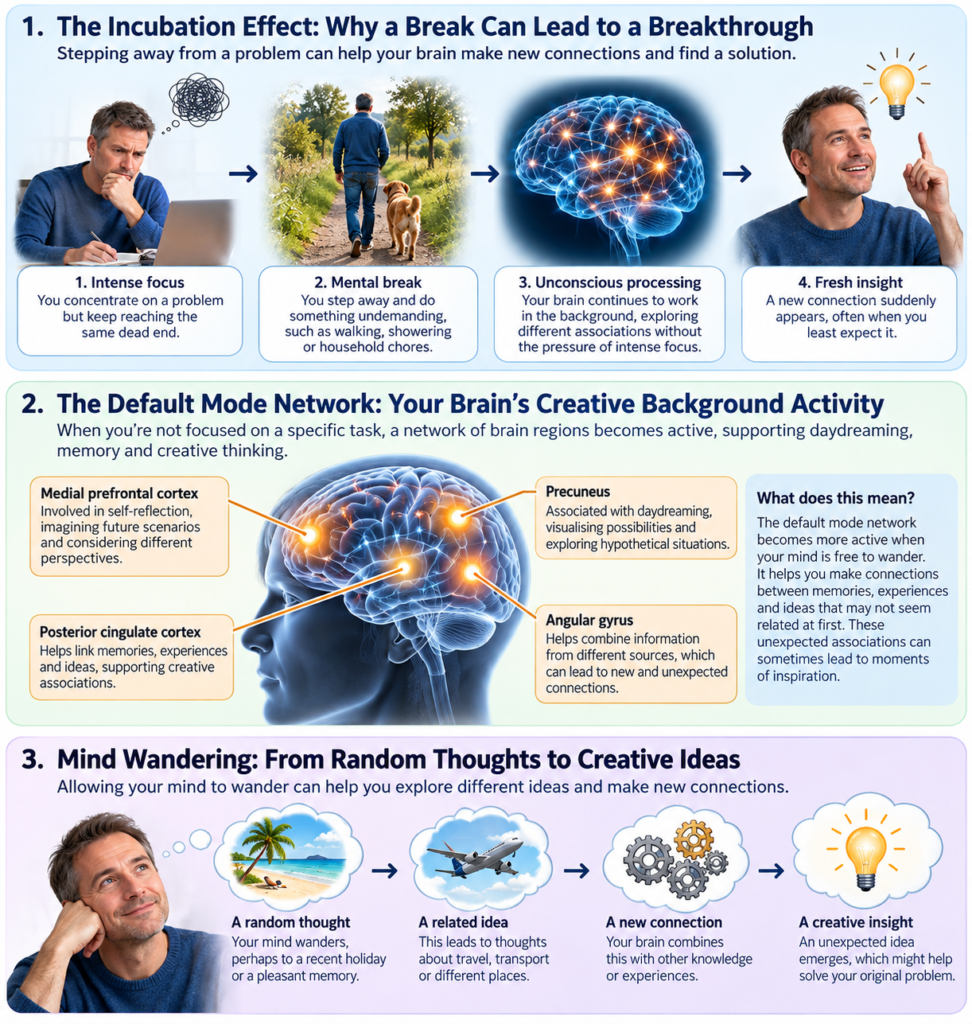
One explanation is that concentrating too intensely can trap us in an unproductive pattern of thinking, sometimes called fixation. We repeatedly consider the same possibilities while overlooking alternatives, until the problem itself begins to look narrower than it really is.
Taking a break may weaken these mental constraints, allowing different associations to emerge. We may return not merely with another answer, but with a different way of asking the question.
Research highlighted by the Association for Psychological Science describes an experiment in which participants considered unusual uses for ordinary objects. Those given an undemanding task between attempts showed benefits consistent with mind wandering; simply taking any break was not the whole story.
However, incubation is not guaranteed to work. Its effectiveness depends on the problem, the activity undertaken during the break and how much thought has already been invested. Experiments measuring unusual uses for objects do not establish that every type of real-world problem will benefit equally.
Why Stepping Away from a Problem Encourages Creative Insights
When we concentrate intensely, our attention becomes selective.
This is useful for tasks requiring precision, but it can sometimes restrict creative thinking.
A mental break allows us to return with a different perspective. What looked like a dead end may become a fresh problem with possibilities we had not previously considered.
Interestingly, the most useful distraction may be something mildly engaging rather than an activity requiring considerable concentration — or even doing absolutely nothing. Researchers studying the so-called shower effect suggest that a modest amount of stimulation can provide room for thoughts to drift without becoming completely aimless.
Walking, gardening or performing familiar household chores can occupy our attention without completely overwhelming it. Even catching up with an unappealing pile of paperwork may give the conscious mind something routine to do while ideas continue to form in the background. A shower is another example: it supplies familiar sensations and routine actions without usually demanding much planning.
Perhaps this explains why so many apparently difficult problems become clearer once we stop trying to force an answer. We may not have discovered a completely new fact; instead, we have found a new angle from which familiar facts fit together. A sensible approach is to work on the problem first, step away for a while and then return to test any new ideas.
It also raises another intriguing question: why do questions lead to more questions?
Sometimes, solving one problem simply reveals another waiting behind it. And sometimes, reframing the first problem is what finally makes a solution possible.
What Happens in the Brain When Our Minds Wander?
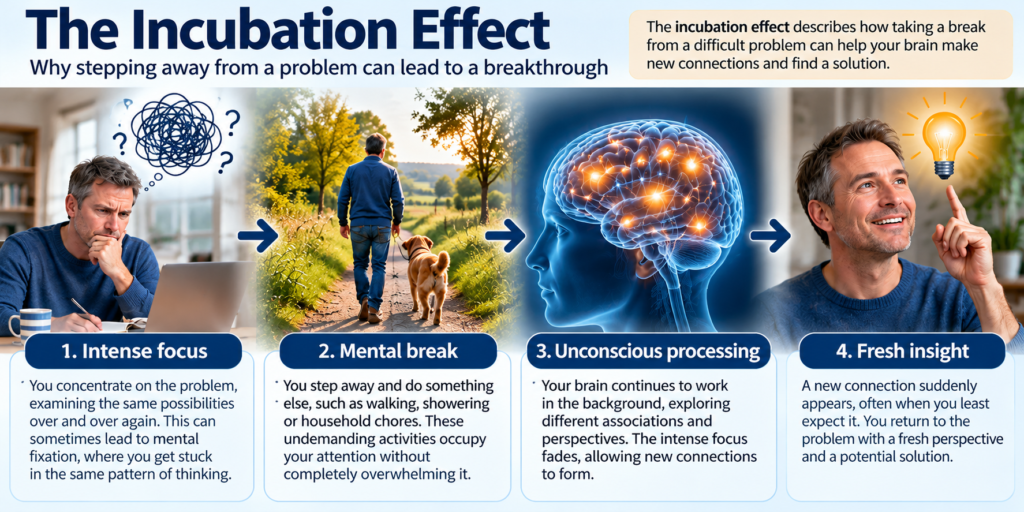
Our brains remain remarkably active even when we are not concentrating on a particular task.
Rather than switching off, different networks become involved in remembering experiences, imagining possibilities and considering future events.
These processes can contribute to creative thought.
How the Default Mode Network Supports Spontaneous Thinking
The default mode network is a collection of interconnected brain regions associated with internally directed thinking. It is not a single ‘creativity centre’ or a switch that turns inspiration on whenever we relax.
It becomes particularly relevant when we daydream, recall memories or imagine hypothetical situations.
Such mental activity can help us make connections between experiences and information that initially appear unrelated. Researchers have linked this network with remembering the past, imagining the future and exploring possible combinations of ideas. That offers one possible explanation for why an old problem can suddenly appear in a new light.
However, creativity does not depend on the default mode network alone.
Research suggests that creative thinking also involves interactions with networks responsible for attention and cognitive control. Generating an unusual possibility is only part of the process; deciding whether it works calls for a more deliberate kind of thinking.
In other words, generating an unusual idea and evaluating whether it makes sense involve different but cooperating mental processes. Brain imaging can reveal associations between these networks and creativity, but it cannot explain every individual flash of inspiration.
This relationship between memory and thought is particularly interesting when considering why smells trigger memories so strongly.
A seemingly insignificant experience can unexpectedly activate memories and associations that have remained unnoticed for years.
Mind Wandering and Unexpected Moments of Inspiration
Mind wandering is often regarded as a distraction, especially when we are supposed to be concentrating.
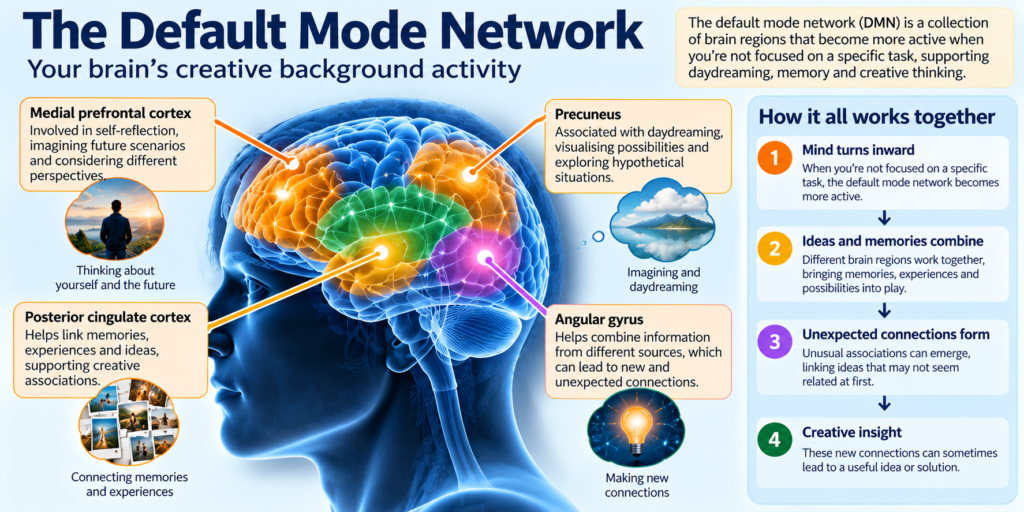
Yet allowing our thoughts to drift can sometimes encourage creative associations, especially when we have already supplied the mind with a problem worth exploring. The conscious effort may have stopped, but the earlier work still gives those wandering thoughts something to connect with.
Instead of following a single logical path, the mind may move between memories, possibilities and apparently unrelated ideas.
Occasionally, those connections produce something genuinely useful. The answer may arrive so abruptly that it feels as though it has appeared from nowhere, even though the earlier struggle helped prepare the ground.
Research on spontaneous inspiration, including reports of writers and physicists recording their ideas, suggests that some important insights arise while attention is elsewhere. Such reports are intriguing, although an unexpected ‘aha’ feeling does not guarantee that the idea is original or correct.
Of course, not every wandering thought produces a brilliant idea. Much of our daydreaming is ordinary mental activity, and wandering attention can be unhelpful when a task demands care or safety.
But occasionally, something clicks. A problem that seemed impossible a short while ago now looks surprisingly straightforward.
And that unexpected moment of recognition can be rather satisfying — even if it leaves us wondering why we spent so long looking in the wrong direction.
Why Having a Brilliant Idea Is Only Half the Story
Over the years, I have had many good ideas. Some, I would go so far as to describe as brilliant!
Unfortunately, I have not always done anything with them.
Sometimes there was insufficient time. On other occasions, I lacked the money or resources needed to develop and market an idea.
More frustratingly, I have occasionally watched somebody else successfully introduce something remarkably similar years later.
Naturally, that does not prove my original idea would have succeeded. Execution, timing and circumstances matter enormously.
Nevertheless, it can be rather galling to recognise an opportunity that you once considered yourself.
Why Creative Inspiration Needs Practical Action
There is an old expression that seems particularly appropriate here: strike while the iron is hot.
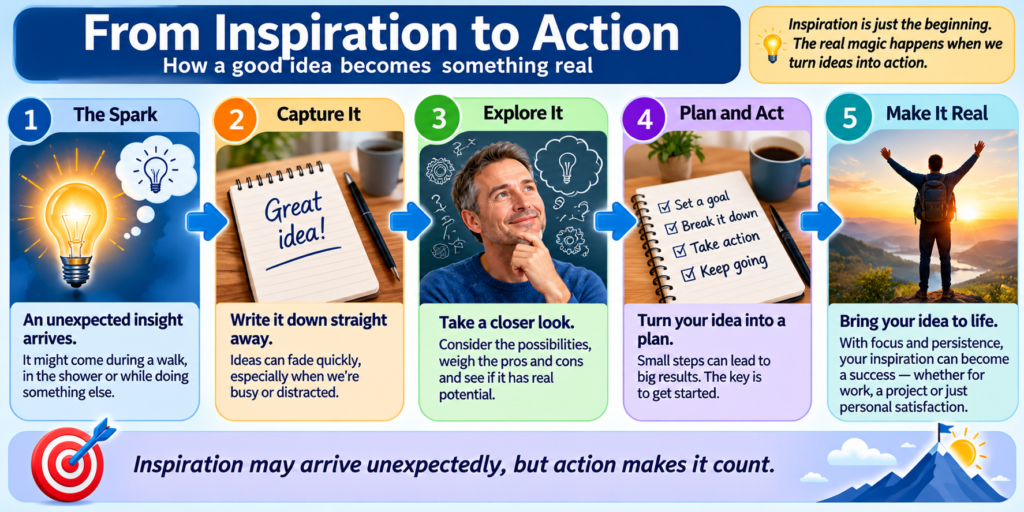
A creative insight might arrive unexpectedly, but turning it into something worthwhile usually requires deliberate effort.
That means recording the idea, evaluating its possibilities and deciding what to do next. It is worth asking whether the apparent solution actually solves the original problem, rather than trusting the excitement of the moment. A change of perspective can be powerful, but it still needs checking.
Even a simple notebook can be invaluable. An idea that seems unforgettable today may have disappeared completely by tomorrow. A brief note, voice memo or sketch can preserve enough detail to examine it properly later.
Of course, not every idea deserves to be pursued. Some are impractical, while others lose their appeal when examined more closely.
The challenge is recognising which ideas deserve further attention.
And perhaps that is why nobody has all the answers. Good ideas are only the beginning of understanding.
Conclusion: Why do our best ideas arrive when we’re doing something else
So why do our best ideas arrive when we’re doing something else?
Sometimes it is because we have stopped approaching the problem in exactly the same way.
Because creative thinking involves more than conscious concentration.
The incubation effect, spontaneous mental activity and the freedom to explore unexpected associations can all contribute to moments of inspiration. Mildly engaging activities may help us revisit a stubborn question from another angle, but they are not a guaranteed shortcut to a breakthrough.
Sometimes, taking a break is precisely what our thinking needs — provided we also give ourselves time to return, question the insight and do the work.
But my own experience suggests one final lesson: when inspiration arrives, write it down and consider acting on it.
After all, somebody else might have the same idea tomorrow!
Discover more intriguing questions about everyday life in Walkeropedia’s collection of quirky questions.