
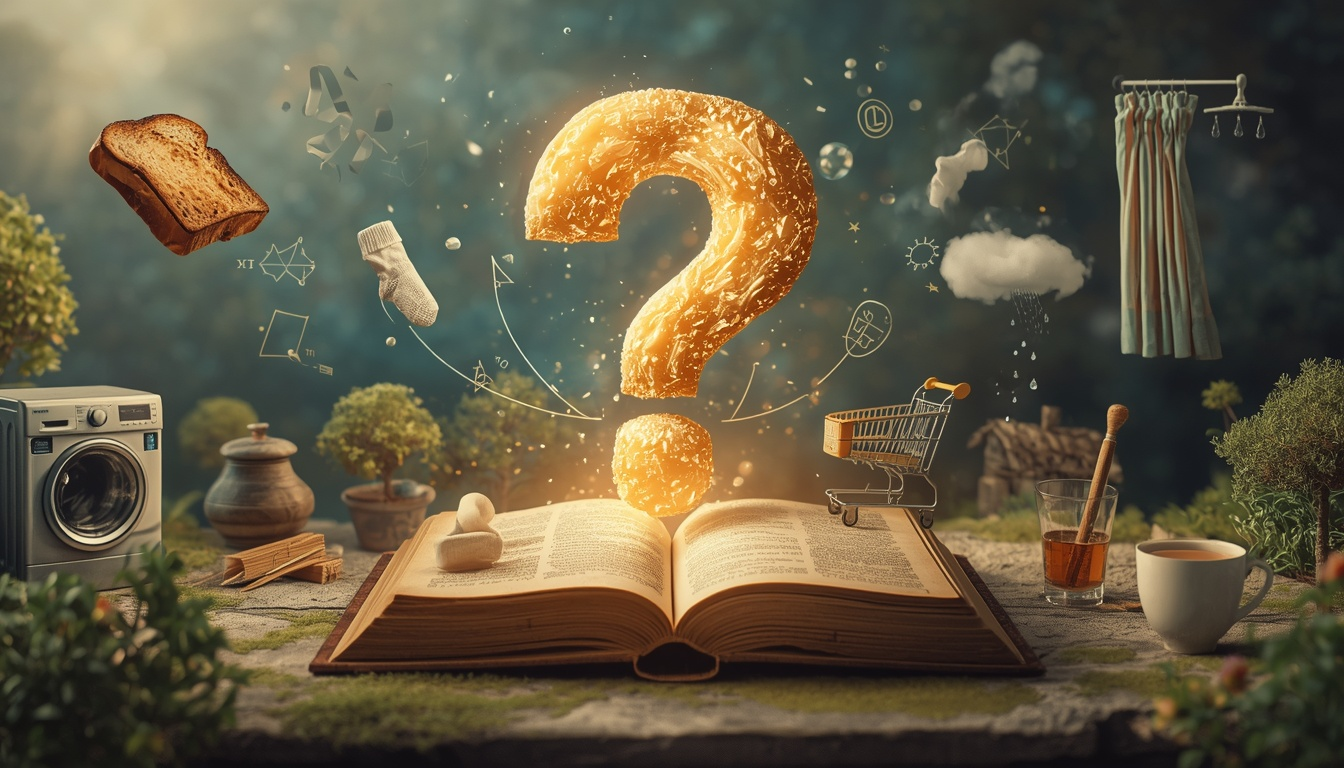
Have you ever wondered why supermarket trolleys insist on steering themselves, why your shower curtain seems determined to join you in the shower, or why the English language has so many peculiar rules?
Quirky Questions
Welcome to Quirky Questions, where everyday mysteries meet curiosity, science and a healthy appreciation of the absurd.
Some questions have surprisingly simple answers. Others lead us into the fascinating worlds of physics, language, psychology and human behaviour. And occasionally, the explanation turns out to be even stranger than the question.
There’s no such thing as a silly question here. After all, every day is a school day!
Everyday Physics: The Science Hiding in Plain Sight: Quirky Questions
Physics isn’t confined to laboratories, complicated equations or scientists wearing white coats. It’s happening all around us, often when we least expect it. From the behaviour of water and ice to the mysterious disappearance of socks, everyday life provides an endless supply of scientific puzzles. Some have straightforward explanations, while others remain surprisingly complicated. These questions explore the invisible forces, curious properties and occasional coincidences that make our ordinary world so extraordinary.

- Why Do Supermarket Trolleys Pull to One Side?
Discover why a perfectly ordinary shopping trip can become a wrestling match with a trolley determined to head in the wrong direction. - Why Does Your Shower Curtain Cling to You?
Explore the curious movement of air and water that makes a harmless shower curtain behave as though it wants a cuddle. - Why Does Toast Land Butter-Side Down?
Is the universe conspiring against your breakfast, or can gravity, rotation and the height of your table explain this familiar frustration? - Why Does Hot Water Sometimes Freeze Faster Than Cold Water?
Investigate the puzzling Mpemba effect and discover why hotter water can sometimes freeze first, despite what common sense might suggest - Why Does Rain Have Such a Distinctive Smell?
Discover the science of petrichor, the earthy aroma released when raindrops meet dry ground, and the remarkable role played by soil bacteria. - Why Does Your Recorded Voice Sound So Different?
Find out why the voice you hear inside your head sounds surprisingly different from the one everyone else has been listening to for years. - Why Do Socks Always Disappear in the Washing Machine?
Investigate the domestic mystery of missing socks, from washing machine mechanics to human forgetfulness. Is there really a secret sock dimension? - Why Does Ice Float on Water?
Discover why frozen water behaves differently from most substances and how this unusual property helps protect life beneath frozen lakes.
Language Oddities: When Words Refuse to Behave
The English language is a wonderful collection of borrowed words, ancient expressions, changing pronunciations and rules that frequently seem determined to contradict themselves. Why do some letters remain silent? Why do similar words form their plurals differently? And why do we continue using expressions whose original meanings have almost disappeared? Behind these linguistic peculiarities lie fascinating stories of history, culture and the extraordinary ways language evolves through everyday use.
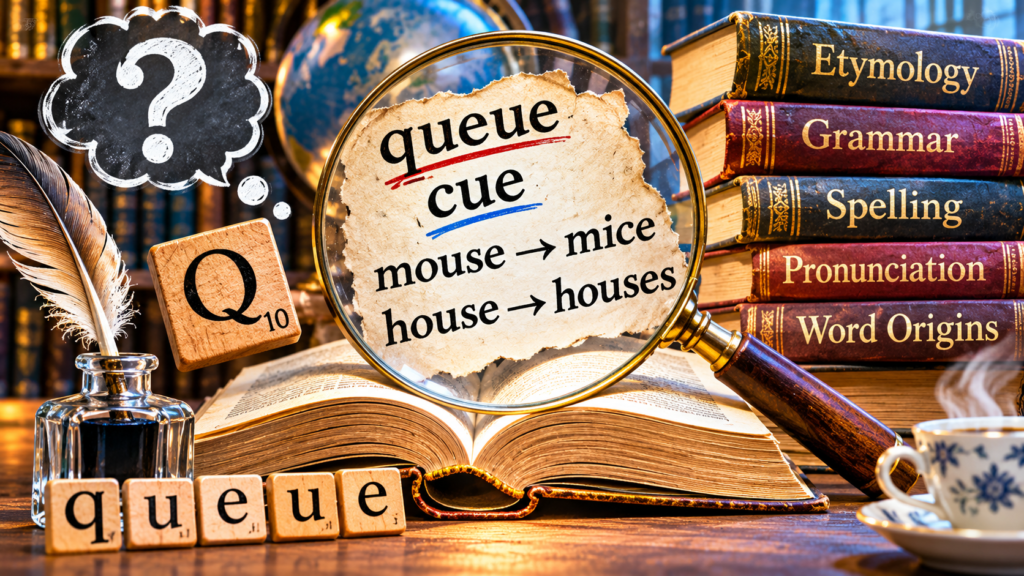
- Why Does Queue Have Four Silent Letters?
Unravel the French origins of a word that appears to use five letters to do the work of one, and discover why English kept the unusual spelling. - Why Is the Plural of Mouse Mice but the Plural of House Is Houses?
Explore the historical changes in English that left us with mice, houses and a collection of plural rules that refuse to behave consistently. - Why Do We Say Look After the Pennies?
Trace the origins of this familiar proverb and discover why looking after small amounts of money has long been considered sound financial wisdom. - Why Do We Say Something Is Under the Weather?
Discover the possible maritime origins of this curious expression and how being under the weather came to mean feeling poorly. - Why Do We Drive on a Parkway but Park on a Driveway?
Take a linguistic detour through the history of roads, gardens and changing word meanings to understand this entertaining contradiction.
The Curious Mind: Why Our Brains Keep Asking Quirky Questions
The human mind is a remarkable storyteller, problem-solver and occasional troublemaker. It can make minutes feel like hours, summon embarrassing memories from decades ago and produce brilliant ideas when we’re supposed to be concentrating on something else. Our senses and perceptions aren’t always as reliable as we imagine, either. These questions explore the fascinating psychology of memory, curiosity, perception and thought, revealing why our brains sometimes behave in wonderfully unexpected ways.

- Why Do Questions Lead to More Questions?
Explore why discovering one answer often reveals several new mysteries and how curiosity drives the endless expansion of human knowledge. - Why Does Time Slow Down When You’re Waiting?
Discover why a few minutes in a queue can feel longer than an enjoyable afternoon, even though the clock never changes its pace. - Why Do Smells Trigger Memories So Strongly?
Find out how a familiar scent can transport you decades into the past and why smell has such a powerful connection with emotion and memory. - Why Do We Forget Names More Easily Than Faces?
Explore why recognising a familiar face can be effortless while remembering the person’s name becomes an unexpectedly difficult mental challenge. - Why Does Nobody Have All the Answers?
Consider the extraordinary breadth of human knowledge and why even the greatest experts must accept that there will always be more to discover. - Why Do We Always Remember Embarrassing Moments from Years Ago?
Discover why the brain insists on replaying awkward moments long after everyone else has probably forgotten they ever happened. - Why Do Our Best Ideas Arrive When We’re Doing Something Else?
Explore the science of creative incubation and why stepping away from a problem can sometimes be the quickest route towards solving it. - Why Does the Moon Look Bigger Near the Horizon?
Investigate the remarkable Moon illusion and discover why our brains can make the same Moon appear enormous near the horizon and smaller overhead. - Why Is Yawning Contagious?
Explore the curious relationship between yawning, social behaviour and the brain, including why simply thinking about yawning can sometimes trigger one. - Why do Our Best Ideas arrive when We’re doing Something Else
Why do our best ideas often appear when we’re doing something completely unrelated? Discover how stepping away from a problem allows the brain to make unexpected connections, turning everyday distractions into moments of inspiration.
There’s Always Another Question in Quirky Questions
The wonderful thing about curiosity is that it never really reaches a finishing line. Every answer adds another small piece to our understanding of the world, but it often reveals a fresh mystery waiting just around the corner.
Quirky Questions will continue growing as we explore more everyday puzzles, linguistic peculiarities and surprising features of the human mind.
So, if you’ve ever found yourself wondering why something happens, no matter how trivial or ridiculous the question might seem, you’re in exactly the right place.
As parents, we are all aware of the need for our children to ask questions and when we answer them they simply ask why? That beautifully encapsulates the purpose of Quirky Questions
Keep questioning. Keep discovering. And remember, every day is a school day!