What is PHP, and why does a programming language that most internet users have never heard of play such an important role in the websites they visit?
Every time you open a website, something happens behind the scenes. Some pages simply display information, while others retrieve data, check passwords, process forms or assemble content specifically for you.
PHP is one of the programming languages responsible for making those more complicated tasks possible.
You might never see PHP working, but if you use a WordPress website, an online shop or a discussion forum, there is a reasonable chance PHP is involved.
And when a PHP security vulnerability makes the news, understanding what the language actually does becomes rather more interesting.
What Does PHP Actually Mean?
PHP originally stood for Personal Home Page, reflecting its beginnings as a collection of tools created by Rasmus Lerdorf in 1994.
Today, PHP officially stands for PHP: Hypertext Preprocessor.
I must admit, I always thought PHP stood for Pre Hypertext Processing. Although that is not its official name, it conveys something of the same idea: processing information before the resulting webpage reaches your browser.
The official name is a rather peculiar recursive acronym, meaning the abbreviation appears within its own definition.
PHP is a server-side scripting language. Unlike JavaScript, which often runs inside your web browser, PHP normally runs on the computer hosting the website.
Its job is to process instructions and generate information that can be sent to your browser.
The important distinction is that your browser usually receives the results of PHP’s work, not the PHP instructions themselves.
For anyone interested in exploring the language further, the official PHP website provides documentation, tutorials and information about current releases.
How PHP Works Behind the Scenes on Websites
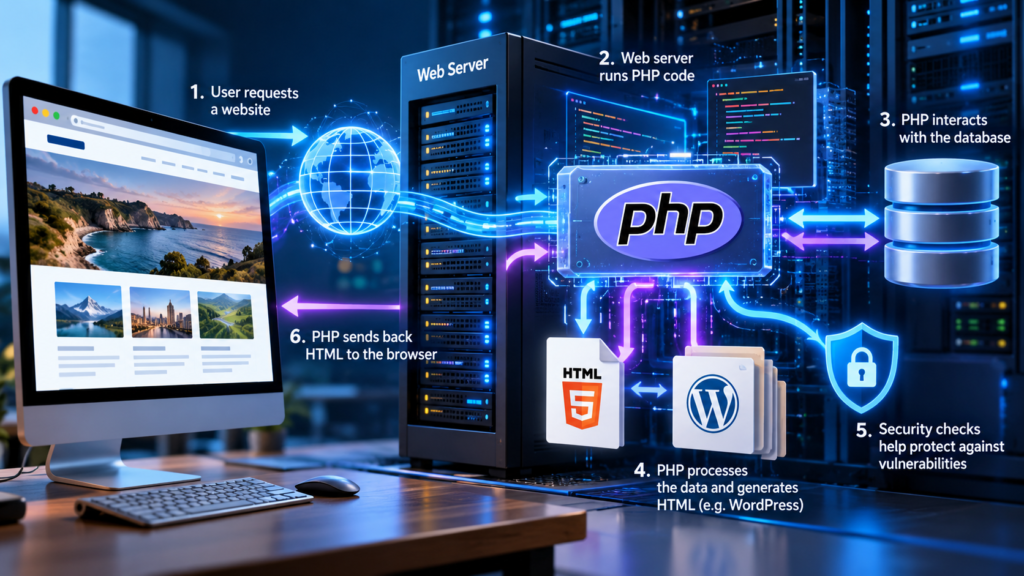
Imagine visiting a website that displays the latest news.
The page might look like a finished document, but much of its content could have been assembled only moments before you saw it.
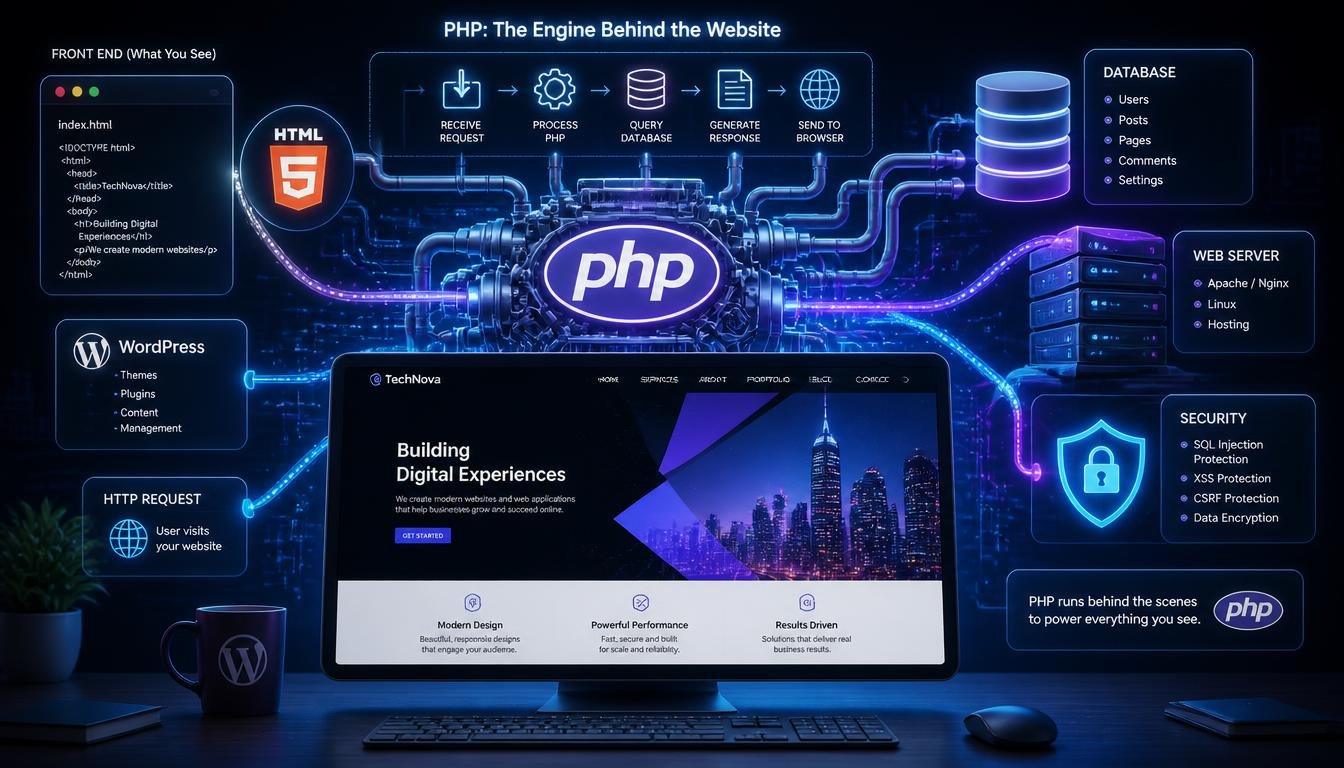
The process works something like this:
- Your browser requests a webpage from a web server.
- The web server and PHP process the instructions needed to prepare that page.
- A database, when required, supplies stored information such as articles or user details.
- The finished webpage is returned to your browser, usually as HTML.
This process often takes only a fraction of a second.
I remember when I first discovered PHP. I was genuinely excited by the possibilities it offered. Suddenly, I could build dynamic webpages rather than simply presenting visitors with static information.
Better still, I had recently discovered MySQL databases. Connecting PHP to MySQL opened up a whole new world of possibilities.
I could store information in a database, retrieve it when needed and use PHP to create webpages dynamically.
For someone who enjoyed understanding how computers worked, this was rather exciting stuff.
Not every website needs PHP, of course. Some use other programming languages, while simpler sites can operate without server-side scripting at all.
What PHP Is Used for in Web Development
PHP is particularly useful when a website needs to do more than display the same information to every visitor.
Common applications include:
- Processing contact forms and submitted information.
- Checking login credentials and managing user sessions.
- Retrieving articles, products and other stored content.
- Building personalised pages for registered users.
- Supporting shopping baskets and online transactions.
PHP can also help manage administrative functions that visitors never see.
For website owners, this means a relatively small collection of templates and instructions can produce hundreds or even thousands of individual pages.
That was precisely what attracted me to PHP in the first place. Instead of creating every page individually, I could develop a system that assembled the appropriate content when someone requested it.
The possibilities seemed almost endless.
Of course, PHP is only one chapter in a much longer story. The development of modern programming languages has its roots in the early history of computer programming, when the very idea of giving machines instructions was still taking shape.
How PHP Interacts with HTML and Databases
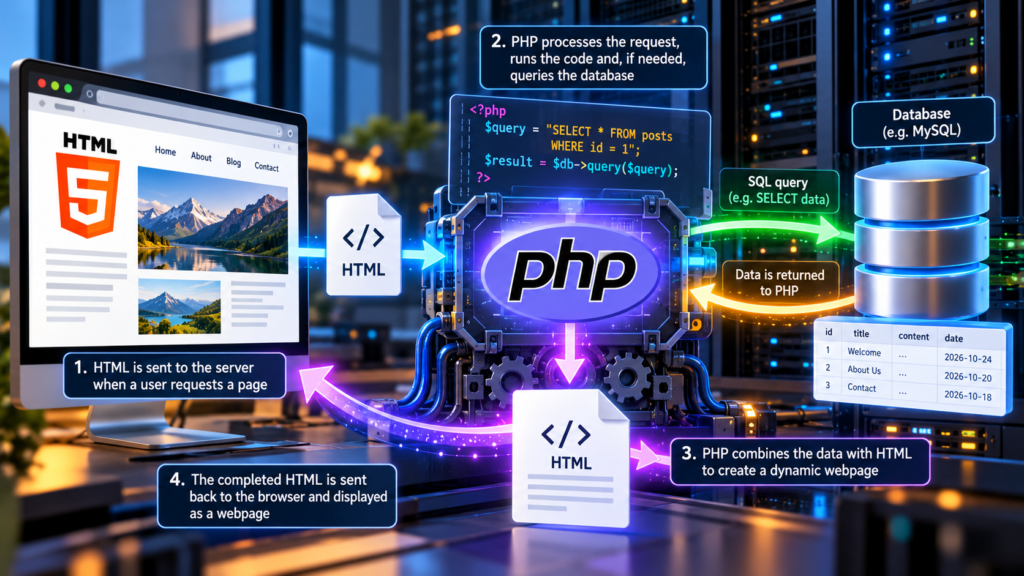
To understand the relationship between PHP and HTML, imagine a restaurant.
HTML is the finished meal presented to the customer. PHP is part of the kitchen operation, following instructions and assembling the order.
The database is the store cupboard containing the ingredients.
In technical terms, HTML describes the structure of a webpage, while PHP can generate HTML dynamically.
A database, often MySQL or MariaDB, stores information such as articles, usernames and settings.
PHP retrieves the information it needs, processes it and helps construct the page.
This combination of instructions and information is part of a much broader computing concept. Symbolic processing explores how computers can manipulate symbols and representations according to defined rules, rather than simply performing arithmetic.
I spent quite some time experimenting with PHP and databases, building dynamic websites that worked remarkably well.
There was, however, a drawback.
Although the websites themselves performed exactly as intended, managing the underlying system became rather convoluted. Creating the pages was one thing; maintaining the code, organising the content and keeping everything working smoothly was another.
I had discovered an excellent way to build dynamic websites, but I was also discovering just how much work went into managing them.
Why WordPress Websites Depend on PHP
Fortunately, around this time, I discovered WordPress.
It was something of a revelation.
Here was a system that could manage content, retrieve information from a database and generate webpages dynamically, using much the same underlying technologies I had been experimenting with.
In effect, WordPress was doing what I had been trying to build for myself.
And it had already solved many of the management problems I was encountering.
Once again, my marvellous idea had already been thought of!
WordPress is largely written in PHP, which helps manage its themes, plugins, administration screens and content delivery.
When you publish a new blog post, WordPress stores the article in its database.
When someone visits that article, PHP helps WordPress retrieve the relevant information and assemble the page using the site’s theme.
This is also why WordPress hosting providers specify supported PHP versions.
An outdated PHP version can create compatibility problems, reduce performance and expose websites to security risks.
Keeping WordPress, its plugins, themes and PHP environment updated is therefore an important part of website maintenance.
How PHP Security Vulnerabilities Affect Websites
A PHP security vulnerability is a weakness that attackers might exploit under particular circumstances.
Because PHP operates on the server, some vulnerabilities can have serious consequences.
Depending on the flaw and how a website is configured, attackers might be able to access sensitive information, interfere with website operations or execute unauthorised instructions.
However, a vulnerability in PHP does not automatically mean every PHP website is vulnerable.
The danger depends on factors such as the affected PHP version, server configuration, installed software and whether security patches have been applied.
It is also important to distinguish between a vulnerability in PHP itself and one in a WordPress plugin or theme written using PHP.
Why an Apparently Healthy Website May Still Be Vulnerable
One of the more troubling aspects of website security is that a website can appear to be working perfectly while its underlying software contains a serious vulnerability.
Visitors may see the familiar pages, images and menus without noticing anything unusual.
Meanwhile, an outdated PHP installation or vulnerable plugin could potentially provide an opportunity for attackers.
This is why security updates matter even when nothing appears to be wrong.
For website owners, sensible precautions include applying security updates, maintaining backups and removing software that is no longer supported.
The same technology that makes websites flexible and powerful also creates a responsibility to maintain the systems operating behind the scenes.
Conclusion: Understanding the Language Behind the Web
So, what is PHP?
It is a programming language that helps websites process information, interact with databases and produce dynamic content.
For me, discovering PHP and MySQL was an exciting introduction to the possibilities of dynamic web development. Discovering WordPress afterwards demonstrated how those same ideas could be developed into something far more practical and manageable.
But PHP is also part of a much longer technological journey.
From the pioneering ideas of Ada Lovelace and the beginnings of programming to the extraordinary developments of 19th-century science, each generation has built upon discoveries made by those who came before.
Although PHP generally works out of sight, its influence extends across millions of websites, including those powered by WordPress.
Understanding its purpose also helps explain why software updates and security warnings matter.
You do not need to become a programmer to appreciate PHP’s importance.
Sometimes, simply understanding what happens behind the screen is enough to make the technology we use every day a little less mysterious.
Final Thoughts
Understanding what is PHP begins with exploring how PHP works behind the scenes on websites and what PHP is used for in web development. From processing user requests to generating dynamic content, PHP plays an important role in modern websites.
Discovering how PHP interacts with HTML and databases helps explain why WordPress websites depend on PHP to deliver their content. However, its widespread use also raises important security questions, particularly how PHP security vulnerabilities affect websites and why keeping software updated is essential for maintaining a safe and reliable online presence.