
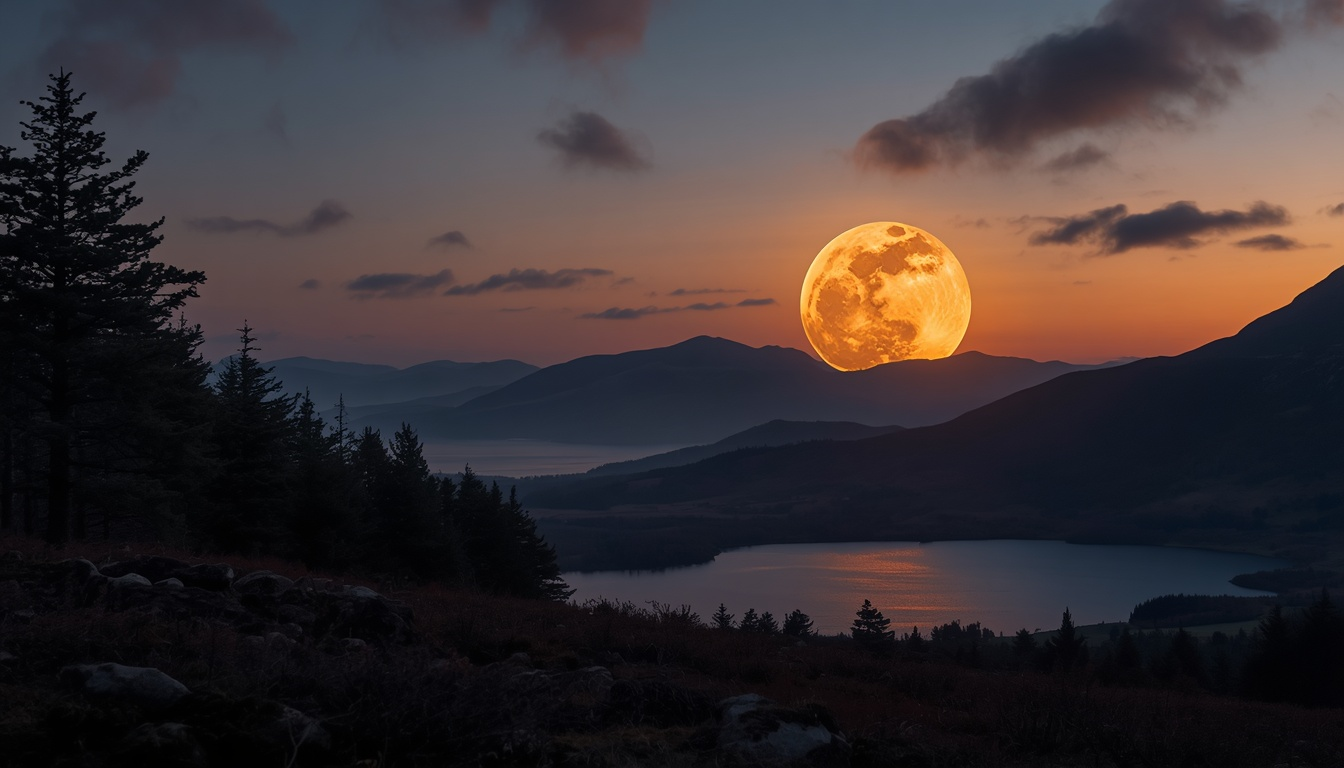
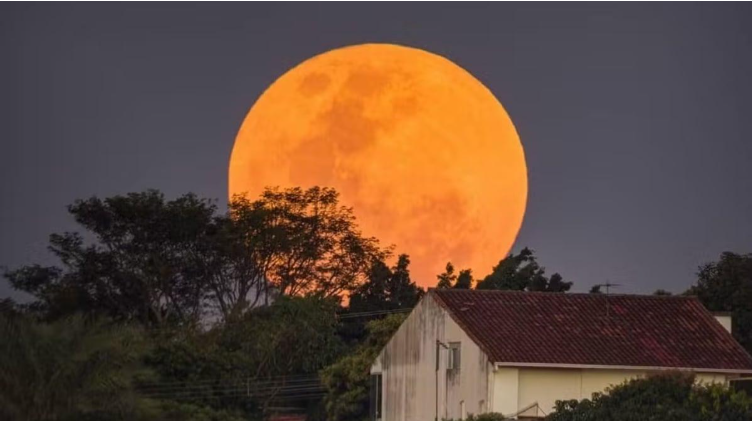
Have you ever watched a full Moon rising above distant rooftops or trees and thought it looked absolutely enormous? Yet, a few hours later, when that same Moon is high overhead, it seems noticeably smaller.
Why does the Moon look bigger near the horizon? Surely it cannot be changing size as it travels across the night sky?
Well, not quite. The Moon’s apparent size does change slightly as its distance from us varies, but that does not explain the enormous Moon we sometimes see near the horizon.
The more intriguing explanation involves something called the Moon illusion, a phenomenon that has puzzled observers for thousands of years.
The Moon Illusion: When Our Eyes Deceive Us
The Moon illusion is a fascinating example of how our brains perceive size and distance.
When the Moon appears close to the horizon, our view often includes familiar objects such as buildings, trees and hills. These provide visual clues that influence our judgement of scale.
High in the sky, however, the Moon is surrounded by a relatively featureless expanse. Without those familiar reference points, our perception can change.
It is another reminder of how our minds interpret the world around us. Just as we sometimes struggle to understand why we forget names more easily than faces, our perception of size involves more than simply recording what our eyes see.
How Foreground Objects Influence Perceived Lunar Size
I remember visiting my father, who lived in a small village in the Scottish Borders.
On the occasional evening when we walked to the local pub, the Moon could be particularly striking. There was very little light pollution from surrounding houses or streetlights, and on a clear night it seemed to dominate the darkness.
I have also experienced almost the opposite impression when looking across vast, open landscapes such as Rannoch Moor. Against that enormous expanse of sky, the Moon can appear surprisingly tiny.
These observations raise an interesting question. How much of what we see depends on the Moon itself, and how much depends on its surroundings?
A dark sky makes the Moon more conspicuous through contrast, but darkness alone does not necessarily make it appear larger.
Likewise, foreground objects can influence our perception, although scientists have found that the Moon illusion can occur even without obvious landmarks.
An interesting explanation published in Scientific American explores how perspective and our perception of the sky’s shape contribute to the Moon illusion.
Does the Atmosphere Magnify the Moon?
A popular explanation suggests that Earth’s atmosphere acts like a giant magnifying glass, enlarging the Moon as it approaches the horizon.
It sounds perfectly reasonable. Unfortunately, it is not correct.
Atmospheric Refraction and Its Effect on the Moon’s Appearance
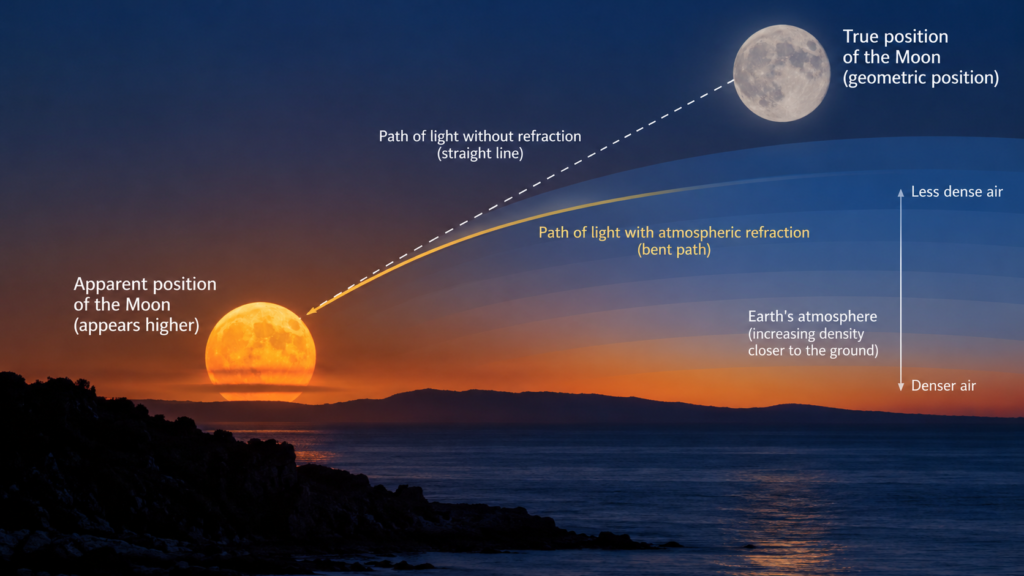
When moonlight enters Earth’s atmosphere, it bends slightly as it passes through layers of air with different densities. This process is called atmospheric refraction.
Near the horizon, refraction can make the Moon appear slightly higher than its true geometric position.
Here is something I find particularly intriguing: we can sometimes still see the Moon when it has technically set below the horizon.
The light reaching our eyes has followed a curved path through the atmosphere, making the Moon appear above its actual position.
Refraction can also distort its shape. Because light from the lower edge is bent more than light from the upper edge, the Moon may appear slightly flattened.
Rather than magnifying the Moon, atmospheric refraction generally reduces its vertical apparent diameter near the horizon.
The atmosphere can also help explain why a rising Moon sometimes looks orange or reddish, as shorter wavelengths of light are scattered out of our direct line of sight.
Angular Size: Why the Moon Does Not Actually Grow
Astronomers measure how large an object appears in the sky using something called angular size.
The Moon normally occupies approximately half a degree of our field of view.
Surprisingly, its angular size is actually marginally smaller at the horizon than when directly overhead, because it is slightly farther from the observer.
Our brains, however, are not always persuaded by geometry.
For another accessible explanation, Science Notes examines why the Moon looks bigger near the horizon and the visual illusion responsible.
The Elliptical Orbit of the moon and Supermoons
There is another complication.
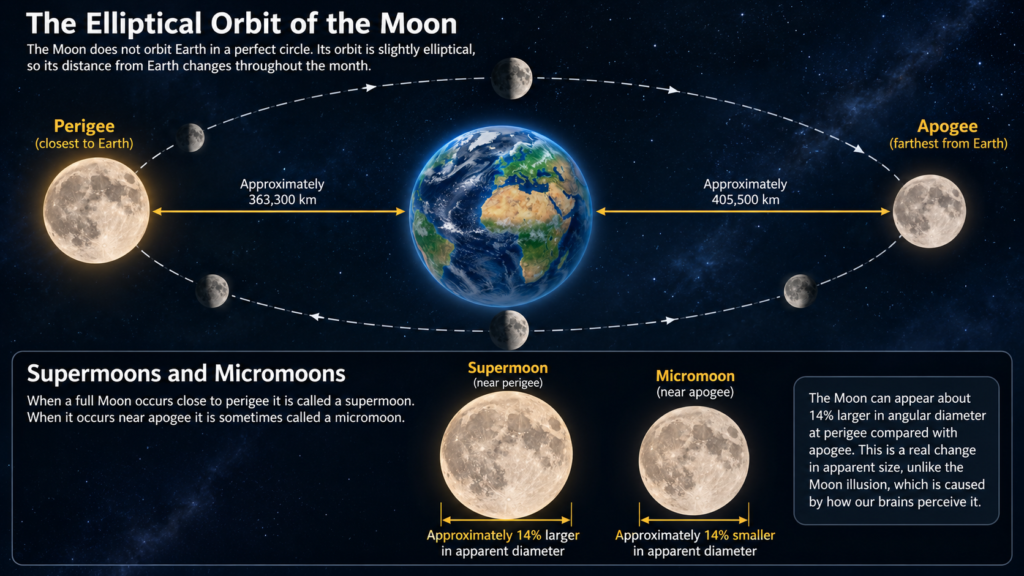
The Moon does not travel around Earth in a perfect circle. Its orbit is elliptical, meaning its distance from Earth changes throughout the month.
At its closest orbital point, called perigee, the Moon is noticeably nearer than at its farthest point, apogee.
When a full Moon occurs close to perigee, it is commonly called a supermoon.
A supermoon can appear roughly 14% larger in angular diameter than a full Moon occurring near apogee.
That is a genuine change in apparent size, unlike the Moon illusion.
However, the Moon’s elliptical orbit cannot explain why it appears dramatically larger near the horizon during a single evening.
A Simple Experiment You Can Try
You do not need a telescope to investigate the Moon illusion.
- Find a clear view of the Moon when it is low on the horizon.
- Photograph it using a fixed camera zoom setting.
- Repeat the photograph when the Moon is much higher.
- Compare the Moon’s diameter in pixels in both photographs.
Provided you use the same camera settings, the Moon should occupy almost the same number of pixels, despite appearing quite different to your eyes.
It is a simple demonstration of the difference between what we perceive and what we can measure.
Why Our Brains Make the Moon Look Bigger
The Moon illusion reminds us that seeing is not simply a matter of recording light.
Our brains interpret visual information using context, experience and expectations.
The enormous Moon rising behind distant trees, the brilliant Moon shining over a quiet Scottish village and the apparently tiny Moon above Rannoch Moor may all involve different combinations of contrast, surroundings and perceived distance.
Scientists have proposed several explanations, including how we perceive the shape of the sky itself. Some explanations are well supported, although researchers continue to investigate the details.
It is rather like the mystery of why our best ideas arrive when we’re doing something else. Our brains are constantly working behind the scenes, sometimes producing results that surprise us.
And perhaps that is why I find these everyday mysteries so appealing. As I explored in why nobody has all the answers, even apparently simple questions can lead us into surprisingly complicated territory.
Conclusion: Why Does the Moon Look Bigger Near the Horizon?
So, why does the Moon look bigger near the horizon?
The Moon illusion and how our brains perceive size offer much of the explanation. Atmospheric refraction and its effect on the Moon’s appearance introduce another fascinating phenomenon, while angular size and why the Moon does not actually grow help us distinguish perception from physical reality.
Perhaps the most remarkable thing is that we can measure the Moon with extraordinary precision, yet our brains can still persuade us that those measurements must be wrong.
Sometimes, the greatest mysteries are not in the sky at all. They are inside our own heads.
And if this particular mystery has stirred your curiosity, there are plenty more everyday puzzles waiting to be explored in my collection of quirky questions.