

Have you ever watched someone yawn and immediately felt the irresistible urge to do the same? Perhaps you’ve even started yawning while reading about yawning.
Why is yawning contagious? It seems rather peculiar that something as ordinary as opening your mouth and taking a deep breath can spread from one person to another without anyone consciously deciding to join in.
And yet it happens remarkably often.
Scientists call this phenomenon contagious yawning, and although researchers have investigated it for decades, the precise explanation remains surprisingly elusive.
The answer may involve how our brains recognise behaviour, how we respond to other people and the unconscious ways we imitate those around us.
What Makes Yawning Contagious?
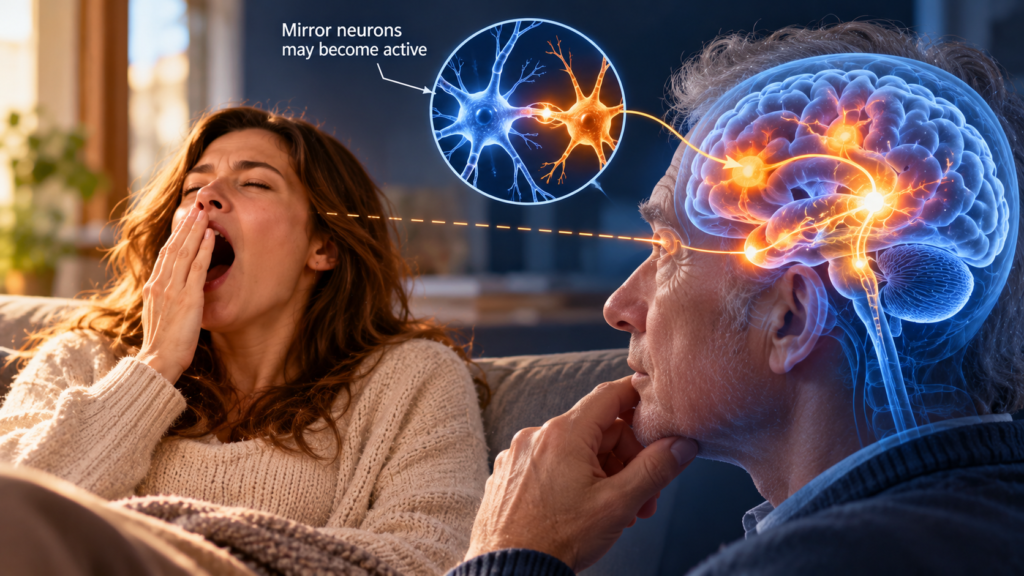
Yawning is a familiar behaviour found in humans and many other animals. A typical yawn involves opening the mouth widely, taking a deep breath and stretching muscles around the face and jaw.
Scientists are still investigating exactly why we yawn spontaneously. Suggestions include regulating alertness and possibly helping to cool the brain, although the evidence remains mixed.
Contagious yawning is slightly different.
Rather than yawning because of tiredness or boredom, we find ourselves yawning after seeing, hearing or even thinking about someone else doing it.
It is one of those quirky questions about everyday life that seems simple until we try to explain it.
How the Brain Responds to Seeing Someone Yawn
As children, we learned an enormous amount simply by copying the adults around us.
We imitated their movements, expressions and behaviour, often without understanding why they did things.
I wonder whether contagious yawning might be a relic of that childhood learning process.
Our brains are remarkably good at recognising other people’s actions. Observing someone move can activate parts of our own motor system, even when we remain perfectly still.
Researchers have suggested that similar mechanisms might contribute to contagious yawning.
This brings us to something I find almost unbelievable: mirror neurons.
These are nerve cells identified in certain brain regions that respond both when an action is performed and when a similar action is observed.
I find the concept nearly as surprising as discovering that our digestive system has its own extensive network of neurons!
Of course, the motor system is part of the central nervous system, which includes the brain and spinal cord. It helps control both voluntary movements and automatic responses.
Whether mirror neurons specifically explain contagious yawning, however, remains uncertain.
It is another example of how questions lead to more questions whenever we investigate the workings of the human brain.
Is Contagious Yawning Connected to Empathy?
One particularly interesting theory concerns the connection between contagious yawning and empathy.
Empathy is our ability to recognise and understand another person’s feelings or experiences.
I rather like this explanation because I consider myself quite empathetic. Perhaps that helps explain why I am so susceptible to catching other people’s yawns.
It is an appealing thought, although scientific evidence has not established a reliable relationship between empathy and contagious yawning.
Indeed, an examination of the available research by Ocarina Health explores the scientific evidence behind contagious yawning, including why the popular empathy explanation remains unproven.
Social Bonding and Unconscious Imitation of Yawning

Humans constantly imitate one another without necessarily realising it.
We may adopt another person’s posture, match their speaking rhythm or smile simply because someone else smiles.
Such unconscious imitation may help social interactions feel more natural.
Contagious yawning could be another example.
Interestingly, some studies suggest that people are more likely to catch yawns from familiar individuals than from strangers.
However, other studies have failed to find a consistent connection between empathy and contagious yawning.
So, although I like the empathy theory, I cannot claim that my tendency to yawn proves anything about my personality.
Can Dogs Catch Yawns from Humans?
Here is another observation from my own experience.
When I see my dog yawn, I sometimes find myself yawning too.
However, I have never noticed the reverse happening. My yawning does not appear to trigger a corresponding yawn from my dog.
That made me wonder whether contagious yawning works across species.
Surprisingly, researchers have found evidence that some dogs do yawn after observing humans yawning.
The results vary between studies, and scientists continue to investigate whether attention, familiarity or other factors influence the response.
Perhaps my dog simply has better things to do than imitate me.
Either way, contagious yawning is not necessarily restricted to interactions between humans.
Can You Catch a Yawn Without Seeing One?
Here is where contagious yawning becomes particularly entertaining.
You do not necessarily need to see someone yawning to experience the effect.
Hearing a yawn, reading about yawning or simply imagining the action can sometimes be enough.
Why Thinking About Yawning Can Trigger a Yawn

Our brains can mentally recreate familiar experiences without those experiences actually happening.
Think about biting into a particularly sour lemon. You might notice your mouth beginning to water, even though there is no lemon anywhere nearby.
Yawning can produce a similar response.
It reminds me of another curious phenomenon: why smells trigger memories so strongly. Both demonstrate how sensory information and mental associations can produce surprisingly powerful responses.
Reading descriptions of yawning may activate associations with the physical action, increasing the likelihood that you will feel the urge yourself.
Not everyone responds in the same way, of course.
Some people seem remarkably susceptible, while others can watch someone yawn repeatedly without feeling the slightest inclination to join in.
Age, attention and individual differences in brain activity may all contribute.
Our perception of time can be equally subjective, as explored in why time seems to slow down when we’re waiting. The brain does not always respond to everyday experiences in the straightforward way we might expect.
And if you have already yawned while reading this article, you have just demonstrated the very phenomenon we are investigating.
It is a rather unusual example of a scientific subject becoming its own experiment.
Conclusion: Why Is Yawning Contagious?
So, why is yawning contagious?
The answer probably involves a combination of automatic behavioural responses, attention and the way our brains process other people’s actions.
The connection between contagious yawning and empathy remains an intriguing possibility, while social bonding and unconscious imitation of yawning may help explain why the behaviour spreads between individuals.
Understanding how the brain responds to seeing someone yawn also offers clues about why thinking about yawning can trigger a yawn without anyone else being present.
My own experiences suggest that contagious yawning can be remarkably persistent, occasionally extending even to interactions with my dog.
But the precise mechanisms remain an open scientific question.
As I discussed when exploring why nobody has all the answers, even familiar everyday experiences can contain mysteries that science has yet to resolve completely.
And perhaps the most amusing part of this particular mystery is that merely investigating it can make us participate.
Now, be honest. Did you yawn while reading this?
“The hardest truth for a child to learn is that their teacher doesn’t know everything.”
– Stephenism
🎵 Soul from the Solo Blogger — Tunes from Túrail.