

Why does Queue have 4 silent letters when we pronounce the entire five-letter word exactly like the single letter Q? It seems wonderfully inefficient. You could remove four-fifths of the word and, when spoken aloud, nobody would notice.
The simple answer is history. Queue did not acquire four extra letters because somebody wanted to make English spelling difficult. The word came into English from French, bringing its spelling history with it.
Those apparently redundant letters are therefore little fossils. They tell us something about where the word came from and how English developed.
Where Did the Word Queue Come From?
The French origins of the word queue take us back several centuries. English borrowed queue from French, where the word means tail. The French word itself developed from earlier forms including cue and coe, ultimately tracing back to Latin coda or cauda, meaning tail.1
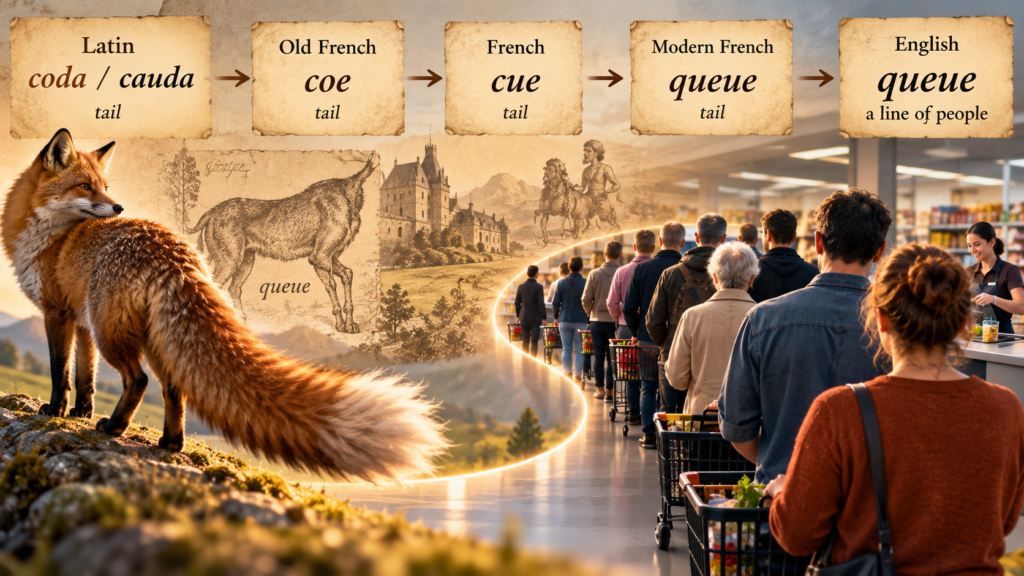
That original meaning makes considerably more sense when you picture a queue.
A row of people waiting at a checkout resembles a tail stretching away from the counter. The familiar meaning of a line of people developed much later, but the visual connection remained.
English was using queue by the late fifteenth century, although initially with meanings connected more literally with something hanging like a tail. The familiar sense of people standing one behind another is recorded much later.2
How Queue Entered the English Language
Understanding how queue entered the English language also explains why its spelling looks so unusual.
English has borrowed an enormous number of words from other languages, particularly French. When that happens, spelling and pronunciation do not necessarily develop together.
English often retains clues to a word’s ancestry even after the way we say it has changed.
That is why queue can look unnecessarily complicated to a modern English speaker. Its spelling reflects its linguistic journey rather than being a neat phonetic instruction manual.
This is not the only oddity English has collected along the way. We find similar curiosities whenever we ask why we drive on a parkway but park on a driveway.
Historical Timeline
- Latin origins — Cauda or coda, meaning tail
- 12th century — Old French forms including cue and coe
- Late 15th century — English records of queue with tail-related meanings
- 18th century — Use for a braid or pigtail
- 19th century — The familiar meaning of people standing in a line becomes established.
- 20th century — The verb to queue becomes established in its modern waiting-in-line sense
Are There Really Four Silent Letters in Queue?
This is where things become slightly more interesting.
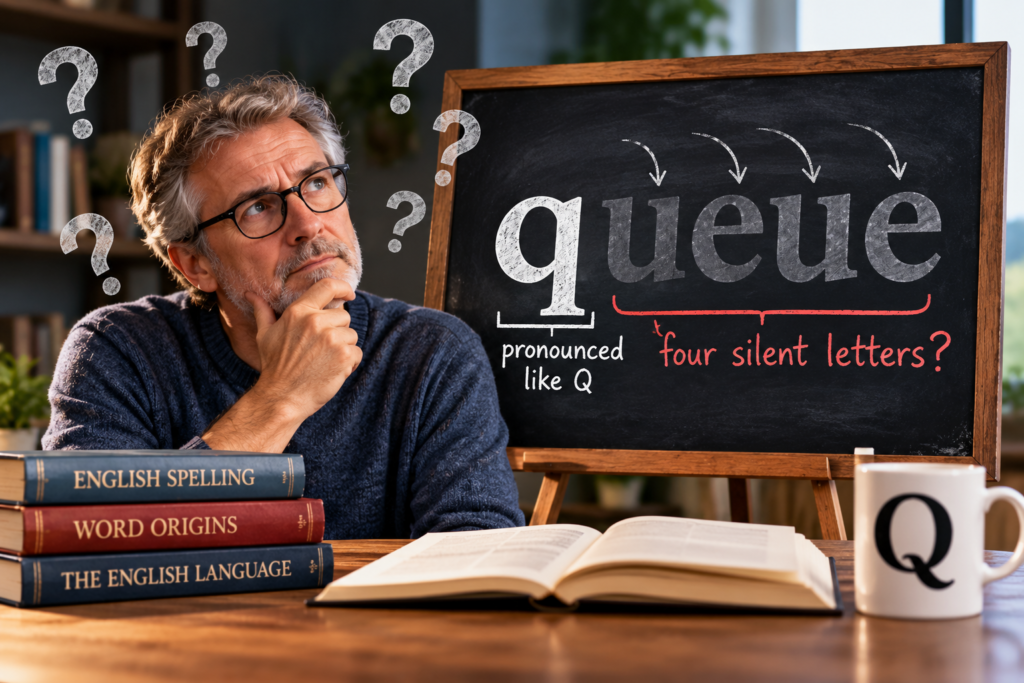
It is common to say that queue consists of the letter Q followed by four silent letters. It certainly behaves that way to our ears: queue and Q are pronounced alike.
However, describing the final four letters of queue as individually silent is a useful simplification rather than a precise description of how English spelling represents sounds.3
Letters frequently work together. We cannot always divide a written word into individual letters and assign one spoken sound to each.
The modern pronunciation /kjuː/ contains several sounds, but it would be misleading to assign a separate phonetic contribution to each of the four letters. The word is better understood as a historically inherited spelling whose letters work collectively rather than individually.
Modern French generally pronounces queue as /kø/, whereas standard British English uses /kjuː/, illustrating how the same inherited spelling can represent different pronunciations.
For another explanation of this peculiar spelling and pronunciation, see Why Queue Sounds Like the Letter Q.
Why Queue Kept Its Unusual Spelling
Understanding why queue kept its unusual spelling means looking at the history of written English.
Spelling tends to be conservative. Once a written form becomes established in books, education and everyday use, changing it is not necessarily easy simply because pronunciation has moved on.
We therefore inherit words whose spelling preserves something of their past.
You can see a similar principle behind many of the expressions and peculiarities explored on Walkeropedia. Even something as ordinary as why we say Look after the Pennies makes more sense once we investigate where it came from.
Language carries its history around with it.
Why Do We Pronounce Queue Like Q?
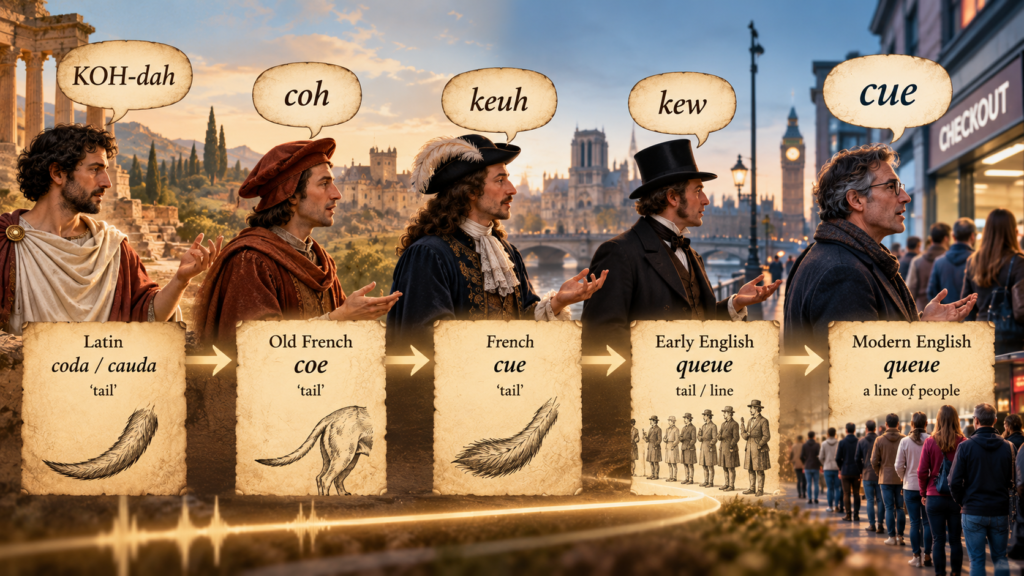
Modern English pronounces queue exactly like cue. The spelling may suggest that much more should be happening, but those five written letters produce a remarkably economical spoken word.
Interestingly, the connection between queue and cue goes beyond their identical pronunciation. The cue used to strike a ball in billiards is historically related to queue, both tracing their origins to the French word for tail. Early billiards players used a stick whose narrow end resembled a tail, eventually giving us the familiar billiards cue.
However, the cue used in theatre to signal an actor’s entrance or prompt a line has a different etymological history. Its precise origins are debated, although one explanation connects it to the letter Q, used as an abbreviation for a Latin word meaning when.
So, we have three words or meanings that sound identical, two with a shared linguistic ancestry and one with a separate history.
The contrast between spelling and speech becomes less mysterious once we stop expecting English spelling to operate as a perfect sound system.
It doesn’t.
If that prompts another question, that is entirely appropriate. After all, we have already explored why questions lead to more questions.
Four Silent Letters That Aren’t Entirely Pointless
The letters in queue may seem redundant when we speak the word, but historically they are anything but pointless.
They provide a visible connection to the word’s French ancestry and to its original meaning of a tail. The modern queue of people waiting at a supermarket checkout is therefore still carrying a tiny piece of linguistic history.
Conclusion: why does Queue have 4 silent letters
So, why does Queue have 4 silent letters? Because English inherited the word and its spelling through French while pronunciation developed into the simple sound we use today.
Perhaps the strangest thing about queue isn’t that four letters appear to be waiting silently behind Q.
It’s that they’re forming a queue.
And if peculiar little questions like this appeal to you, there are plenty more waiting in Walkeropedia’s Quirky Questions.