

Have you ever walked into a room, heard someone speaking or visited somewhere completely new and suddenly felt certain that you’ve experienced the exact moment before?
You know it hasn’t happened. Yet something in your mind insists that it has.
So why do we get déjà vu? Is our brain remembering something we’ve forgotten, or is it playing tricks on us?
The answer lies in the fascinating relationship between memory, recognition and the way our brains interpret familiar experiences.
What Exactly Is Déjà Vu?
Déjà vu is a French expression literally meaning already seen. In everyday English, we generally understand it as seen before.
It describes the strange sensation that something happening right now has happened before, even when we know that isn’t possible.
The experience usually lasts only a few seconds. We might recognise a conversation we’ve never had or feel familiar with a place we’re visiting for the first time. Research suggests déjà vu is widespread: a 2024 review estimated that about three-quarters of healthy people have experienced it, although estimates vary between studies.
Interestingly, déjà vu isn’t necessarily a sign of poor memory. It may actually reveal how sophisticated our memory systems are.
Our brains constantly compare new experiences with information already stored in memory.
Occasionally, that comparison produces a rather convincing false alarm. Researchers have also found that everyday déjà vu tends to be reported more often by younger people.
How Does the Brain Create a False Sense of Familiarity?
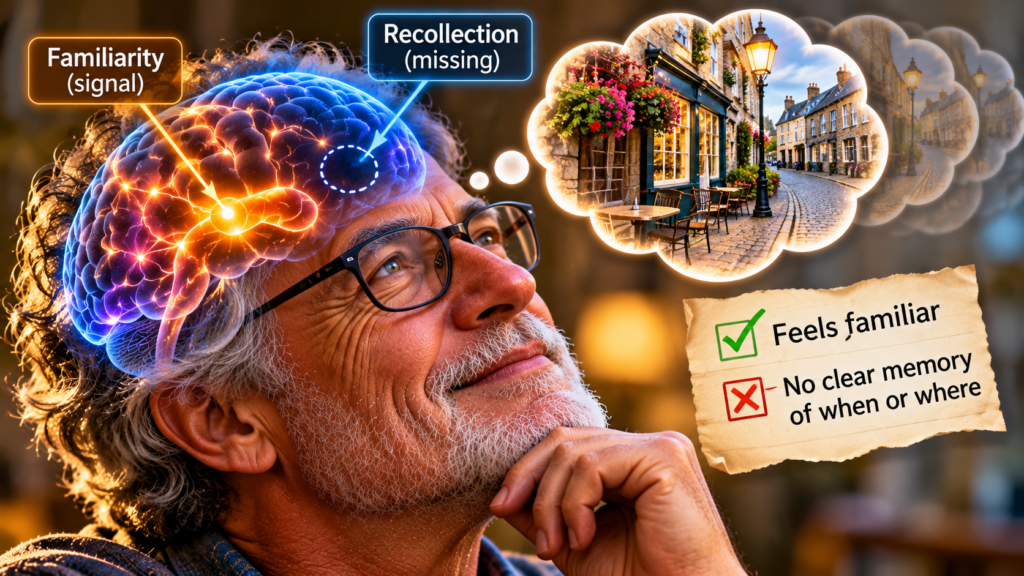
Normally, when we recognise something, our brains provide two related experiences.
The first is familiarity: the feeling that something is known to us.
The second is recollection: remembering where or when we encountered it.
These processes often work together, but they aren’t identical. Knowing that you’ve solved a problem before while struggling to remember the solution is an ordinary retrieval difficulty. Déjà vu is stranger: a new situation feels familiar even when you cannot identify a real earlier encounter.
Understanding how the brain creates a false sense of familiarity helps explain déjà vu.
Imagine entering a café you’ve never visited. Its arrangement of tables, lighting and background sounds might resemble somewhere you visited years earlier. Experiments using similar-looking scenes suggest that resemblance can generate familiarity even when people cannot identify the earlier scene. Our perception can be surprising in other ways too, as the question why mirrors seem to reverse left and right demonstrates.
Your brain may register that resemblance without identifying the original memory.
The result is a powerful feeling of recognition without a clear explanation.
However, researchers believe déjà vu can arise through several mechanisms. Similarity between experiences is one possible explanation rather than the complete answer. Another proposal involves the brain detecting a conflict between feeling familiar and knowing that the situation is new.
What Role Does Memory Processing Play in Déjà Vu?
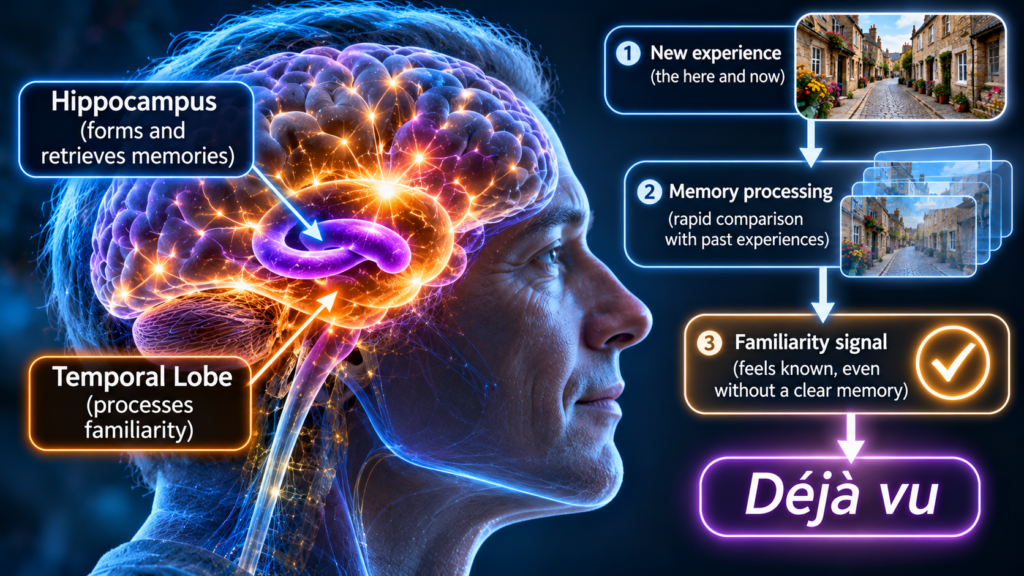
The role of memory processing in déjà vu experiences is particularly interesting because memory isn’t simply a recording of past events.
Every time we remember something, our brains reconstruct information using stored details and associations. Sometimes a genuine memory is difficult to retrieve, only to surface later when we stop actively searching for it. That familiar experience isn’t itself déjà vu, but it shows that memory and our conscious access to it don’t always move together. Another everyday example of memory working without deliberate effort is why songs get stuck in our heads.
The hippocampus and surrounding regions of the medial temporal lobe help us form and retrieve memories.
Other connected brain systems contribute to recognising whether something feels familiar.
One theory suggests that déjà vu occurs when a familiarity signal appears without the corresponding memory.
This may help explain how recognition and recollection become temporarily disconnected. But the idea isn’t settled: a 2013 study involving 206 participants found no straightforward relationship between how often people reported déjà vu and their performance on standard tests of familiarity and recollection.
We experience the unmistakable sensation of remembering something but cannot identify what we’re supposedly remembering. Unlike a temporarily forgotten solution to an old problem, there may be no previous event to retrieve.
It’s rather like recognising someone’s face while having absolutely no idea where you’ve met them.
Except, during déjà vu, you might never have met them at all.
Are There Neurological Explanations for Déjà Vu?
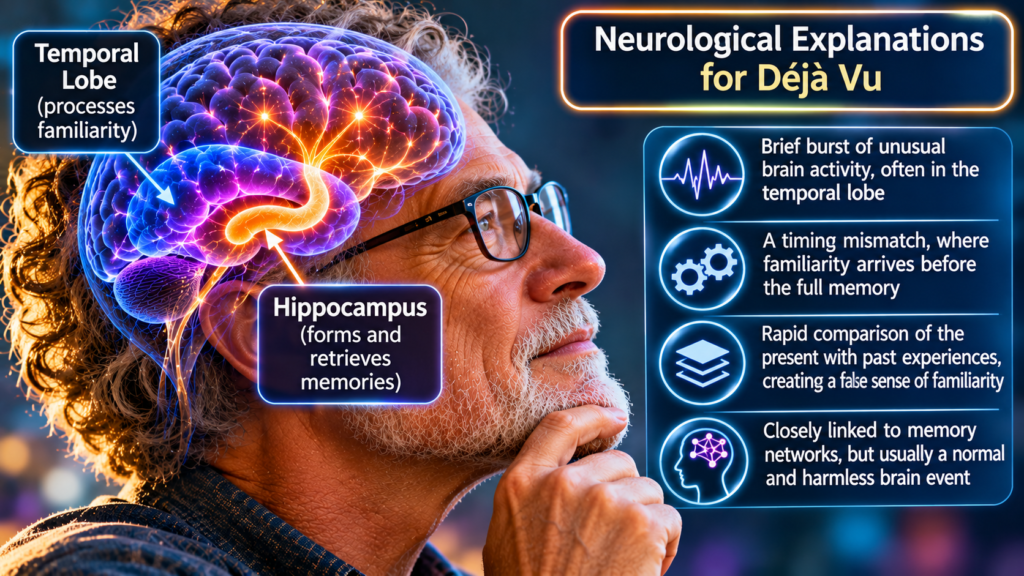
Scientists have investigated several neurological explanations for déjà vu sensations.
Some research links déjà vu to activity in brain regions involved in familiarity and memory, particularly within the temporal lobes.
Déjà vu can sometimes occur as part of a focal seizure, especially in certain forms of temporal lobe epilepsy.
However, this doesn’t mean that ordinary déjà vu indicates epilepsy.
For most people, occasional déjà vu is a normal experience that doesn’t suggest an underlying medical condition.
Researchers have also investigated whether fatigue, stress and attention influence the experience, although their precise roles remain uncertain. Many seemingly automatic experiences raise similar questions about brain processes, including why yawning can be contagious.
Reports of déjà vu also vary with age and life experience, but those associations don’t establish a single cause.
One intriguing possibility is that déjà vu involves the brain recognising a mismatch between a feeling of familiarity and the knowledge that an event is genuinely new.
In other words, part of the brain seems to say, “I’ve been here before,” while another part replies, “No, you haven’t.”
And for a moment, neither side seems particularly convincing. There is even a curious counterpart called jamais vu, when something you know well suddenly feels strangely unfamiliar.
Why Does Déjà Vu Feel So Real?
Perhaps the strangest feature of déjà vu is how convincing it feels. The gap between what we perceive and what we can explain is also evident in why the Moon looks bigger near the horizon, although the mechanisms behind these experiences differ.
We aren’t merely reminded of something similar. We sometimes feel certain that an entire moment has already happened.
Yet that certainty doesn’t provide evidence that the event actually occurred before.
Our brains normally rely on familiarity as a useful shortcut when navigating everyday life.
Most of the time, it works remarkably well.
Occasionally, however, the sensation of familiarity appears in the wrong circumstances.
Because the feeling itself is genuine, the experience can seem mysterious even when we understand that the apparent memory is mistaken. That tension may be part of what makes déjà vu so distinctive: we sense familiarity while recognising that it cannot be right. A delayed recollection, by contrast, can eventually reveal the real event we were trying to remember.
It’s a reminder that confidence and accuracy aren’t always the same thing. Occasional brief episodes are generally harmless, but unusually frequent or prolonged déjà vu, particularly alongside confusion, loss of awareness or other symptoms, is worth discussing with a healthcare professional. The Cleveland Clinic’s explanation of déjà vu offers further context on when the experience may warrant attention.
Conclusion: Why Do We Get Déjà Vu?
So why do we get déjà vu?
The most promising explanations involve memory processing, familiarity signals and the brain’s ability to distinguish new experiences from remembered ones. Studies of similar environments and memory monitoring offer clues, but neither provides a universal answer.
Scientists haven’t established one definitive explanation for every instance of déjà vu.
What seems clear is that our brains don’t always agree about whether something is familiar.
Fortunately, the disagreement usually lasts only a moment.
Perhaps the real mystery isn’t why our brains occasionally get confused.
It’s how they manage to recognise thousands of familiar experiences every day, retrieve old knowledge when we need it and occasionally surprise us with an answer only after we’ve stopped looking.
And if you have the strange feeling that you’ve read this article before…
Well, that would be rather appropriate. For more unusual questions about everyday experiences, explore Walkeropedia’s Quirky Questions collection.


