
Why Is the Plural of Mouse Mice but the Plural of House is Houses? At first glance, English appears to be making up the rules as it goes along. It is the sort of puzzle that can take you straight back to a school grammar lesson: learn the form, remember the exception, and don’t necessarily expect anyone to explain why.
Mouse becomes mice. House becomes houses. Yet the two words look and sound remarkably similar. Surely, if English were behaving itself, we ought to have either mouses and houses or mice and hice.
Fortunately, there is an explanation, and it is rather more interesting than simply calling mice an exception.
The difference is a surviving piece of English history. Mouse inherited an ancient way of forming its plural through a change in the vowel, while house eventually adopted the familiar -s ending used by most modern English nouns.
English is not so much breaking its own rules as carrying several generations of old rules around with it. Once we ask where those rules came from, the apparent nonsense begins to make sense.
Why Does Mouse Become Mice?
To understand the historical development of mouse into mice, we need to travel back more than a thousand years to Old English.
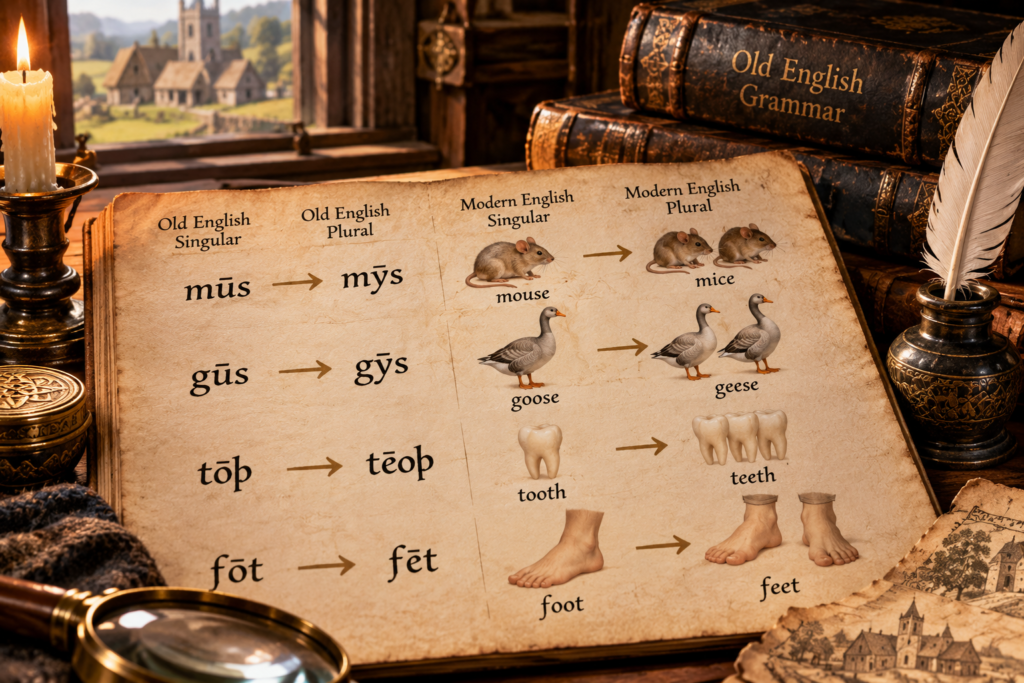
The Old English word for mouse was mūs. Its plural was mȳs. The marks above the vowels indicate long sounds, but the two vowels were not pronounced alike. The plural had already acquired a different vowel long before modern English existed.
This happened because of a historical sound process known as i-mutation, or i-umlaut. In an earlier form of the word, an i-like sound in a following syllable influenced the vowel before it. Speakers gradually moved the tongue towards the position needed for that later sound. Eventually, the ending responsible for the change disappeared, but the altered vowel remained.
That is the crucial point: the plural did not become mice because somebody decided that changing a vowel was more elegant than adding s. The sound change happened first, and later generations inherited its result. A classroom rule tells us what to say; linguistic history tells us why.
One mouse becomes two mice. One goose becomes two geese. One tooth becomes several teeth. One foot becomes two feet.
These are not random exceptions invented to torment people learning English. They are survivors of much older grammatical patterns. And the modern spelling mice does not reproduce the Old English pronunciation of mȳs: centuries of further sound changes helped produce the word we say today.
For a practical account of current usage, Scribbr’s guide to the plural of mouse also distinguishes the animal from the computer accessory.
How Old English Vowel Changes Created Irregular Plurals
Old English had considerably more grammatical machinery than the English we speak today. Nouns belonged to different declension classes, which meant that two words ending in similar sounds could nevertheless form their plurals differently.
The ancestors of mouse and house are a particularly neat example. Mouse belonged to a class whose plural developed the vowel change that gave Old English mȳs. House, from Old English hūs, followed a different pattern; its older plural could look like the singular rather than displaying the same changed vowel.
As the language developed, many of these distinctions disappeared. The -s or -es plural became dominant, leaving us with familiar pairs such as book/books, table/tables and house/houses.
Some very common words resisted that process. Their older forms were used so frequently that they survived while the language around them changed. Other surviving patterns include children and oxen, whose histories are different from that of mice.
English therefore contains layers of linguistic history. Rather like asking why we say “Look after the pennies”, examining something familiar can reveal a much older story hiding beneath everyday language.
Remembering the answer is one thing; discovering the explanation is rather more satisfying.
Why Didn’t Mouse Eventually Become Mouses?
Languages tend to regularise themselves over time. Unusual forms can disappear and be replaced by forms that follow more common patterns. So why didn’t mice eventually become mouses?
Frequency probably helped. Words heard and repeated often can retain irregular forms because speakers learn them as familiar units. Children do not normally work out an ancient rule when they say mice; they hear it, remember it and use it. That is effective for everyday speech, although it can leave curious learners wondering why the rule exists at all.
There is, however, a modern twist. When mouse acquired a new meaning as a computer pointing device, speakers began using both computer mice and computer mouses. The latter is accepted in some technical and informal contexts, although mice remains widely used. For the animal, mice is the standard plural; mouses and mices are not standard forms.
The distinction is revealing. A familiar old meaning preserves an inherited plural, while a newer meaning can invite a regular alternative. Language continues to change even when its oldest patterns survive.
This is also a useful example of why questions lead to more questions. Once we know why mouse becomes mice, it is almost inevitable that another question appears: if mouse becomes mice, why doesn’t house become hice?

Why Does House Become Houses?
Although mouse and house look similar in modern English, their grammatical histories are not identical.
House comes from Old English hūs. Unlike mūs, it did not belong to the same vowel-changing plural pattern. In Old English its nominative and accusative plural could be hūs, identical in form to the singular. Similar spelling, in other words, never guaranteed similar grammar.
As English grammar simplified, the increasingly productive -s plural spread to many nouns. House eventually joined that regular pattern, giving us houses. Mouse retained its inherited irregular plural instead.
Even the pronunciation of houses has a little surprise: its middle consonant is voiced, sounding like a z, rather than the s sound at the end of the singular house. But this modern pronunciation detail is not the historical reason that the plural differs from mice.
It is a little like two neighbouring houses that look almost identical from the street but were built centuries apart. Their appearance does not tell you everything about what is underneath.
English Rules Are Built From Its History
English can sometimes seem unnecessarily inconsistent. We have mouse/mice but house/houses. We have goose/geese but moose/moose. We have ox/oxen but fox/foxes.
There is rarely one neat rule capable of explaining every example because modern English is the product of centuries of change. Different grammatical systems have appeared, disappeared and overlapped. English has also borrowed extensively from other languages, adding still more patterns to the mixture. Learning Spanish or Italian can make English’s inherited irregularities seem especially noticeable, although those languages have plenty of irregularities of their own.
Borrowing also raises another entertaining question: what happens to a foreign plural once English speakers adopt the word? In Italian, panino is singular and panini is plural. Yet English speakers commonly say a panini and two paninis, treating panini as an English singular. That may sound jarring to someone who knows the Italian forms, but it is a recognised example of a borrowed word acquiring new English grammar. Languages do not always preserve the rules that travel with their vocabulary.
That does not make English chaotic. It makes it historical. Many of the oddities we take for granted are linguistic fossils — surviving evidence of how earlier speakers used the language. Others are new patterns forming before our eyes.
The same tendency to overlook familiar processes occurs elsewhere in everyday life. We might wonder why we forget names more easily than faces, or why our best ideas arrive when we’re doing something else.
Something that seems peculiar often becomes more understandable once we investigate what is happening beneath the surface.
Conclusion: Why Is the Plural of Mouse Mice but the Plural of House is Houses?
So, Why Is the Plural of Mouse Mice but the Plural of House is Houses?
Because the two words followed different paths through the history of English.
Mice preserves an ancient vowel change inherited from Old English, while houses adopted the regular plural pattern that eventually became dominant. What looks like an inconsistency is really a small piece of linguistic history that we repeat every time we talk about mice and houses.
We can memorise the plurals, of course, but understanding their history is much more interesting. It is precisely the sort of everyday puzzle explored in Walkeropedia’s Quirky Questions.
Summary
The mystery of why mouse becomes mice while house becomes houses reveals the fascinating history of Old English vowel changes, particularly the process known as i-mutation. These changes expla
n the origins of irregular plurals in English and why some words retained ancient grammatical patterns while others adopted regular endings.
Understanding why mouse becomes mice instead of mouses also helps explain how English plural rules evolved over time, leaving us with a language full of curious exceptions that make far more sense when we explore their history.
Understanding why house follows the regular English plural rule takes us back to a time when English nouns followed several different grammatical patterns. Exploring how irregular plurals survive as languages evolve reveals why familiar words such as mouse, goose and tooth retained their ancient vowel changes, while house adopted the increasingly common -s plural ending.