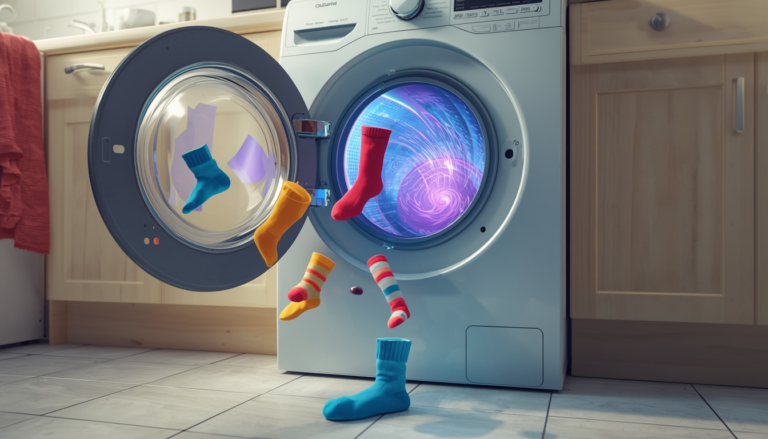

Why does hot water sometimes freeze faster than cold water? It sounds like one of those questions with an obvious answer. Surely cold water, already closer to freezing, should turn to ice first?
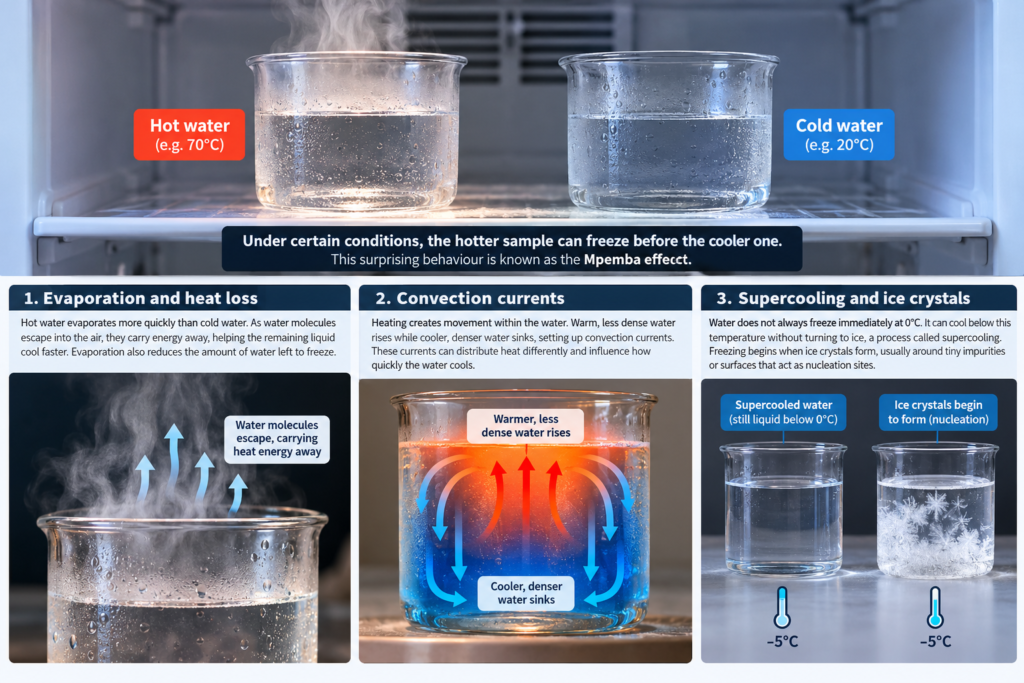
Usually, it does. But under certain conditions, initially hotter water has been observed to reach a chosen freezing milestone before cooler water. This curious behaviour is known as the Mpemba effect, and it has puzzled scientists for generations. The result is not guaranteed, and exactly what counts as ‘freezing’ matters.
The explanation is more complicated than you might expect. Evaporation, heat circulation and even the way ice crystals begin forming can influence the result.
It is another example of how everyday physics can challenge what we think we know.
The Mpemba Effect and the Science Behind Faster Freezing
The phenomenon takes its name from Erasto Mpemba, a Tanzanian schoolboy who noticed something peculiar while making ice cream in the 1960s.
Mpemba noticed that a hot ice-cream mixture sometimes appeared to freeze before a cooler one. Rather than dismissing the observation, he questioned why it happened; his initial mixture was not simply pure water, an important distinction when interpreting the story.
Working with physicist Denis Osborne, Mpemba helped bring the phenomenon to scientific attention in 1969.
However, the idea was not entirely new. Similar observations had been discussed since ancient times, including by Aristotle.
The surprising part is that hot water initially contains more thermal energy than the same quantity of cold water. Before freezing, it normally has more heat to lose. But once cooling begins, the samples need not remain identical apart from temperature.
Under otherwise identical conditions, we would normally expect the colder sample to freeze first.
Yet changing the starting temperature can also change how the water behaves as it cools.
Researchers have investigated several possible mechanisms, including those discussed in HowStuffWorks’ overview of the Mpemba effect. Some affect the water itself; others depend on its container and the freezer.
The difficulty is that no single explanation accounts for every reported experiment. Some studies have observed the effect while others have struggled to reproduce it. Reaching 0°C, forming the first ice and becoming completely solid are not interchangeable endpoints.
What Happens to Water as It Cools?
To understand the Mpemba effect, we need to look beyond temperature alone. Water does not simply sit motionless while its heat escapes.
Several physical processes occur simultaneously, and their interactions can influence how quickly freezing begins. Heating can alter the amount of dissolved gas in water, for example, although whether this contributes significantly to the effect remains disputed.
Evaporation and Heat Loss During the Freezing Process
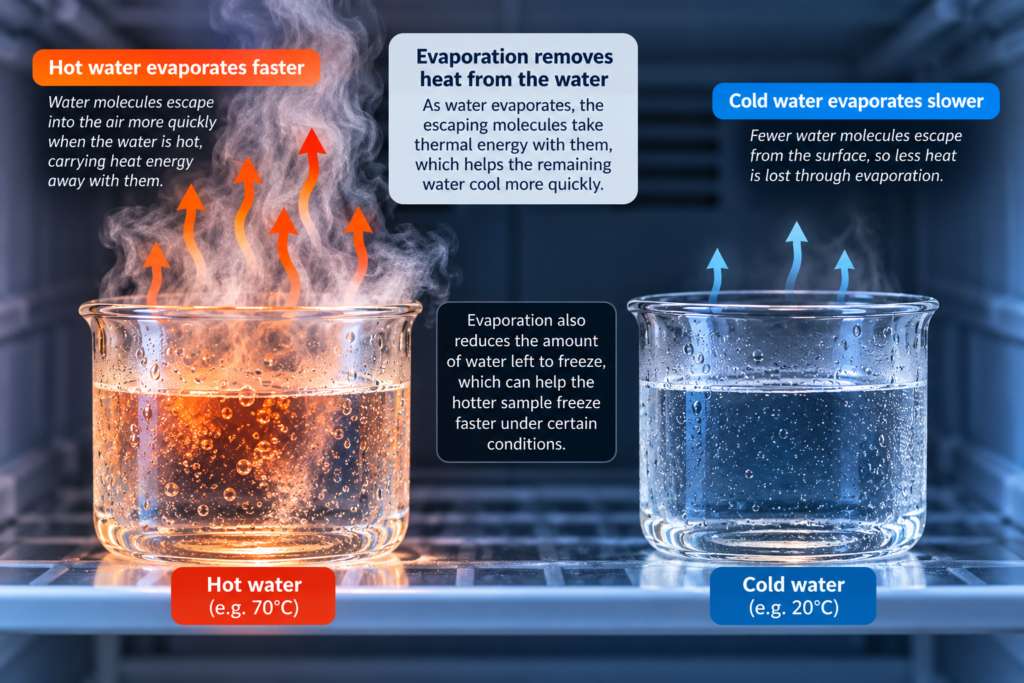
Hot water generally evaporates more rapidly than cold water, particularly when left uncovered.
As water molecules escape into the air, they carry energy away. This cools the remaining liquid.
Evaporation also reduces the quantity of water left in the container. With less water remaining, there may be less material to cool and freeze.
Both effects can help a hotter sample catch up with a cooler one.
However, evaporation cannot explain every observation. Some experiments have reported unusual freezing behaviour even when water loss was restricted or prevented. In an open container, a hotter sample that evaporates substantially may also produce less ice, so comparing equal starting quantities is not always the same as comparing equal quantities at the finish.
Clearly, something else may be happening.
Convection Currents and Temperature Distribution in Water
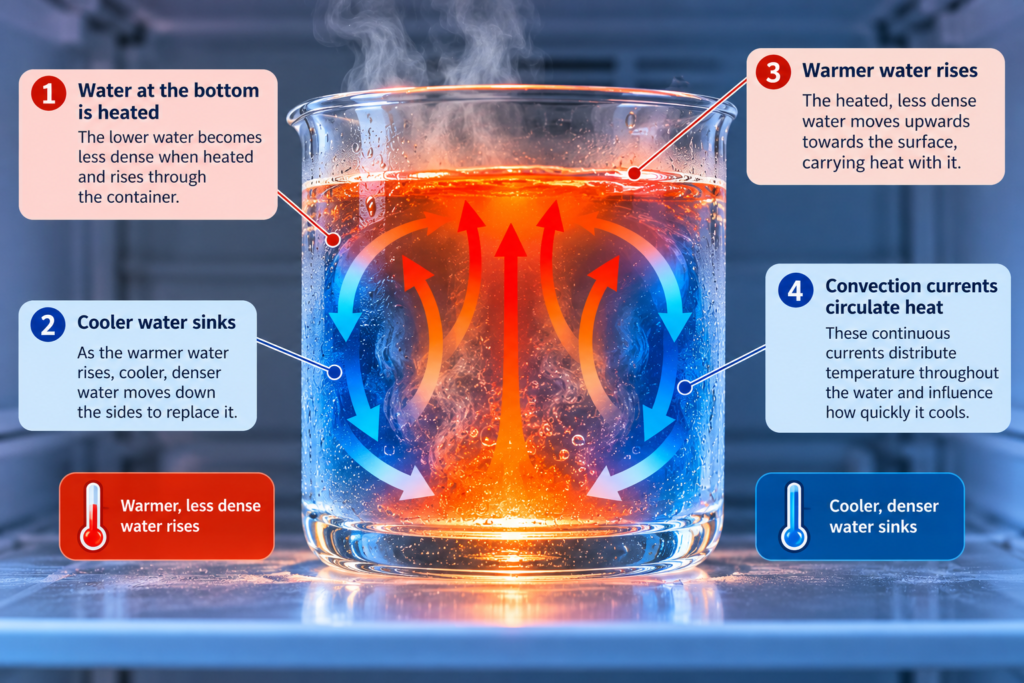
When water is heated, its temperature does not necessarily remain uniform throughout the container. The average temperature can conceal warmer and cooler layers.
Warmer and cooler regions move around through a process called convection.
These circulating currents redistribute thermal energy and influence how quickly heat reaches the surface or container walls.
Hot water may establish different circulation patterns from cooler water, potentially changing its overall cooling behaviour. A sample that began hotter can therefore have a different internal temperature distribution even after its average temperature falls to match that of the initially cooler sample.
The importance of convection depends on the container’s shape, the surrounding temperature and the conditions of the experiment. It is a plausible contributing mechanism, not a settled explanation for every result.
This is similar to the hidden physical forces explored in why your shower curtain clings to you. Something apparently simple becomes more interesting once we examine the movement of fluids.
Supercooling and the Formation of Ice Crystals
Perhaps the most intriguing explanation involves supercooling.
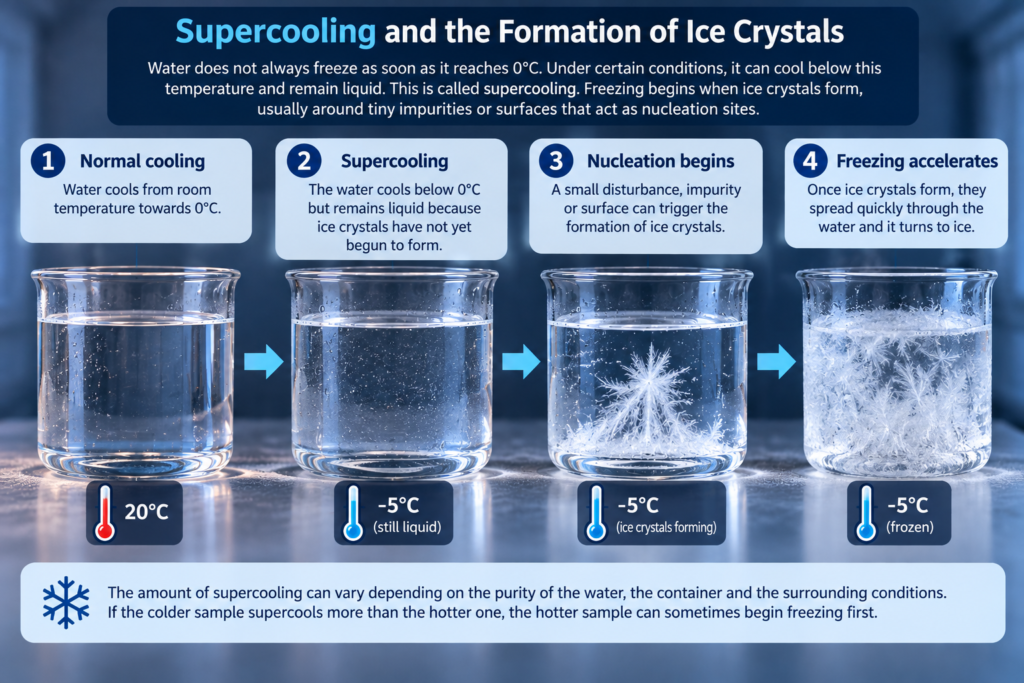
Water does not always begin freezing immediately upon reaching 0°C.
Under suitable conditions, particularly when there are few impurities or suitable sites for ice formation, liquid water can remain unfrozen below that temperature.
This is called supercooling.
Freezing begins when ice crystals start to form, a process known as nucleation.
Two samples of water may cool differently and begin forming ice at different temperatures. If the initially colder sample supercools more deeply, the hotter sample could potentially begin freezing first, even if the colder sample reached 0°C sooner.
However, supercooling is sensitive to experimental conditions and does not provide a universal explanation. Tiny differences in impurities, container surfaces or disturbances can influence when nucleation starts. That makes a single trial particularly unreliable.
It also raises another fascinating question: why does ice float on water when most solids sink in their own liquids?
Can You Reproduce the Mpemba Effect at Home?
You could try comparing equal quantities of warm and cold water in identical freezer-safe containers. Treat it as an exploration rather than a demonstration guaranteed to work: most trials may show the cooler sample freezing first.
Use a thermometer to measure their starting temperatures and observe how they cool. Avoid boiling water, hot glass containers and placing very hot vessels directly into the freezer. Very hot water can damage surfaces or warm nearby food.
For a fair comparison, consider the following:
Use identical containers and equal starting quantities of water.
Position them where airflow and cooling conditions are as similar as possible. Use a flat, comparable surface: a hot container can sometimes melt frost beneath it and change how efficiently it loses heat.
Decide whether you are measuring when each sample reaches 0°C, the first appearance of ice or complete freezing. These are different outcomes, and a thermometer alone cannot establish that the whole sample is solid.
Repeat the experiment because individual results may vary. Record the starting temperatures, container positions and chosen endpoint; if possible, swap the positions in later trials.
Even carefully controlled experiments do not always produce the Mpemba effect. A 2026 experimental investigation recorded different numbers of apparent Mpemba-effect cases depending on whether it counted reaching 0°C first or beginning the liquid-to-ice transition first. The definition of freezing and the experimental conditions matter enormously.
For another accessible discussion, see the counterintuitive science of hot water freezing faster. The University of California’s physics discussion also examines evaporation, dissolved gases, convection, surroundings and supercooling without claiming a single universal cause.
The Mpemba effect belongs alongside other everyday mysteries, such as why toast seems to land butter-side down and why supermarket trolleys pull to one side.
Conclusion: why does hot water sometimes freeze faster than cold water
So why does hot water sometimes freeze faster than cold water? Because starting temperature is only one factor in a complicated physical process.
Evaporation, convection, supercooling and the conditions around the container may each play a part. Whether hot water actually freezes first depends on the setup and on what the experiment measures.
The Mpemba effect reminds us that familiar experiences do not always have straightforward explanations. It also illustrates a basic scientific lesson: a surprising result needs a careful definition, controlled comparisons and repeated tests before we can explain it confidently.
And that is precisely why everyday questions are worth asking. Discover more of them in Walkeropedia’s Quirky Questions.