

Why does toast land butter-side down? It is one of those minor domestic disasters that seems suspiciously predictable. A freshly buttered slice slips from your plate, tumbles from the table and lands with an almost inevitable splat — butter firmly against the floor.
It feels as though the universe has a personal grudge against breakfast — particularly when the toast carries a generous helping of marmalade.
There is, however, some interesting physics behind our unfortunate toast. Gravity, rotation and even the height of your table can influence which side reaches the floor first.
The butter itself isn’t plotting against you.
Does Toast Really Prefer the Buttered Side?
The first thing to clear up is that toast isn’t inherently attracted to the floor butter-side down. There is a crucial difference between toast tipping off a table and a slice tossed freely into the air. A BBC Q.E.D. experiment in 1991 found approximately even outcomes when toast was thrown, whereas ordinary edge-of-table falls can favour the buttered side. Unlike a fair coin toss, the starting conditions of a falling slice are not necessarily symmetrical.
The familiar kitchen accident is different.
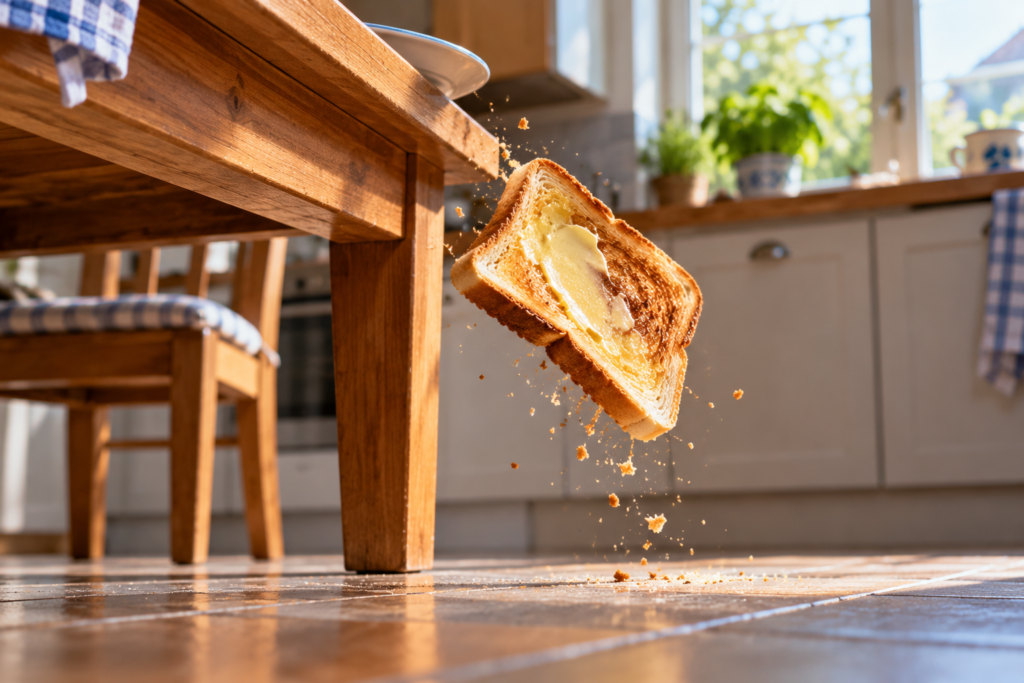
Toast usually begins its fall from a plate or the edge of a table with the buttered surface facing upwards. It then tips over the edge rather than simply dropping flat.
That initial tipping motion gives it rotation.
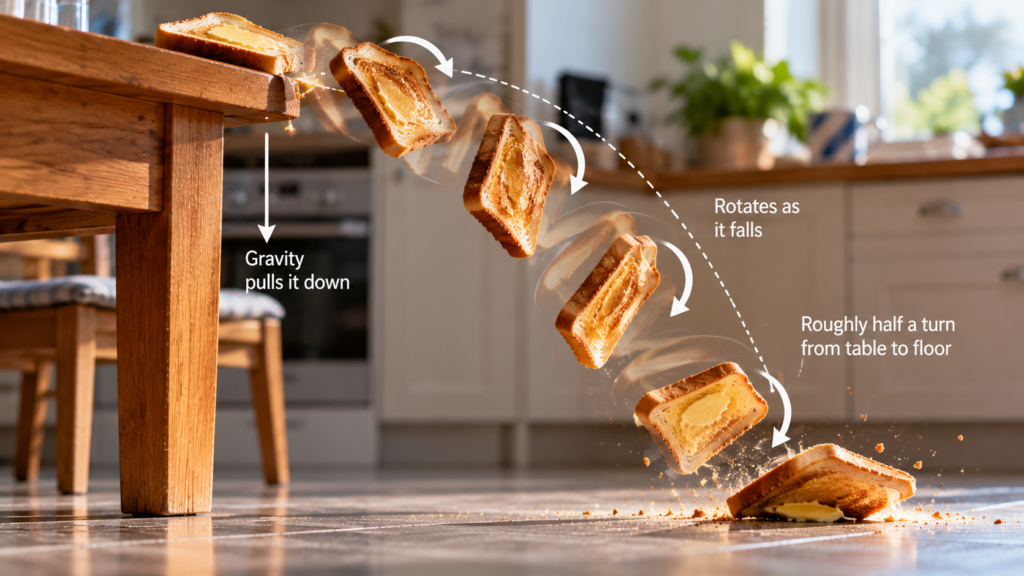
Understanding how gravity affects falling toast therefore requires looking at what happens before the slice becomes completely airborne. Gravity pulls the toast down, but its movement over the table edge starts it turning at the same time. How far the slice projects beyond the edge, whether it slips and its horizontal speed can all affect the eventual landing.
Why Does the Toast Start to Rotate?
Imagine slowly pushing a book over the edge of a table.
As more of the book moves beyond the edge, its centre of mass eventually reaches a point where the table can no longer support it. The book begins to tip.
Toast behaves in much the same way.
Once it starts tipping, gravity continues pulling it down while the toast continues rotating. It doesn’t normally leave the table perfectly horizontal and simply fall butter-side up.
The important question is therefore not merely whether toast rotates, but how far it manages to rotate before meeting the floor.
That is where the height of your breakfast table becomes unexpectedly important.
Why Falling Toast Often Makes Half a Turn
A normal dining table is often around three-quarters of a metre above the floor. That doesn’t give falling toast very long to complete its journey. The exact rotation depends on the toast’s size, starting position, speed and friction at the edge, so half a turn is a useful typical picture rather than a guarantee.
But it can be enough.
The slice begins butter-side up, tips from the table and rotates as it falls. Under typical circumstances, it can turn through roughly half a rotation before hitting the floor.
And what started on top is now underneath.
This is the wonderfully mundane explanation for why falling toast often makes roughly half a turn. It isn’t Murphy’s Law operating in the kitchen. It is a consequence of the way toast leaves the table and the limited distance available for it to fall. The result may look like bad luck, but the physical conditions have already influenced the odds.
Physicist Robert Matthews put this question to the test in a 1995 paper, ‘Tumbling toast, Murphy’s Law and the fundamental constants’. His work earned the 1996 Ig Nobel Prize in Physics. Matthews later reported that a 2001 experiment involving more than 1,000 schoolchildren and 21,000 toast drops found butter-side-down landings almost two-thirds of the time when toast fell from a plate. For the researcher’s own explanation, read Robert Matthews on why toast often lands butter-side down in BBC Science Focus.
The Role of Table Height in Toast Rotation
Now imagine the same accident happening from a much higher surface.
The toast would have more time to fall and therefore more time to rotate.
Under some simplified conditions, a fall of around three metres can allow something closer to a complete revolution. But that is an illustration from particular models, not a universal height at which toast suddenly becomes safe.
This is the role of table height in toast rotation.
Curiously, the dimensions of ordinary furniture help create the conditions for the familiar butter-down landing. We happen to eat at heights that allow the toast enough falling time to turn over but often not enough to turn back again. A related question about temperature and unexpected outcomes is why hot water sometimes freezes faster than cold water.
Is the Butter Actually Important?
Not as much as you might expect.
It is tempting to assume that the heavier buttered side pulls itself towards the floor. Some popular accounts suggest this, but the weight of a normal spread of butter is not considered the main driver of the effect. Starting orientation, tipping, friction and the time available to rotate matter much more.
The butter certainly matters once the toast lands. A dry side hitting the floor is annoying; a buttered side hitting the floor creates evidence. Add jam or marmalade and the evidence becomes considerably stickier, although the extra mess is not proof that the landing was more likely.
That may also explain why we remember butter-side-down landings particularly well. A messy landing is more memorable than a harmless one, though selective memory alone does not account for the experimentally observed bias in some kinds of fall. The last slice of bread is especially memorable: one unfortunate landing can mean breakfast has to be reconsidered.
A successful butter-side-up landing barely deserves a thought. The disastrous alternative requires cleaning the floor and possibly making another slice.
The Physics Behind the Buttered Toast Phenomenon
The real explanation is therefore less mysterious than the folklore but arguably more interesting.
Toast begins butter-side up. It moves beyond the table edge, gravity causes it to tip and fall, and its existing rotation continues while it is airborne. The height of an ordinary table provides only a short falling time. That sequence is supported by theoretical analysis, but the outcome varies with how the slice leaves the edge.
The result can be something remarkably close to the rotation required to put the butter underneath.
Is It a Law of Nature?
No. Toast can land butter-side up, sideways or against something else entirely. Change its starting motion, height or rotation and you can change the outcome. Think of a fair coin: even after ten heads in a row, the next independent toss still has a 50% chance of heads. Previous outcomes do not force the next one to be tails.
The physics behind the buttered toast phenomenon describes why butter-side-down landings are more likely under certain familiar conditions — not an unavoidable law requiring every breakfast to end badly. Unlike a fair coin, however, toast tipping off a table may have a built-in physical bias. Probability describes the pattern; gravity and rotation help explain it.
You can investigate the claim yourself using several equal-sized pieces of dry toast and a clean tray or mat on the floor. First let each slice tip naturally over the same table edge, starting with the same face up; then compare with slices released without an edge-induced tip. Record every landing, not just the messy-looking ones. Keep the height and method consistent within each group. Similar apparently peculiar behaviour occurs when moving air makes us wonder why your shower curtain clings to you. Everyday objects can reveal surprisingly interesting physics. And the familiar scent after a shower of rain raises another question: why does rain have such a distinctive smell?
Conclusion: Why does toast land butter-side down
So, why does toast land butter-side down? Often because of how it tips from a table, how quickly it rotates and how little time it has before reaching the floor. Matthews’ analysis and later experiments show that the familiar mishap can be more than bad luck, although it is far from inevitable.
The universe isn’t conspiring against your breakfast after all — although a marmalade-covered carpet and an empty bread bin may offer a different opinion. You can find more everyday mysteries hiding in plain sight among Walkeropedia’s Quirky Questions.
Summary
Why does toast land butter-side down? The answer lies in how gravity affects falling toast, the role of table height in toast rotation, and why falling toast usually makes half a turn before reaching the floor. Understanding the physics behind the buttered toast phenomenon reveals that this familiar breakfast disaster is not simply bad luck or Murphy’s Law.
The way toast tips over a table edge, begins rotating and falls through a limited distance can make a butter-side-down landing more likely. Add a generous helping of marmalade and the last slice of bread, and the consequences become considerably more memorable!