

Why does rain have such a distinctive smell? After all, rainwater itself is virtually odourless. Yet when it falls onto dry ground, the surrounding air can suddenly become filled with a fragrance that many of us recognise immediately.
It turns out that we are not really smelling the rain at all.
We are smelling a remarkable combination of substances released from the soil, plants and even microscopic organisms beneath our feet.
And there is a scientific name for that familiar fragrance: petrichor.
What Is Petrichor and Why Does Rain Produce It?
I love linguistics, and the ancient Greeks never let me down.
The word petrichor was introduced in 1964 by Australian researchers Isabel Joy Bear and Richard Thomas.
It comes from two Greek words: petra, meaning stone, and ichor, the mythical fluid said to flow through the veins of the gods.
Rather a grand name for the smell of a damp pavement!
Petrichor and the earthy scent after rainfall are particularly noticeable when rain arrives following a prolonged dry spell.
Living in Scotland, we don’t always get many opportunities to enjoy a particularly strong burst of petrichor. It generally needs a period of dry weather beforehand, something that can seem rather optimistic during our interminable Scottish rain.
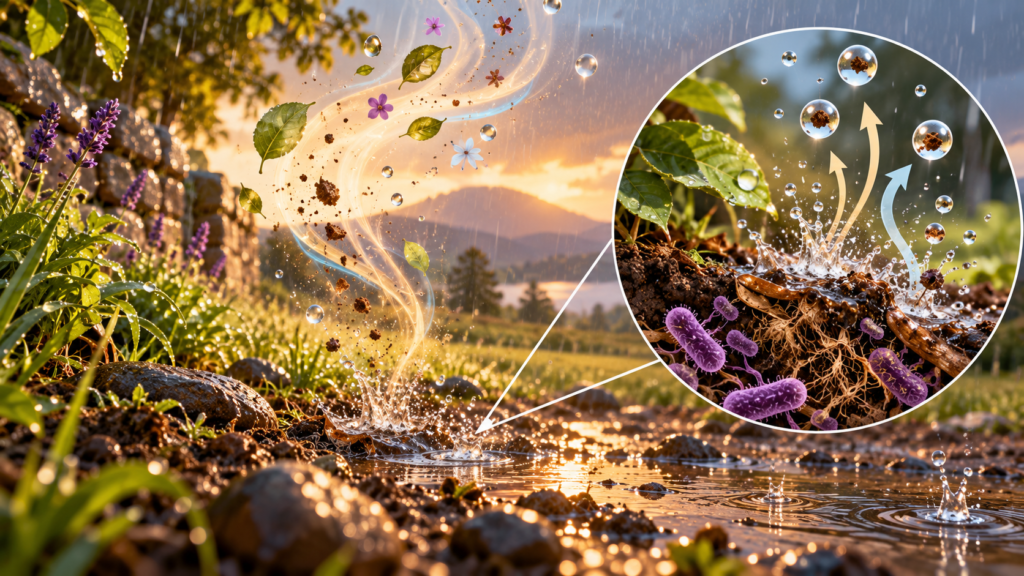
During dry weather, certain compounds accumulate on soil, rocks and other surfaces. When rain finally arrives, some of these substances are released into the atmosphere.
Our noses detect the resulting mixture as that wonderfully familiar smell of rain.
The scientific history of petrichor is explored in EarthSky’s explanation of why we can smell rain, which also describes the contributions of plants and soil bacteria.
The Role of Plant Oils in the Smell of Rain
Plants release a variety of natural oils and organic compounds into their surroundings.
During dry periods, some of these substances accumulate on rocks and in the soil.
When rain arrives, water helps release them into the air, where they contribute to the distinctive smell.
Picture raindrops gently splashing onto plant leaves and bouncing off the rocks in a garden. It is a wonderfully ordinary scene, yet beneath those tiny splashes, some rather interesting chemistry is taking place.
These plant-derived compounds form part of the original scientific explanation of petrichor.
But they are only part of the story.
One of the strongest earthy notes comes from something considerably smaller than a plant.
How Soil Bacteria Produce the Compound Geosmin
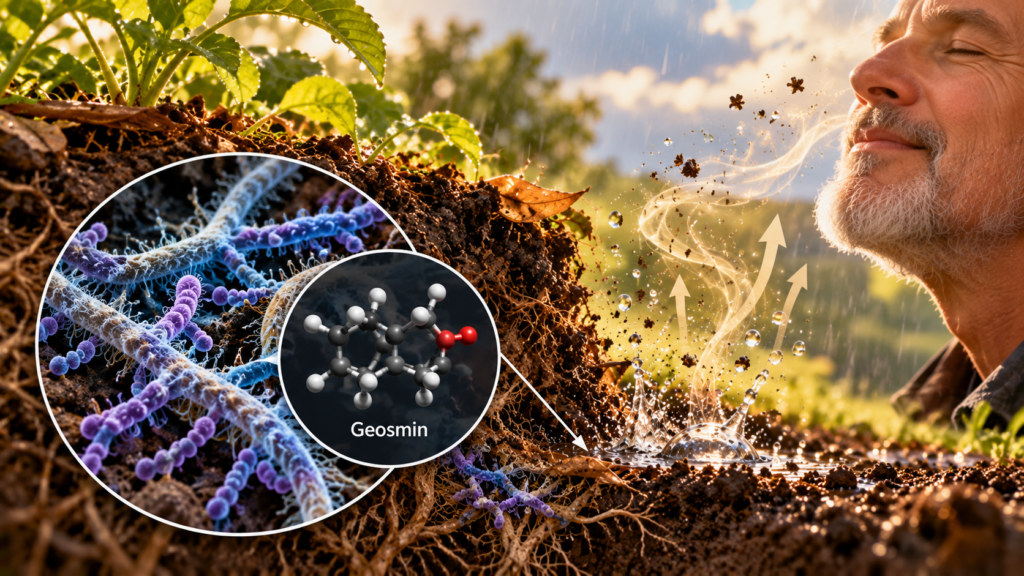
Beneath our feet lives an extraordinary community of microscopic organisms.
Among them are bacteria called Streptomyces, which are particularly common in soil.
Some of these bacteria produce an organic compound called geosmin.
And here we have another wonderful word derived from Greek. Geosmin comes from words meaning earth and smell.
The name describes the chemical responsible for much of the characteristic earthy aroma associated with damp soil.
I find it remarkable that something so pleasant can owe its existence partly to bacteria.
I was rather horrified when I discovered that our distinctive underarm odour also results largely from bacterial activity. Bacteria break down substances in sweat and skin secretions, producing the smelly compounds responsible.
Yuch!
Fortunately, the bacteria in our soil can produce something considerably more agreeable to the nose.
Why Does Geosmin Smell So Strong?
Humans are remarkably sensitive to geosmin. Even extremely small concentrations can be detected by our sense of smell.
Our noses contain specialised sensory receptors that respond to particular airborne molecules.
When geosmin molecules reach the nose, they can trigger a recognisable earthy sensation at surprisingly low concentrations.
I can only imagine what dogs make of it, given their extraordinary sense of smell.
Of course, a dog’s ability to detect particular odours depends on the substance involved, so we cannot automatically assume that geosmin smells more intense to them.
Scientists are still investigating why humans are so sensitive to this particular compound.
One possibility is that recognising earthy smells may once have helped our ancestors identify water or particular environmental conditions.
That remains a hypothesis rather than an established evolutionary explanation.
For a broader explanation of the chemistry involved, Science Behind Life examines why rain smells so pleasant, including the roles of geosmin and plant oils.
But how does a chemical produced in the soil find its way into the air?
For that, we need to examine what happens when a raindrop strikes the ground.
How Raindrops Release Aromatic Particles into the Air
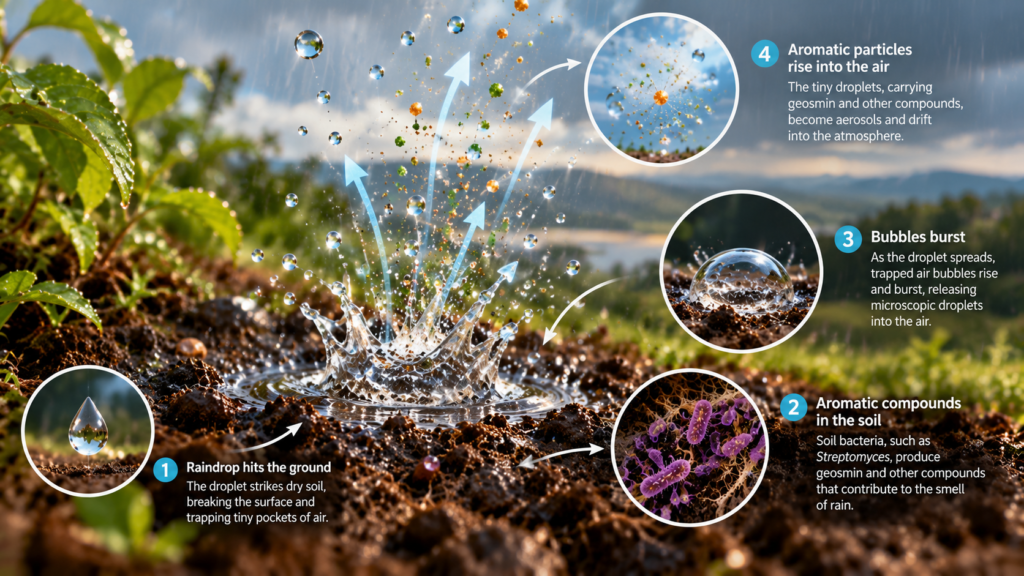
When a raindrop lands on a porous surface such as dry soil, tiny pockets of air can become trapped beneath it.
As the droplet spreads, these air bubbles may rise and burst through the water’s surface.
The bursting bubbles release microscopic droplets called aerosols into the surrounding air.
These aerosols can carry compounds associated with petrichor, including geosmin.
In effect, raindrops help transport earthy aromas from the ground into the atmosphere.
Researchers have demonstrated this process using high-speed cameras, revealing that an ordinary raindrop can create a surprisingly complex miniature event.
It rather changes the way we might think about rain gently splashing onto the garden.
And it reminds me of another everyday mystery: why your shower curtain clings to you. Both involve the surprising behaviour of water and air, although the underlying mechanisms are quite different.
Why Light Rain Can Smell Stronger Than Heavy Rain
You might expect a heavy downpour to produce the strongest earthy fragrance.
Surprisingly, that is not always the case.
Research suggests that light to moderate rainfall can sometimes generate aerosols particularly effectively, depending on the surface and how the droplets strike it.
Heavy rain may produce fewer aerosols under certain conditions, while also washing substances away or dispersing their scent differently.
So the intensity of petrichor depends on more than simply how much rain falls.
Soil conditions, the length of the preceding dry spell and the surrounding environment can all influence what we smell.
That helps explain why the first gentle shower after a warm, dry period can seem especially fragrant.
It also explains why a prolonged spell of Scottish drizzle is unlikely to produce the same dramatic fragrance as that first welcome shower after a summer drought.
Water has a remarkable talent for surprising us. Consider why hot water sometimes freezes faster than cold water. Once again, something apparently straightforward turns out to involve more complicated physics than we might expect.
Conclusion: Why Does Rain Have Such a Distinctive Smell?
So, why does rain have such a distinctive smell?
The answer lies in a fascinating interaction between chemistry, biology and physics.
Petrichor and the earthy scent after rainfall arise partly from plant oils and other substances that accumulate during dry weather.
Meanwhile, soil bacteria produce the compound geosmin, which gives damp earth much of its recognisable aroma.
When raindrops strike the ground, tiny aerosols can carry these aromatic substances into the air, allowing our noses to detect them.
I particularly enjoy the thought that this familiar fragrance has two wonderfully descriptive names rooted in ancient Greek.
And that something as ordinary as a shower of rain involves microscopic bacteria, natural chemistry and miniature bursting bubbles.
It belongs alongside the other quirky questions about everyday life that make Walkeropedia such an entertaining journey through ordinary experiences.
After all, who would have thought that the smell of rain could be as scientifically interesting as why supermarket trolleys pull to one side or why toast lands butter-side down?
The next time you step outside after a summer shower, remember that you are not simply smelling the rain.
“Save the trees, they allow us to breathe.”
– Stephenism
🎵 Soul from the Solo Blogger — Tunes from Túrail.