
Why does your shower curtain cling to you? You step into the shower, turn on the water and moments later the curtain begins creeping inwards as though it has developed an unexpected fondness for you.
Push it away and back it comes.
It can feel as though the shower is somehow sucking the curtain towards you. You might even suspect static electricity: after all, we’ve all seen a balloon cling to a wall or clothing stick together. But the curtain’s familiar inward billow while the shower runs has a more convincing explanation in moving air and pressure differences.
Moving water affects the surrounding air. Differences in air pressure, circulating air and temperature can all influence the curtain, while its light weight makes it particularly easy to move.
What appears to be an annoyingly affectionate piece of plastic is actually a small physics experiment taking place in your bathroom — and a useful reminder that the first explanation that springs to mind isn’t always the best one.
Moving Water Also Moves the Air
A shower does more than send water downwards. Thousands of droplets move rapidly through the surrounding air, interacting with it as they fall.
That movement helps set the air inside the shower enclosure in motion.
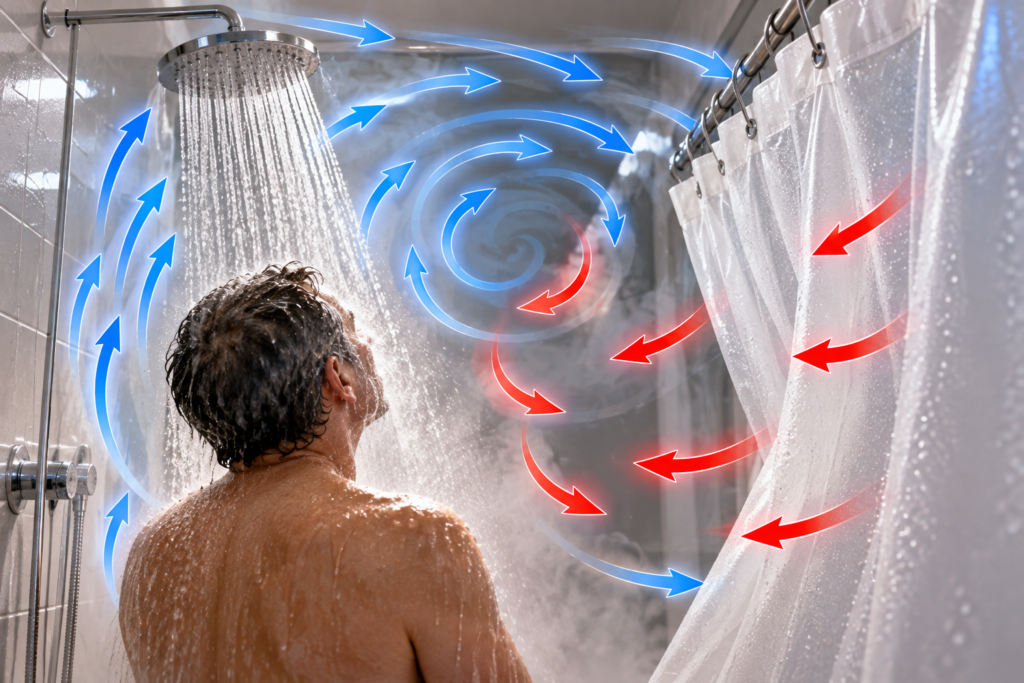
How Moving Shower Water Creates Air Circulation
In 2001, engineer David Schmidt at the University of Massachusetts Amherst used computational fluid dynamics to model a shower. His simulation showed that falling droplets could drive a horizontal vortex — a circulating movement of air — within the enclosure. The research earned him the 2001 Ig Nobel Prize in Physics, an award celebrating unusual research that makes people laugh and then think. That seems rather appropriate for a curtain determined to join you in the shower.
Water Drags Nearby Air Along
As droplets travel downwards, aerodynamic drag transfers some of their momentum to nearby air.
That movement helps create a circulating flow, with regions of slightly different pressure inside and outside the shower. The effect can occur with cold water too, so rising steam cannot be the whole explanation.
A lightweight curtain responds to that pressure difference and moves towards the lower-pressure region.
The effect does not require an enormous pressure difference. A shower curtain has a large surface area while weighing very little, so even modest forces can make it move.
The Curtain Makes the Effect Obvious
The same air movement would be much harder to notice if the barrier beside you were made from something heavy.
A glass shower screen does not visibly bend towards you.
A thin sheet of plastic certainly can.
That is why lightweight shower curtains move towards the water so readily: there is relatively little mass resisting the forces acting upon them.
Everyday objects often reveal physical forces we would otherwise overlook.
Even something as ordinary as a shower curtain can challenge a perfectly plausible schoolroom explanation. The same curiosity helps explain why supermarket trolleys pull to one side.
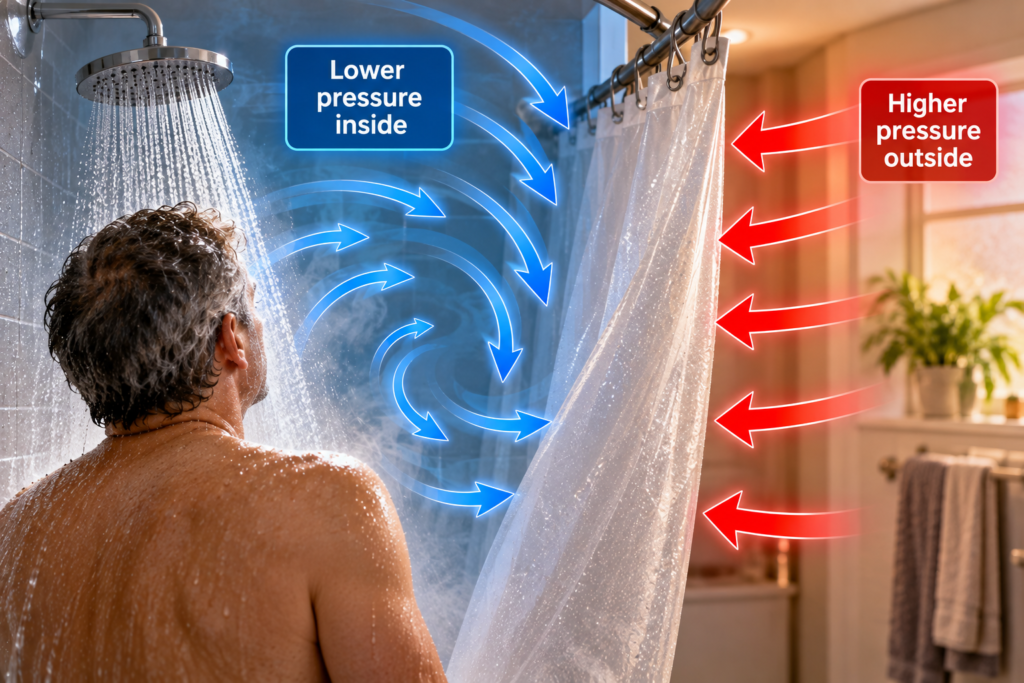
Air Pressure Helps Pull the Curtain Inwards
The role of air pressure around a shower curtain is central to understanding why it moves.
If circulating air inside the shower creates slightly lower pressure than the relatively still air outside, the greater pressure outside pushes the curtain towards the shower. That answers the obvious follow-up: why does it move towards you instead of away? The imbalance acts from the higher-pressure bathroom side towards the lower-pressure region inside.
We commonly describe this as the curtain being “sucked in”, but technically the higher-pressure air outside helps push it inward. The same broad idea — moving fluids creating forces — appears in discussions of aircraft wings and sailing boats. Their aerodynamics are more complicated, however, and neither is a precise model of a shower curtain.
Is It the Bernoulli Effect?
The Bernoulli principle is frequently mentioned when explaining shower curtains. In suitable flowing-fluid conditions, changes in speed and pressure are related. It is also part of the language used to explain lift on wings and forces on sails, though those effects involve more than a single simple rule.
Bernoulli Is Only Part of the Story
It is tempting to imagine that fast-moving water acts on the curtain in the same way as air passing over a wing.
That analogy captures the importance of moving fluids, but it misses what the shower spray does to the surrounding air.
Nor should we automatically blame static electricity. Friction and certain materials can produce electrostatic attraction, and static cling may occur in some circumstances. But static charge is not needed to explain why a curtain repeatedly billows inward when the water is running.
Water droplets, air circulation, turbulence, temperature and the shape of the shower enclosure all interact. Schmidt’s computer modelling suggested that a horizontal vortex driven by the spray is an important contributor to the low-pressure region. The model is influential, but it is not a universal measurement of every bathroom or shower design.
So Bernoulli’s principle can help us think about moving fluids and pressure, but describing the entire shower-curtain effect as “just Bernoulli” oversimplifies what is happening. The spray-driven vortex is the distinctive feature of Schmidt’s explanation. Another everyday puzzle in which simple-sounding explanations deserve a closer look is why toast lands butter-side down.
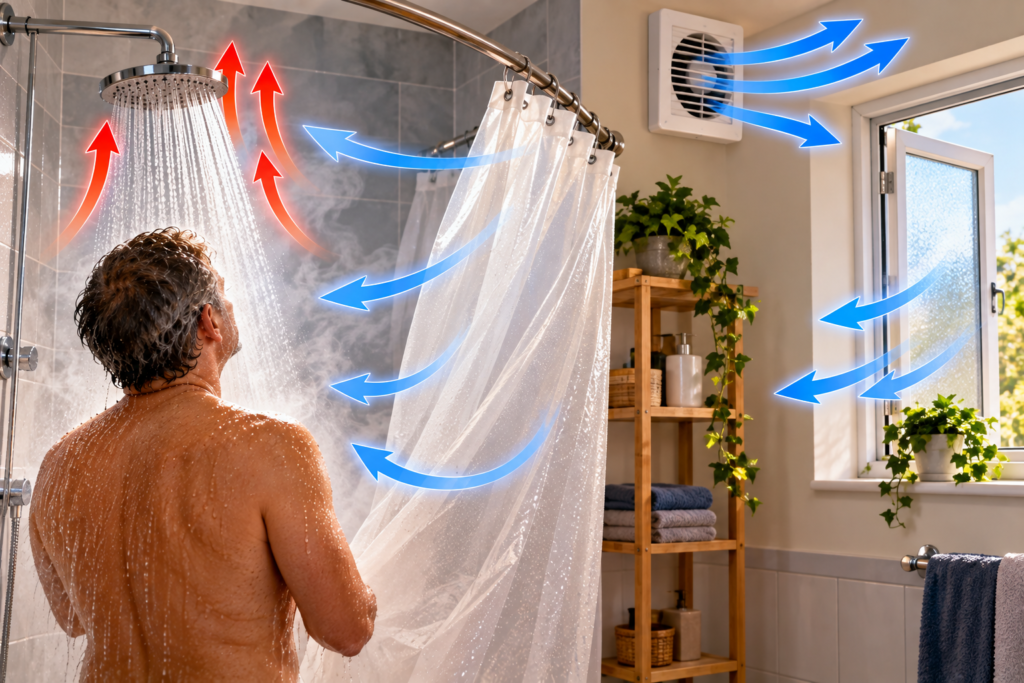
Does Hot Water Make the Curtain Move More?
Most of us probably associate the problem with a hot shower, which makes temperature seem an obvious culprit.
Hot water warms the surrounding air. Warm air becomes less dense and tends to rise, creating convection currents.
Warm Air Can Add to the Movement
How warm rising air influences curtain movement depends on the shower and bathroom.
Convection Creates More Air Circulation
As warm moist air rises, cooler air moves in to replace it. This creates additional air movement around the shower.
That circulation can contribute to the movement of the curtain.
However, heat cannot be the complete explanation because the inward movement can also occur with cold water. If you want to see that for yourself, observe a light curtain from outside the bath while running a cold shower, then compare its behaviour with warm water. Keep the floor dry and don’t step into the spray to conduct the experiment. The difference may be interesting, but it won’t by itself isolate every force involved.
Temperature is therefore better thought of as one influence among several rather than the sole cause. Water has other surprises too, including why ice floats on water.
Bathroom Ventilation Can Change Things
An extractor fan, open door or window can alter air movement and pressure around the shower.
That helps explain why the effect may seem much stronger in one bathroom than another.
The size of the shower, position of the shower head, strength of the water flow and ventilation can all change the airflow. In some bathrooms, directing the spray more downwards or adjusting its strength may make a difference, although there is no guarantee.
Can You Stop a Shower Curtain Clinging to You?
Fortunately, understanding the physics is not essential when you simply want the curtain to leave you alone.
The easiest solutions involve either making the curtain harder to move or preventing it from moving far enough to reach you.
Add Weight or Hold the Curtain in Place
A heavier curtain is less responsive to small changes in airflow and pressure.
Weighted Hems Can Help
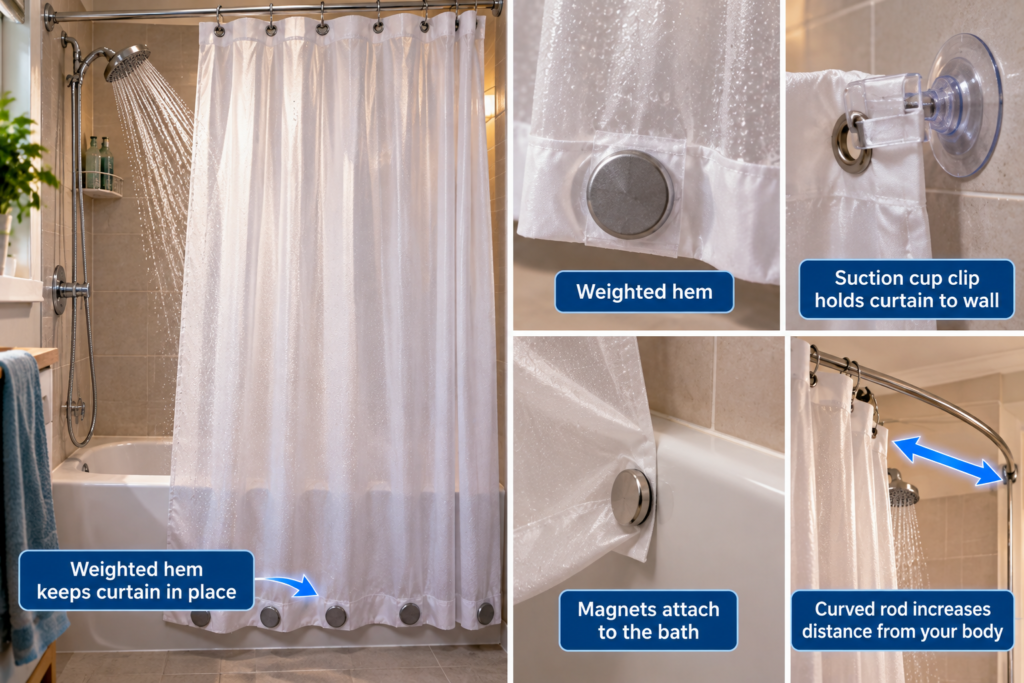
Some shower curtains have weighted hems specifically to reduce movement. Small magnets can also work when the bath is made from a magnetic material such as suitable steel; they will not attach to acrylic or fibreglass baths. Suction cups or clips may provide another option.
A curved shower-curtain rod can increase the distance between the curtain and your body, giving it more room to move without making contact.
Reduce the Opportunity to Billow
Keeping part of the curtain against the inside wall of the bath can sometimes help restrict its movement. A simple trick is to wet the lower edge of a clean liner and press it gently against the inside of the bath so it stays put for a while.
Changing ventilation may also alter the airflow, although the results will depend on the bathroom. Leaving a small gap at one side can sometimes reduce pressure differences, provided it does not let water escape onto the floor.
For more practical approaches, Real Simple’s guide to stopping shower-curtain cling discusses weighted liners, magnetic hems, curved rods and the wet-edge trick. A heavier liner or weighted hem is generally more dependable than trying to control invisible air currents. If the curtain still misbehaves, a rigid shower screen avoids the billowing problem altogether.
Conclusion: Why does your shower curtain cling to you
Ultimately, why does your shower curtain cling to you? Because moving shower water sets the surrounding air in motion, producing circulation and pressure differences capable of pushing a lightweight curtain inward. The effect can resemble static attraction, but a spray-driven vortex offers a better explanation for the familiar billowing.
Warm rising air and bathroom ventilation can influence the effect, while a thin curtain makes those otherwise subtle forces surprisingly noticeable. It is an everyday annoyance with some fascinating physics behind it — and exactly the sort of ordinary mystery explored in Walkeropedia’s Quirky Questions.