

Stand in front of a mirror and raise your right hand. Your reflection appears to raise its left hand.
Now raise your head. Your reflection doesn’t suddenly turn upside down.
So why do mirrors reverse left and right but leave up and down completely untouched?
It seems like a straightforward question, but the answer reveals something rather surprising about how light behaves and how our brains construct what we believe we see.
The mirror isn’t actually reversing left and right at all.
We’re doing most of the interpreting ourselves.
Do Mirrors Really Reverse Left and Right?
The short answer is no.
A mirror doesn’t distinguish between left, right, up or down. It simply reflects light according to a physical rule: the angle at which light strikes the mirror equals the angle at which it reflects away.
This is known as the law of reflection. For another approachable explanation of the physics, see BBC Science Focus on why mirrors appear to reverse left and right.
When you stand in front of a flat mirror, light travelling from your right hand is reflected towards your eyes in a way that makes its image appear on your right. Try putting a coloured sticker on that hand: the sticker remains on the same side of the room in the reflection.
Your left hand appears on your left.
Nothing has swapped positions.
Yet your reflection appears to be facing you, which creates the impression that its left and right sides are reversed.
The apparent contradiction comes from how we compare ourselves with the person we imagine standing on the other side of the glass. A reflection and a person who has physically turned around are not the same arrangement. What feels obvious to our eyes is not always an accurate description of what happened.
How Mirrors Reflect Light Without Reversing Directions
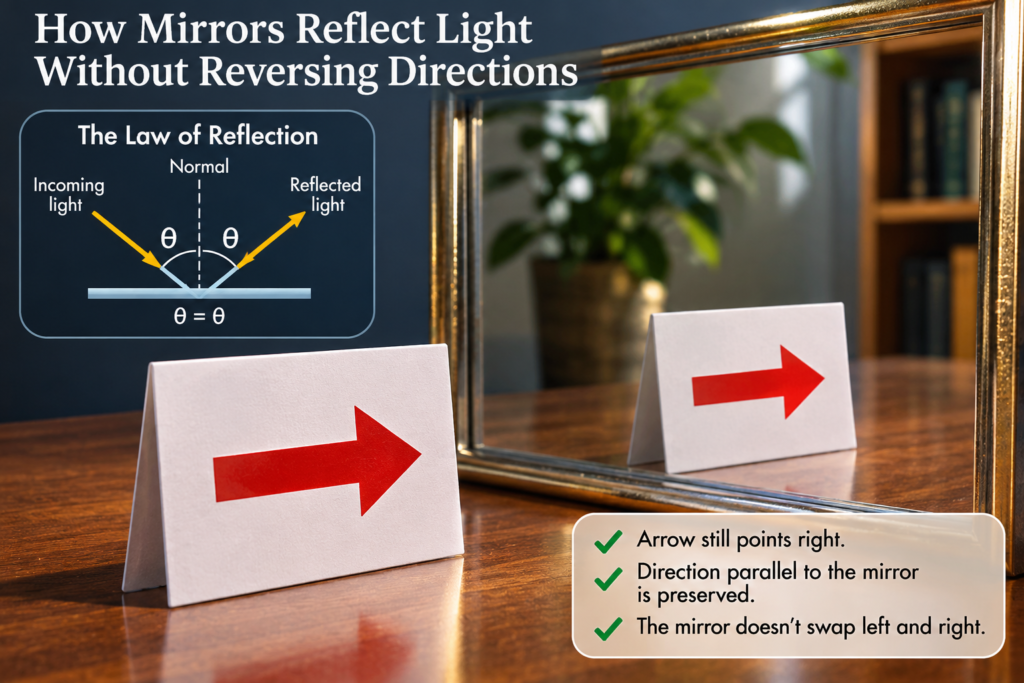
Understanding how mirrors reflect light without reversing directions helps explain the illusion.
Imagine placing a small arrow pointing upwards in front of a mirror.
Its reflection still points upwards.
Turn the arrow sideways so it points towards your left, and its reflection also points towards your left.
But point the arrow directly towards the mirror and something different happens.
Its reflection appears to point back towards you. Try this with a pencil held perpendicular to the glass: its tip appears to point in the opposite front-to-back direction.
This is the crucial difference.
A flat mirror preserves directions parallel to its surface while reversing the direction perpendicular to it.
In everyday language, that means the mirror changes the apparent front-to-back direction.
It doesn’t selectively reverse left and right. If you lie with your feet pointing towards a mirror, the direction perpendicular to the surface is now along your head-to-foot axis instead.
What Is the Difference Between Mirror Reflection and Lateral Inversion?
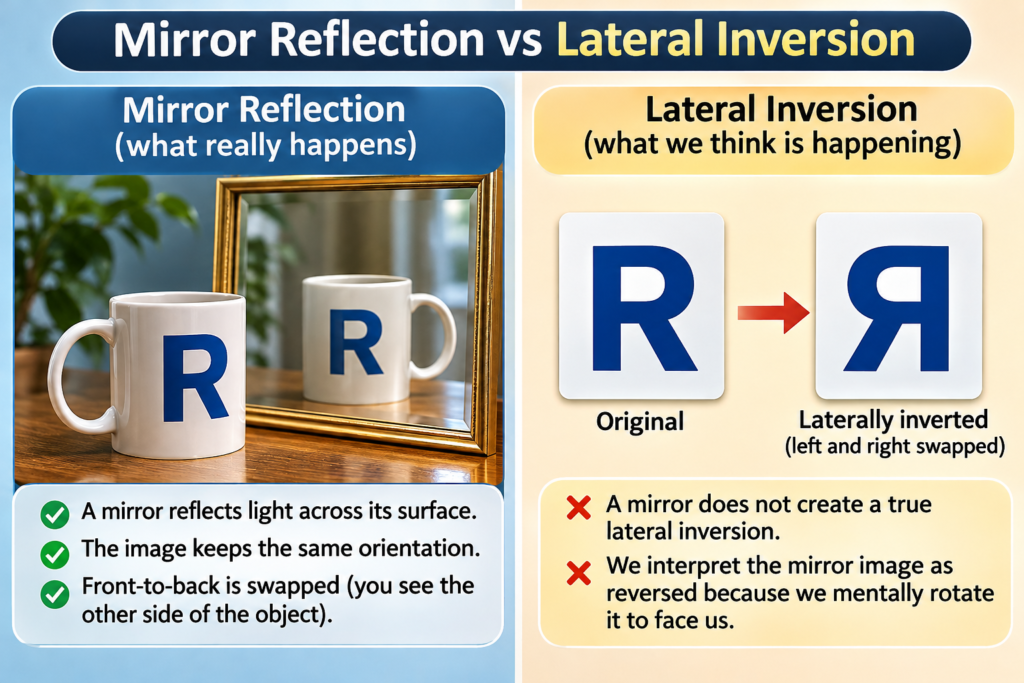
The difference between mirror reflection and lateral inversion is often misunderstood.
Lateral inversion is the familiar description of the apparent left-right reversal we notice in mirror images.
But it doesn’t mean the mirror physically exchanges everything on the left with everything on the right.
Consider writing your name on a piece of transparent plastic and holding it upright facing the mirror, so you can see the letters and their reflection without turning the sheet.
From that position, the letters and their reflected positions are not secretly exchanged left for right. The familiar backwards-writing effect becomes obvious when you compare the reflection with lettering that has been physically turned to face the other way.
Why?
Because a mirror image faces you from the opposite side of the reflecting plane, we tend to compare it with a page or person rotated through half a turn. That rotation, rather than a special left-right rule built into the glass, changes how the letters appear.
You can spot the same issue on emergency vehicles: the word AMBULANCE is sometimes printed in reversed lettering on the front so that it appears readable in a driver’s rear-view mirror.
The mirror hasn’t rearranged the letters. It has reflected their positions across the plane of its surface.
The apparent reversal depends on how we orient ourselves and the object we’re comparing. A mirror preserves each point’s sideways and vertical position relative to the glass while placing its virtual image the same distance behind the mirror as the object is in front.
Why Do Our Brains Interpret Mirror Images as Reversed?
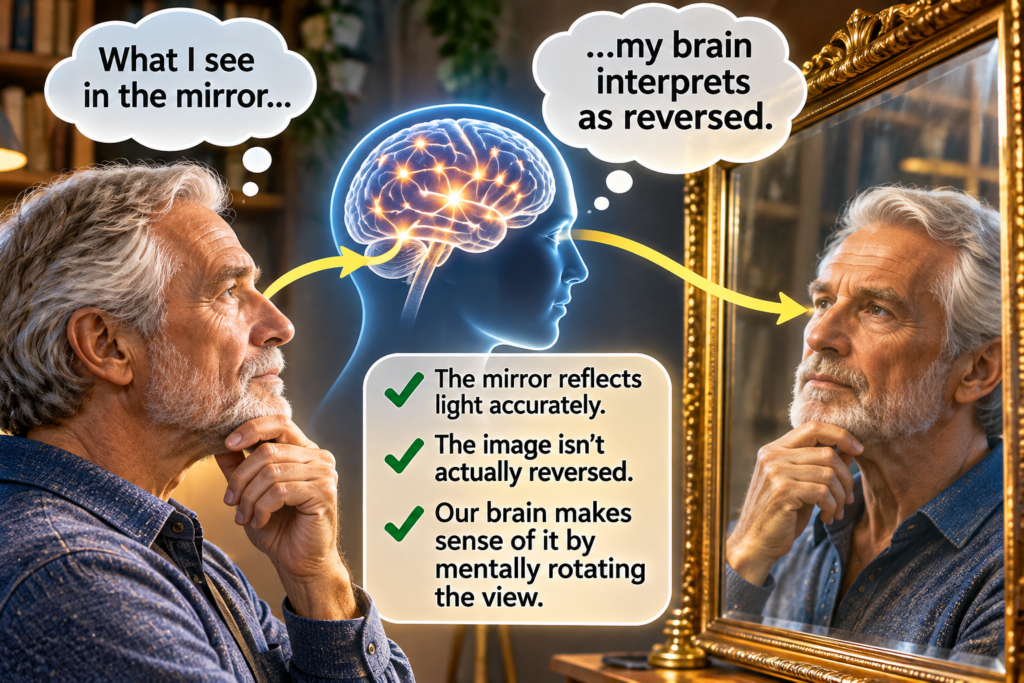
Understanding why our brains interpret mirror images as reversed requires us to consider something beyond physics. Our eyes collect light; it is the brain that turns those signals into the scene we experience. That interpretation also helps explain why we get déjà vu, when familiarity can feel convincing without a matching memory.
When we look at another person facing us, we instinctively compare their body with our own. Human bodies are approximately symmetrical left to right, but our fronts look quite different from our backs.
Imagine turning around to face someone standing behind you.
Your right side would move to the opposite side of the room from where it started.
We often make a similar mental rotation when interpreting our reflection as another person facing us. That imagined turn is easier to picture than a body somehow reversed from front to back.
This makes the reflected figure seem to have exchanged left and right.
However, the mirror itself hasn’t performed that rotation.
Our interpretation has. That distinction matters whenever we insist something must be true simply because we saw it: perception is an interpretation of evidence, not an infallible recording. A similar gap between a physical signal and our experience appears in why yawning can be contagious, where seeing someone yawn can influence our own behaviour.
It’s a useful reminder that seeing something and understanding its geometry aren’t always quite the same thing. Even ordinary vision involves a small processing delay, so our experience of the present is built from light that arrived moments earlier. That delay does not cause mirror reversal, but it shows why perception should not be confused with the physical world itself. Our senses also interact with memory, as explored in why smells trigger memories so strongly. A spiral pattern offers another clue: its reflected winding direction can look reversed even though the mirror hasn’t chosen a left or a right side.
How Does Front-to-Back Reflection Create the Illusion?
Understanding how front-to-back reflection creates the illusion of left-right reversal brings the explanation together.
Imagine standing one metre in front of a large flat mirror.
Your reflected image appears one metre behind it. That is a virtual image: light does not actually travel behind the glass, but reflected rays reach your eyes as though they came from there.
Move closer, and the image appears to move closer too.
Step sideways to your right, and the image also moves to your right.
But if you point directly towards the mirror, the reflected direction points back towards you.
The front-to-back component has changed sign.
This is why physicists describe mirror reflection as a reversal across a plane rather than a simple left-right swap.
The mirror is obeying geometry, not deciding which direction to reverse. This explanation applies to a flat mirror; curved mirrors can also magnify or invert an image depending on their shape and the object’s position.
Conclusion: Why Do Mirrors Reverse Left and Right?
So why do mirrors reverse left and right?
Strictly speaking, they don’t.
A flat mirror reverses the direction perpendicular to its surface while preserving directions parallel to it.
The apparent left-right reversal comes from how we mentally compare ourselves with a reflected figure facing the opposite way.
Once you understand that distinction, the mystery becomes much less mysterious. The light follows dependable rules; the illusion emerges when our brain supplies an intuitive but misleading comparison. And, as with why questions lead to more questions, discovering the answer often reveals another puzzle.
Although there’s still something wonderfully peculiar about standing in front of a mirror and realising that the person looking back at you isn’t quite behaving the way you thought.
And the next time someone asks why mirrors don’t reverse up and down, you can tell them the answer.
They don’t reverse left and right either. For more everyday puzzles with surprisingly factual explanations, explore the Quirky Questions collection.


