Logic and Algorithms are fundamental to modern computing. Logic provides rules for determining whether statements and relationships are valid, while algorithms provide structured sequences of instructions for solving problems. Together, they allow computers to process information systematically and produce predictable results.
Neither concept began with electronic computers. Their histories extend through ancient mathematics, philosophy and centuries of attempts to formalise human reasoning. During the nineteenth century, mathematicians including Augustus De Morgan and George Boole transformed logic into increasingly mathematical forms. At the same time, Charles Babbage and Ada Lovelace explored how defined procedures could control a programmable calculating machine.
These developments helped establish the intellectual foundations upon which computer programming would eventually be built.
Logic and Algorithms Before Modern Computers
An algorithm is essentially a defined procedure for accomplishing a task or solving a problem. Humans have been developing such procedures for thousands of years.
Ancient mathematicians used systematic methods for arithmetic and geometry. Euclid described an efficient procedure for finding the greatest common divisor of two numbers more than two thousand years ago. The method remains known as the Euclidean algorithm.
The word algorithm itself is derived from the Latinised name of the Persian mathematician Muhammad ibn Musa al-Khwarizmi, whose ninth-century mathematical works helped introduce systematic methods of calculation to a wider audience.
These examples demonstrate that the development of algorithmic thinking began long before anyone imagined a digital computer.
The Foundations of Mathematical Logic
Logic has an equally ancient history, stretching back to philosophers such as Aristotle. For centuries, however, logic was primarily associated with philosophy and reasoning expressed through ordinary language.
During the nineteenth century, this began to change.
Augustus De Morgan developed formal rules governing logical relationships, including the principles now known as De Morgan’s laws. George Boole went further by developing an algebraic system in which logical propositions could be represented mathematically.
Boolean algebra allowed statements to be expressed using values corresponding to true and false and combined using operations such as AND, OR and NOT.
These foundations of mathematical logic would become enormously important when electronic computers appeared. Digital circuits could represent two logical states physically, allowing Boolean operations to be implemented directly in hardware.
From Mathematical Procedures to Programmable Machines
The nineteenth century also witnessed an important transition from performing algorithms manually to considering how machines might execute them.
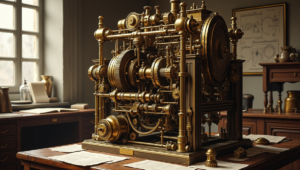
Charles Babbage’s proposed Analytical Engine was intended to perform different sequences of operations according to instructions supplied using punched cards. This represented a fundamental departure from machines constructed to perform only one predetermined calculation.
Ada Lovelace and Algorithmic Thinking
Ada Lovelace recognised the significance of Babbage’s design. Her extensive notes on the Analytical Engine included a detailed procedure for calculating Bernoulli numbers.
That procedure is frequently described as the first published computer program.
Lovelace also understood something more profound: if information could be represented appropriately, a machine might manipulate entities other than ordinary numerical quantities. Her ideas form an important part of the wider Ada Lovelace computing legacy.
This was an early connection between algorithms and representation. A machine could follow a sequence of operations, while symbols could stand for information upon which those operations were performed.
Formal Reasoning and Computation
The relationship between formal reasoning and computation became increasingly important during the twentieth century.
Mathematicians including Gottlob Frege, Bertrand Russell, David Hilbert, Kurt Gödel and Alan Turing investigated whether mathematical reasoning itself could be represented through formal systems.
Turing’s theoretical model of computation demonstrated how a simple abstract machine could execute instructions according to precisely defined rules. This helped establish the mathematical foundations of computer science.
The origins of computational mathematics therefore emerged from the convergence of two ideas: information could be represented symbolically, and systematic procedures could operate upon those representations.
This principle remains central to symbolic processing, where computers manipulate expressions, rules and relationships rather than merely calculating numerical values.
Why Logic and Algorithms Still Matter
Every computer program ultimately depends upon logical decisions and algorithms.
A simple program might ask whether a password matches a stored value. A navigation application uses algorithms to identify routes. Search engines apply complex procedures to retrieve and organise information, while computer games constantly evaluate logical conditions governing objects, players and events.
From Programming to Artificial Intelligence
Algorithms have become vastly more sophisticated, but their underlying purpose remains unchanged: define a procedure that transforms information or solves a problem.
Artificial intelligence demonstrates how broad this principle has become. Traditional symbolic AI uses explicitly defined rules and logical relationships, while machine-learning systems use algorithms to identify patterns within data and adjust mathematical models.
Modern computing therefore combines different approaches, but structured procedures and logical evaluation remain fundamental.
The wider history of algorithms demonstrates how a concept developed through mathematics became central to almost every aspect of digital technology.
These developments also need to be understood within their historical setting. Nineteenth-century advances in mathematics, engineering and mechanical computation occurred during a period of extraordinary intellectual and technological change explored more broadly in Victorian science and society.
Frequently Asked Questions
Conclusion
Logic and Algorithms connect that historical world with our digital one. From Boolean reasoning and Babbage’s mechanical designs to software, search engines and artificial intelligence, the basic ambition remains remarkably consistent: represent a problem clearly, establish reliable rules and develop a sequence of operations capable of producing a useful result.
“A good engineer will do the job once — and only once.”
Stephenism
🎵 Soul from the Solo Blogger — Tunes from Túrail.