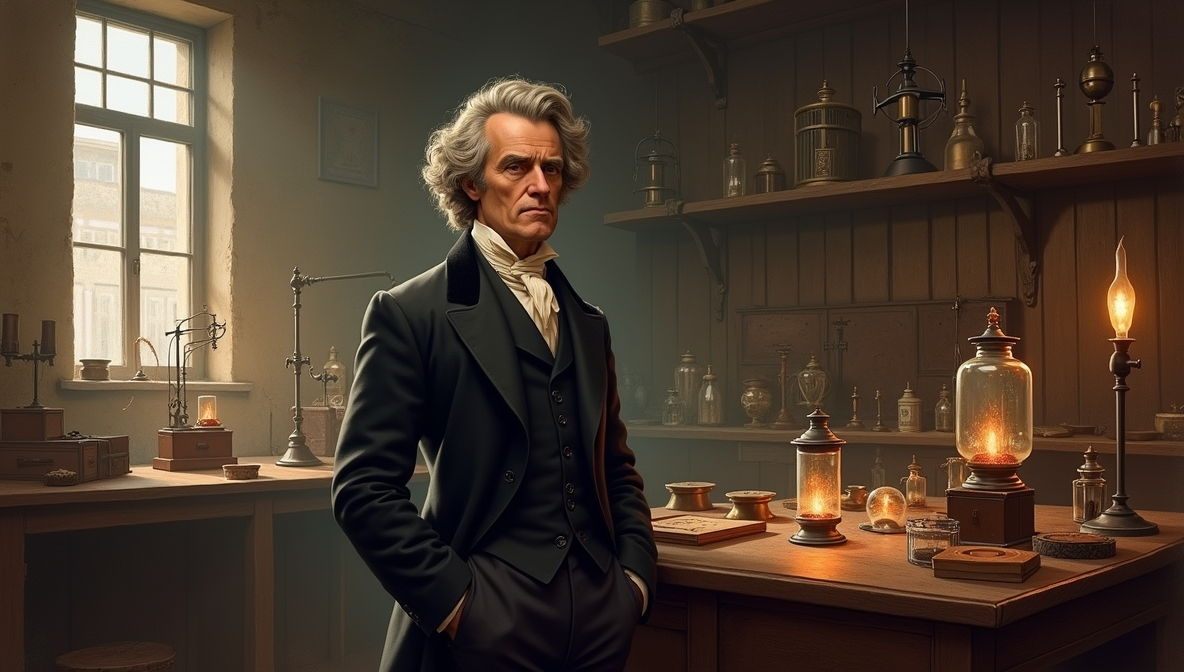
Few scientists demonstrate the power of experiment as clearly as Michael Faraday. Born into modest circumstances with little formal education, he became one of the nineteenth century’s most influential experimental physicists and chemists. His discoveries helped establish the principles behind electric motors, generators, transformers and electromagnetic shielding.
Faraday was experimentally brilliant but mathematically modest. Where some Victorian thinkers sought to describe nature through equations or mechanical systems, he preferred to make invisible forces reveal themselves on the laboratory bench. His work on electromagnetic induction transformed electricity and magnetism from intriguing phenomena into forces that could eventually power an industrial world.
Michael Faraday and the Power of Experiment
Born in Newington Butts, Surrey, in 1791, Faraday came from a working-class family and received only a basic education. Apprenticed to a bookbinder, he developed his scientific knowledge by reading the books passing through his hands.
From Bookbinder to the Royal Institution
Faraday’s fortunes changed after he attended lectures by the chemist Humphry Davy. He carefully compiled his notes and sent them to Davy, eventually securing employment at the Royal Institution.
His rise was extraordinary, but Victorian society did not instantly forget his background. Faraday entered an intellectual world in which education, class and social connections carried considerable weight. Nevertheless, his exceptional experimental abilities ultimately earned him enormous institutional respect.
His career provides an interesting contrast with Charles Babbage and his visionary machines. Babbage attempted to embody mathematical reasoning within machinery; Faraday used physical experiments to expose natural laws that could not be seen.

Electromagnetic Induction Changes Everything
Faraday’s most important breakthrough came in 1831 with his experiments in electromagnetic induction. He demonstrated that a changing magnetic environment could produce an electric current.
This discovery established the principle underlying electrical generators. Instead of electricity merely being stored chemically in batteries, mechanical movement could be converted into electrical energy.
That insight alone would justify Faraday’s reputation as a pioneer of electromagnetism. Modern power generation still depends fundamentally upon the relationship he demonstrated experimentally.
For a broader account of his life and discoveries, see the Encyclopaedia Britannica biography of Michael Faraday.

Motors, Fields and Invisible Forces
Faraday did not simply discover isolated electrical effects. His experiments encouraged a new way of thinking about forces acting through space. Rather than beginning with abstract theory, he repeatedly allowed physical evidence to lead him towards broader scientific principles.
The Electric Motor Pioneer
In 1821, Faraday demonstrated electromagnetic rotation, producing continuous motion through the interaction between electricity and magnetism. This simple apparatus was primitive compared with later motors, but it established a fundamental principle.
As an electric motor pioneer, Faraday therefore helped establish both sides of the modern electrical relationship: electricity could create motion, while motion could generate electricity.
His experimental approach differed significantly from the abstract logical reasoning associated with Augustus de Morgan and mathematical logic. Both men investigated hidden structures, but Faraday preferred apparatus, observation and repeated experimentation to symbolic formalism.
The Faraday Cage and Fields
The Faraday cage emerged from experiments demonstrating how electrical charge behaves on a conductor. A conducting enclosure can shield its interior from certain external electrical and electromagnetic effects, a principle that remains important in laboratories, communications and electronic equipment.
Faraday also developed the concept of lines of force. Rather than treating electrical and magnetic effects simply as mysterious actions across empty space, he visualised forces extending through the surrounding environment.
This conceptual leap later became crucial to James Clerk Maxwell’s mathematical description of electromagnetism. Faraday could see the physical relationship experimentally even when he lacked the advanced mathematics required to express it formally.
His place within Victorian science also connects naturally with Mary Somerville and nineteenth-century scientific culture, where observation, mathematics and communication increasingly brought previously separate branches of knowledge together.

Michael Faraday’s Enduring Scientific Legacy
Faraday’s importance extends beyond any single invention. He demonstrated how careful experiments could uncover universal principles before mathematics had fully described them.
Seven Remarkable Contributions
Seven achievements particularly define his legacy: electromagnetic rotation, electromagnetic induction, the principle behind the electric generator, investigations of electrolysis, the laws of electrolysis, the Faraday effect linking light and magnetism, and electromagnetic shielding associated with the Faraday cage.
Together they reveal why Faraday became the practical force behind invisible laws. His laboratory was not merely a place for confirming theories; it was where new physical relationships were allowed to announce themselves through observable effects.
His discoveries also belong to the intellectual environment explored in the Ada Lovelace and Victorian computing cluster. Lovelace and Babbage investigated what machines might do with symbols and numbers; Faraday investigated what nature itself could make electricity and magnetism do.
A detailed overview of his career and publications can also be found in the Michael Faraday biography on Wikipedia.
Frequently Asked Questions
Conclusion
Michael Faraday showed that sophisticated mathematics was not the only route to profound scientific discovery. Through ingenious apparatus, disciplined observation and relentless experimentation, he made invisible forces physically understandable.
Where Babbage imagined machinery capable of manipulating abstract information, Faraday made electricity and magnetism perform before his eyes. Later mathematicians could formalise what he had discovered, while engineers could turn his principles into motors, generators and electrical systems.
That combination of curiosity and experimental precision made Michael Faraday far more than a gifted laboratory scientist. He became one of the essential architects of the electrical age and perhaps the clearest Victorian example of how practical experimentation could expose the invisible laws governing the physical world.
Learning how to learn is school’s real lesson.
Stephenism
🎵 Soul from the Solo Blogger — Tunes from Túrail.