

Why do we say something is ‘under the weather’ when we really mean that someone is feeling unwell? After all, we are all under the weather in the literal sense. Unless, of course, we happen to be astronauts!
It is one of those familiar English expressions that we use without giving much thought to its origins. Someone might have a headache, a cold or simply feel a little off-colour, and we describe them as being under the weather.
But what has the weather got to do with feeling ill?
The answer may lie in the language of sailors, rough seas and life aboard ships. However, as with many old expressions, the true story is not quite as straightforward as popular explanations suggest.
The Nautical Origins of the Phrase Under the Weather
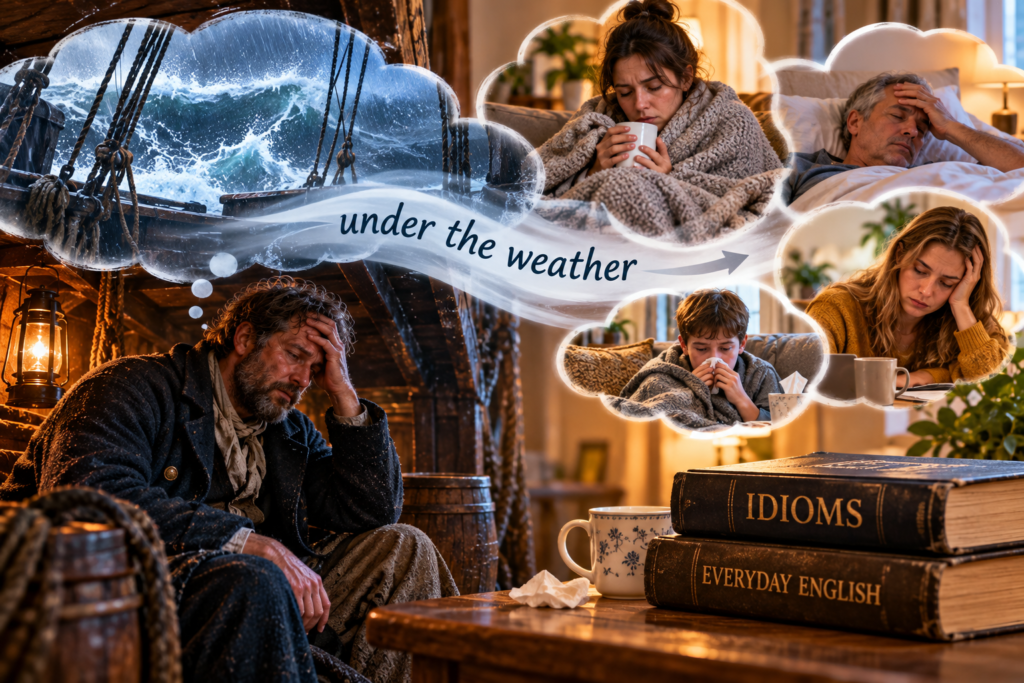
One widely repeated explanation connects the expression with sailors who became ill during stormy voyages.
Life aboard a sailing ship could be uncomfortable at the best of times.
When rough weather arrived, conditions became considerably worse.
Imagine being tossed about by enormous waves while trying to keep your breakfast where it belongs. Seasickness would hardly have been unusual.
According to the popular nautical explanation, sailors who became unwell would retreat below deck, where they could shelter from the wind and rain.
But shelter from the weather is not necessarily relief from seasickness. For someone already nauseated by a boat’s motion, a cabin with no clear view of the horizon may make the experience worse.
Being below deck supposedly meant being under the weather. Another version points to the ‘weather bow’: the windward side of a vessel’s bow, exposed to rough conditions. These are related maritime stories, but they are not identical explanations — and neither should be accepted simply because it sounds nautical.
It is an appealing story, but there is a problem: there is insufficient historical evidence to establish a clear chain from either shipboard practice or ‘under the weather bow’ to the modern idiom.
The Farmers’ Almanac discussion of ‘under the weather’ presents the below-deck story and the proposed phrase ‘under the weather bow’, citing a book of nautical expressions. It is a useful example of how widely a memorable explanation can circulate, but the source repeating a story is not necessarily the source that proves its origin.
Nevertheless, a plausible explanation is not necessarily a proven one.

How Sailors Associated Rough Seas with Illness
The connection between bad weather and feeling unwell is easy to understand.
Rough seas can cause motion sickness when signals about movement from the eyes and balance organs of the inner ear do not agree. Looking towards a relatively stable horizon can sometimes help the brain make sense of that movement; inside a moving cabin, the visual information may be less helpful.
Symptoms can include nausea, dizziness, headaches and general discomfort.
Cold, damp conditions and physical exhaustion could make life aboard ship even more unpleasant. Going below deck might protect someone from wind and spray, but it could also remove the steady visual reference of the horizon. That makes the traditional story less straightforward than it first appears.
Sailors therefore had good reason to associate deteriorating weather with deteriorating physical comfort. That does not mean that every proposed response to seasickness was effective.
However, the existence of this association does not prove that it gave rise to the phrase.
That is an important consideration when investigating the origins of everyday expressions.
The Historical Meaning and Evolution of the Expression
The expression is documented in nineteenth-century English, although its precise beginnings remain uncertain. Some accounts point to American usage during that period, but claims about the very first appearance need careful checking against dated original texts.
Historical descriptions give ‘under the weather’ a wider range than today’s mild illness: it has also been associated with feeling indisposed, intoxicated or even financially embarrassed in some older sources. The morning-after effects of drinking fit the general idea of feeling poorly, although that does not prove alcohol was the phrase’s original meaning.
Some explanations connect the phrase with ‘under the weather bow’, referring to the windward part of a ship’s bow. Others suggest the simple idea of an unwell sailor sheltering below deck. Both are plausible maritime associations, but neither is a conclusively documented origin story.
What we can say with greater confidence is that the expression became established as a way of describing someone feeling unwell. The historical meaning and evolution of the expression are easier to trace than the exact moment it was coined.
From Maritime Language to Everyday English
English has borrowed numerous expressions from seafaring life.
Terms such as taken aback, in the doldrums and on an even keel have nautical associations, although their histories differ.
It would therefore be unsurprising if ‘under the weather’ also developed through maritime usage. But similarities to known nautical idioms do not establish a shared origin.
Yet the important word here is if.
The expression may instead have developed through a broader association between unpleasant weather and feeling physically uncomfortable. Its history is a reminder to distinguish a source that reports a popular theory from evidence that actually establishes it.
Historical sources do not conclusively settle which explanation is correct.
Over time, its meaning became detached from actual weather conditions.
This gradual change is a common feature of language.
Consider why queue has four silent letters. Its unusual spelling reflects a fascinating linguistic history that is not immediately obvious from the modern word.
Likewise, why mouse becomes mice but house becomes houses reveals how older patterns of English survive in everyday speech.
How Under the Weather Became an Everyday Idiom for Feeling Unwell
Today, ‘under the weather’ is generally understood as a mild and informal way of saying that someone feels poorly. This is how under the weather became an everyday idiom for feeling unwell, regardless of the actual forecast. It can also serve as a tactful description when the reason for feeling unwell is something we would rather not explain.
We might say:
- “I’m feeling a bit under the weather today.”
- “She’s been under the weather all week.”
- “I think I’ll stay home because I’m feeling under the weather.”
Interestingly, the expression rarely suggests a serious medical emergency.
It is usually a gentle, deliberately imprecise description rather than a diagnosis.
Instead, it usually describes temporary illness, tiredness or general discomfort.
It also allows us to communicate that something is wrong without explaining every symptom — or, occasionally, the previous evening’s activities.
For another discussion of the phrase’s meaning and usage, Words Universe explores ‘under the weather’ with examples. Cambridge Dictionary defines it as feeling slightly ill, reflecting the phrase’s everyday conversational meaning rather than resolving its disputed history.
Like many idioms, the expression survives because people understand its intended meaning without interpreting the words literally.
Why Do We Still Use Expressions Like Under the Weather?
Idioms make language more colourful, memorable and conversational.
Saying that someone is under the weather feels gentler than announcing that they are ill. It can also spare us a detailed account of why they feel unwell.
It conveys discomfort without sounding unnecessarily dramatic.
This is particularly useful when we feel slightly unwell but cannot identify anything seriously wrong.
The expression also demonstrates how language can preserve older ideas long after their original circumstances have disappeared — although in this case we cannot be certain exactly what those circumstances were.
Something similar happens with familiar sayings such as look after the pennies, where a short phrase carries a much broader meaning.
Conclusion: Why do we say something is ‘under the weather’
So why do we say something is ‘under the weather’?
The most popular explanation connects the expression with sailors seeking shelter from rough seas or with the weather bow of a ship, but its exact origin remains unproven. The below-deck account deserves particular caution: sheltering from a storm and easing seasickness are not necessarily the same thing.
What matters today is the meaning it has acquired: a simple and familiar way to describe feeling less than our best.
And perhaps that is the most interesting thing about language. We can use an expression for generations without knowing precisely where it began. A memorable origin story is not quite the same thing as a documented history, especially when everyday experience raises sensible questions about it.
For more curious questions about the words and expressions we take for granted, explore Walkeropedia’s collection of Quirky Questions.