

Why do we drive on a parkway but park on a driveway? It’s one of those wonderfully peculiar questions that makes the English language seem determined to contradict itself.
After all, a driveway is where we park our cars, while a parkway is somewhere we drive. Surely someone got the names the wrong way round?
We Brits have a tendency to dismiss some of these linguistic oddities as Americanisms, often with a slightly disparaging shake of the head. But perhaps we’re being a little unfair.
After all, Americans speak English because English-speaking settlers, including those from England, Scotland and Ireland, carried the language across the Atlantic centuries ago. What happened afterwards was a natural consequence of different societies developing their own ways of speaking.
The explanation isn’t quite as ridiculous as it first appears. Both words made perfect sense when they first came into use. The apparent contradiction developed because roads, vehicles and the way we use them have changed over time.
To understand what happened, we need to travel back to a world of horse-drawn carriages, grand estates and landscaped roads.
The Historical Origins of the Terms Parkway and Driveway
The confusion begins with a simple misunderstanding: the words park and drive haven’t always meant quite what we assume they mean today.
A driveway originally referred to a route intended for driving, often involving horses and carriages rather than motor vehicles.
Meanwhile, a parkway wasn’t named because people were supposed to park their vehicles on it. The word referred to a road associated with parkland or landscaped surroundings.
Both names described the original purpose or setting of the route rather than what modern motorists do there.
The historical distinction is explained particularly well by Merriam-Webster’s examination of parkways and driveways, which traces both expressions back to the nineteenth century.
And that’s where the story becomes interesting.
How Driveways Evolved from Private Carriage Routes
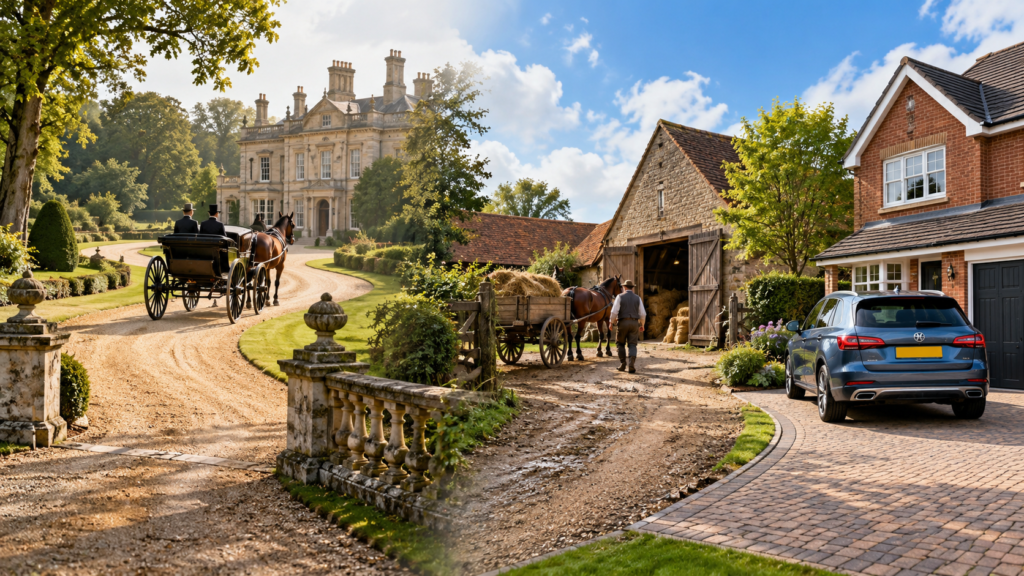
Imagine visiting a grand country house during the nineteenth century.
Rather than pulling into a short strip of tarmac outside the front door, visitors might travel along a sweeping private road through the estate.
This was a driveway: a route along which a carriage could be driven towards the house.
Of course, not every early driveway belonged to a grand estate. Some were practical access routes to barns and other buildings where horse-drawn wagons delivered or collected goods.
The important word was drive, not park.
As motor vehicles became increasingly common, private driveways began appearing outside ordinary homes. These were considerably shorter than the impressive carriage approaches of wealthy landowners.
Eventually, the driveway became somewhere to leave the family car when it wasn’t being used.
The name remained, even though its everyday function had changed.
Why We Now Park on Driveways
Modern residential driveways often serve two purposes. They provide access from the public road to a property and offer somewhere to park a vehicle.
For many households, parking has become their most obvious function.
But the historical name survives because language doesn’t automatically update itself whenever technology or behaviour changes.
We still call it a driveway because that’s what generations before us called it.
It’s a little like the way old expressions survive long after their original meaning has become less obvious. Consider why we say look after the pennies, an expression whose underlying wisdom has endured despite changes in money and everyday life.
Why Parkways Were Originally Designed as Scenic Roads
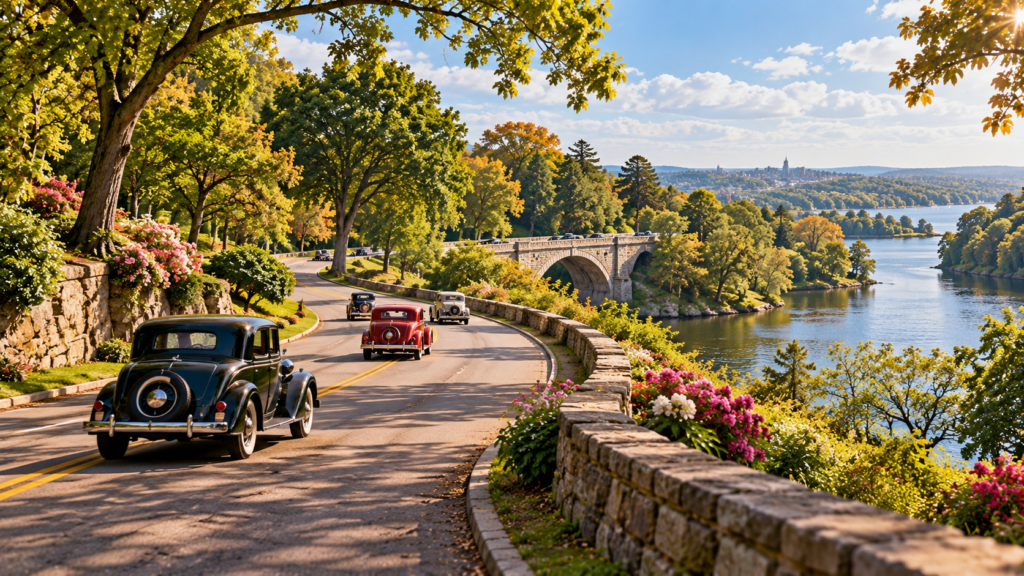
The word parkway has a rather different history, particularly in the United States.
During the nineteenth century, landscape designers began developing roads intended to provide pleasant journeys through parks and attractive green spaces.
These weren’t simply routes for getting from one place to another. Their surroundings were part of the experience.
A parkway might feature sweeping curves, tree-lined verges and carefully planned views.
The emphasis was on enjoying the landscape while travelling through it.
From Pleasant Drives to Major Roads
As cities expanded and motor vehicles became dominant, the meaning of parkway gradually broadened.
Some parkways developed into major roads carrying substantial volumes of traffic. Others retained their scenic character and restrictions on certain types of vehicles.
In American English, the term became associated with several kinds of landscaped or specially designed roads.
Not every modern parkway resembles a peaceful drive through the countryside.
Nevertheless, the name preserves something of its original connection with parks and pleasant surroundings.
Interestingly, the word parking also has a history connected with landscaped spaces rather than simply leaving vehicles unattended. Mental Floss explores the changing meanings of parking and parkways, including how areas associated with planting and greenery eventually became places for vehicles.
How Changing Transport Habits Altered the Meaning of Road Names
The apparent contradiction between parkways and driveways illustrates something fascinating about language.
Words often outlive the circumstances that created them.
Consider how we still speak of dialling a telephone number, even though most telephones haven’t had rotary dials for decades.
Similarly, we talk about rolling down a car window when many modern vehicles use electric switches.
The actions have changed, but the expressions survive.
English is full of such historical peculiarities. For example, why does queue have four silent letters when the entire word sounds like a single letter?
Sometimes the explanation lies in the history of the word rather than the logic of its modern use.
Parkway and driveway followed a comparable path.
From Walking to Space Travel
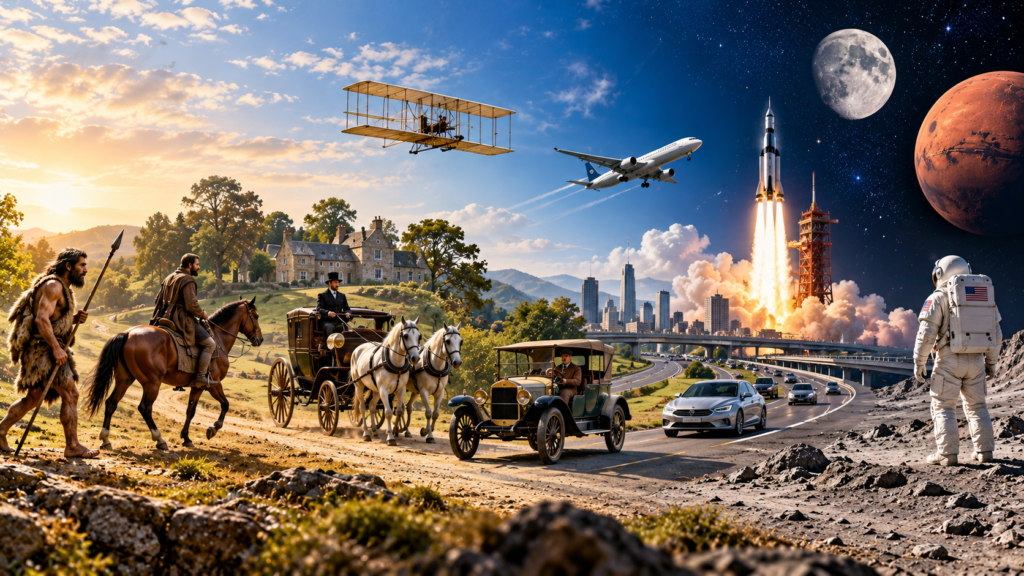
Of course, language isn’t the only thing that has evolved. Our methods of transport have undergone changes that previous generations could scarcely have imagined.
We progressed from travelling on foot to riding horseback, then to horse-drawn carriages and eventually motor cars — or automobiles, if we adopt the American terminology.
From there, we took to the skies.
And the pace of change has been remarkable. Within a relatively short period of human history, we progressed from relying on horses to sending people to the Moon.
Now we’re discussing permanent settlements on the Moon and even the possibility of colonising Mars.
Are there no bounds to humanity’s travel aspirations?
Against that extraordinary background, perhaps we shouldn’t be surprised that some of our road names have struggled to keep up.
A driveway retained its name as private carriage routes evolved into places for parking cars. A parkway retained its name as scenic routes developed into modern roads.
Neither word was incorrectly named. Their meanings simply developed alongside changing transport habits.
Is This Confusion Mainly an American English Problem?
There’s another twist to this linguistic puzzle.
The parkway and driveway contradiction is especially familiar in American English.
In Britain, we commonly use the word driveway, but parkway is much less common as an everyday description of a road.
British motorists are more likely to encounter motorways, dual carriageways and bypasses.
That doesn’t mean British road names are entirely logical, of course.
A ring road doesn’t necessarily form a complete ring, and a high street doesn’t have to occupy particularly high ground.
Perhaps we Brits should be a little more forgiving of Americanisms. American English and British English share a common ancestry, but both have continued evolving in their own ways.
Indeed, the peculiarities of English extend far beyond road names. Consider why the plural of mouse is mice but the plural of house is houses.
Or, for another numerical oddity, why eleven isn’t called onety-one.
Both examples remind us that language isn’t constructed according to a single consistent set of rules. Its vocabulary and grammar carry the influence of centuries of change.
Even familiar expressions can preserve surprising historical connections, as we discover when asking why we say someone is under the weather.
Language is constantly changing, and that change is inevitable.
Perhaps the real problem isn’t American English at all.
Perhaps it’s simply English being English.
Conclusion: Why do we drive on a parkway but park on a driveway
So, why do we drive on a parkway but park on a driveway?
Because the names describe how these routes originated, not necessarily how we use them today.
Driveways were routes for driving towards properties, while parkways were roads associated with parks and landscaped surroundings.
As transport evolved, their uses changed while their names remained.
What looks like a contradiction is actually a small piece of linguistic history hiding in plain sight.
And with humanity already contemplating journeys to Mars, who knows what new words future generations might invent to describe their travels?
Thankfully, I have no intention of waltzing off to Mars. If and when that becomes a reality, I suspect I’ll have been gone for quite some time.
I’ll leave the interplanetary parking arrangements to someone else.
If you’ve enjoyed this little linguistic detour, there are plenty more everyday mysteries waiting to be explored in our Quirky Questions collection.
Final Thoughts
Why do we drive on a parkway but park on a driveway? The answer lies in the historical origins of the terms parkway and driveway and how their meanings have evolved.
Understanding how driveways evolved from private carriage routes and why parkways were originally designed as scenic roads reveals that these names once made perfect sense. Ultimately, how changing transport habits altered the meaning of road names demonstrates how language preserves its history, even when everyday usage has moved on.