
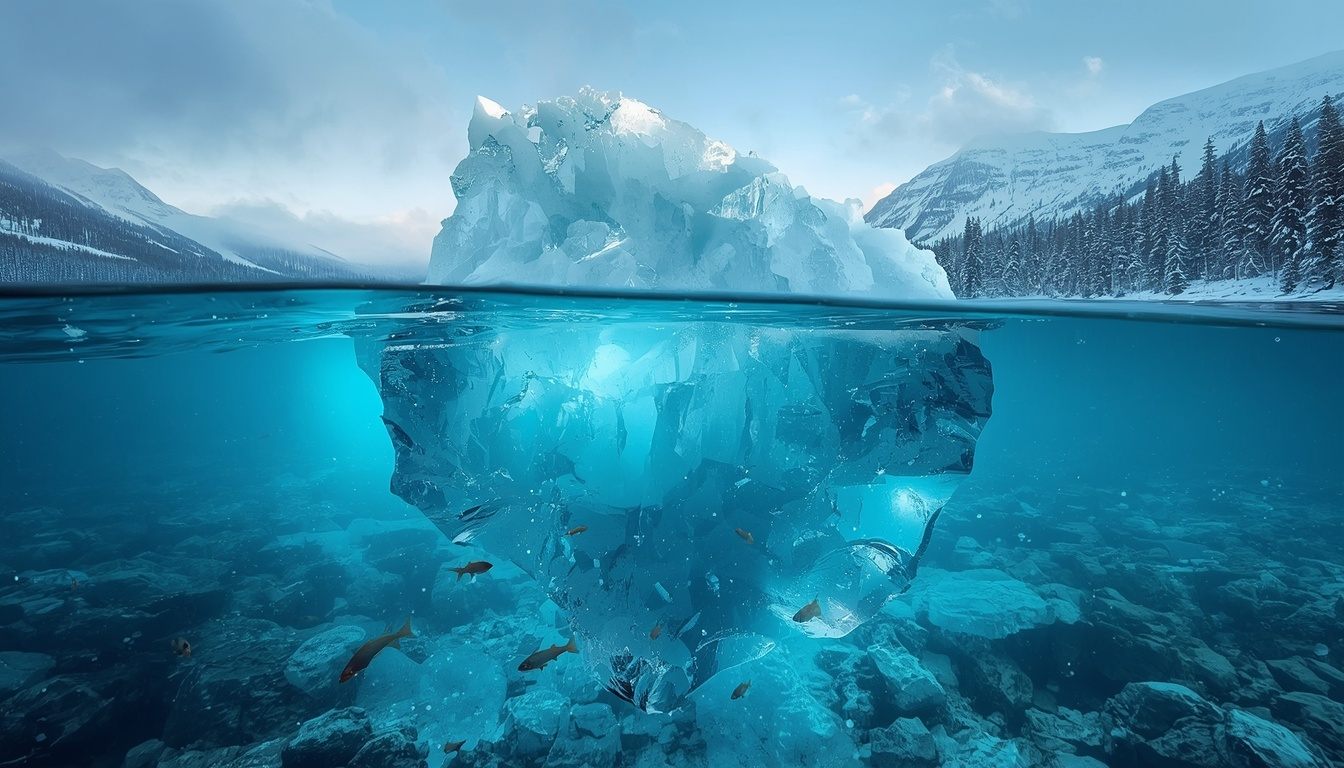
Drop an ice cube into a glass of water and it immediately rises to the surface. But why does ice float on water when most solid substances are denser than their liquid forms?
The answer lies in the unusual behaviour of water molecules. As water freezes, its molecules arrange themselves into a structure that occupies more space. The resulting ice is less dense than liquid water, allowing it to float.
This apparently simple phenomenon has remarkable consequences.
Without it, frozen lakes would behave very differently, and life in cold freshwater environments would face additional challenges.
Let’s investigate the science behind an ice cube that refuses to sink.
Why Does Ice Float on Water? The Density Explanation
The first secret is density.
Density describes how much mass is packed into a particular volume. A kilogram of feathers and a kilogram of iron have the same mass, but the feathers occupy considerably more space. Another everyday mystery where physical behaviour challenges our expectations is why toast seems to land butter-side down.
The same principle explains why ice behaves differently from liquid water.
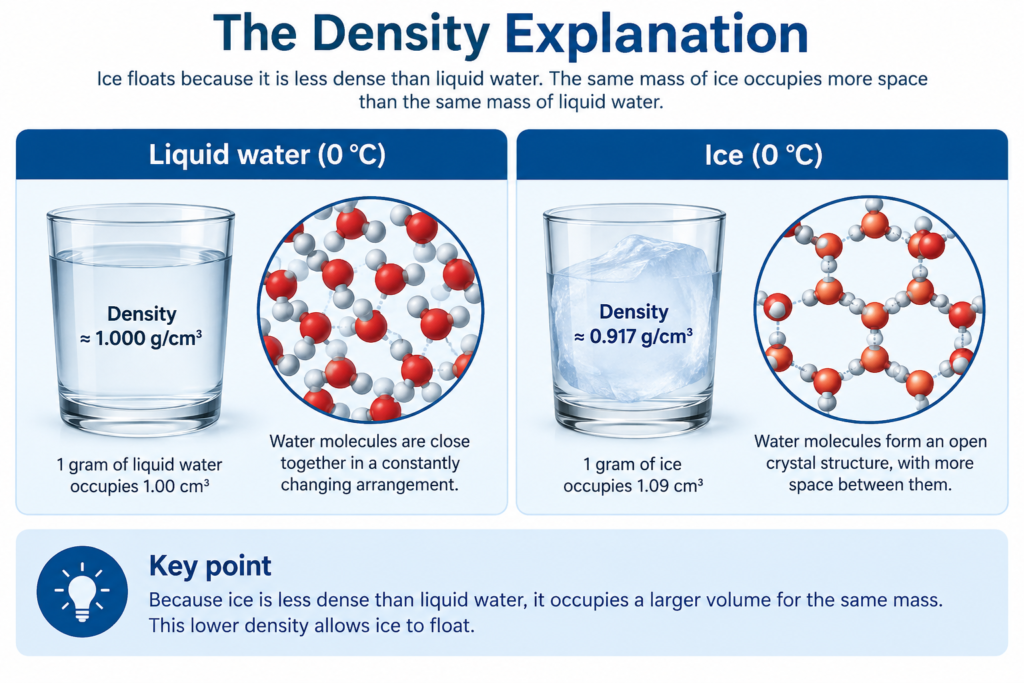
At approximately 0°C, ordinary ice has a density of about 0.917 grams per cubic centimetre, while liquid water at 0°C is about 0.9998 grams per cubic centimetre. Liquid water reaches its maximum density, close to 1.000 grams per cubic centimetre, at roughly 4°C.
That difference means a given mass of ice occupies more space than the same mass of liquid water.
Why Most Solids Behave Differently
In many substances, cooling reduces molecular movement and allows particles to pack more closely together.
Their solid forms therefore tend to be denser than their liquids.
Water is unusual because freezing produces a more spacious molecular arrangement instead. It is not entirely unique: a few other materials also have solid forms that are less dense than their liquids. The surprise is a little like why your recorded voice sounds so different: familiar experiences can have explanations we rarely consider.
This explains the lower density of ice compared with liquid water and provides the foundation for understanding why an ice cube stays at the surface.
But what makes water behave so differently?
Hydrogen Bonds: The Secret Inside an Ice Cube
A water molecule contains one oxygen atom and two hydrogen atoms. Its chemical formula is H₂O.
The oxygen side of the molecule has a slight negative electrical charge, while the hydrogen side has a slight positive charge. These differences allow neighbouring molecules to attract one another through interactions called hydrogen bonds.
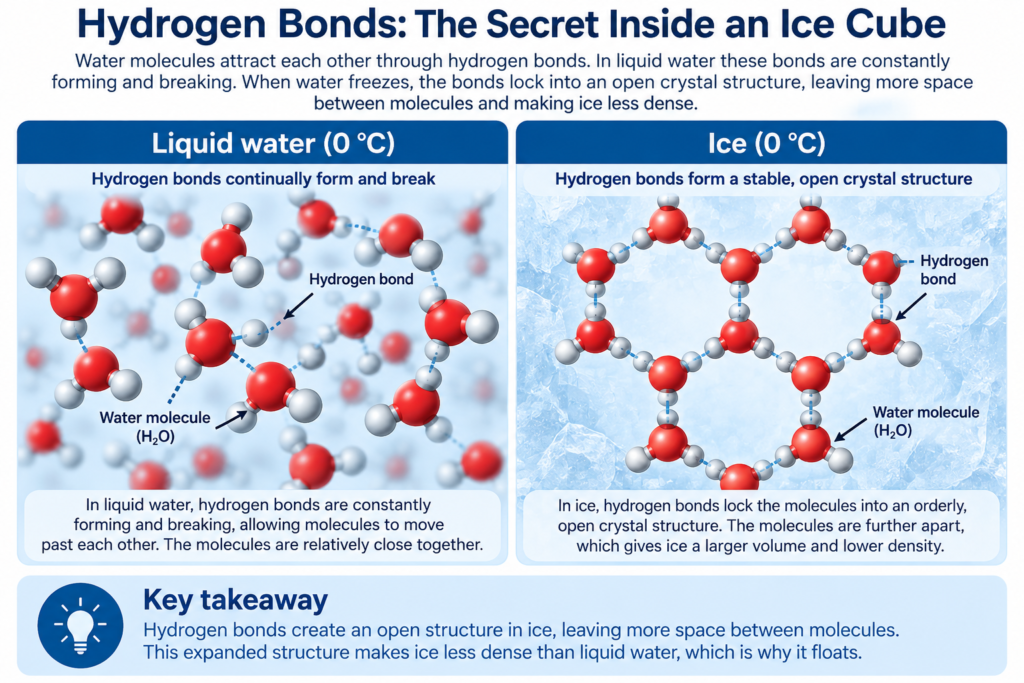
In liquid water, hydrogen bonds continually form and break as molecules move around. When water freezes under ordinary atmospheric pressure, the molecules settle into a more organised arrangement.
How Freezing Creates an Open Crystal Structure
The hydrogen bonding and the open crystal structure of ice explain why freezing increases water’s volume.
In ordinary ice, hydrogen bonds help arrange molecules into an orderly, open network with a roughly hexagonal crystal structure. The arrangement leaves more space between molecules than exists in liquid water. The bonds are not simply stronger when frozen; the difference is how the molecules are organised.
Imagine people moving around a crowded room. They can stand relatively close together. Now imagine everyone holding their arms out and forming an organised pattern. The same number of people would require more room. The difference is rather like the space between water molecules before and after freezing.
Water molecules behave somewhat similarly when they freeze. You can see the result in an ordinary ice-cube tray: fill each compartment carefully and the frozen cubes may develop rounded tops that rise above the original water level.
This expansion of water as it freezes is roughly 9% by volume under ordinary conditions. A tightly filled glass bottle can crack or shatter as its contents freeze, which is why rigid sealed glass containers should not be placed in the freezer without suitable headspace and freezer-safe design.
For a safer demonstration, leave ample space in a flexible freezer-safe container and compare the water and ice levels. Freezing has another curious twist explored in why hot water sometimes freezes faster than cold water.
Water also has another unusual property: it reaches its maximum density at approximately 4°C. As it cools below that temperature, it begins expanding again, even before freezing.
These behaviours demonstrate how a substance’s microscopic structure can produce consequences that are visible in everyday life. Freezing fruit offers another example: ice crystals can damage delicate plant cells, and thawed strawberries often become soft and release juice. Their texture also depends on freezing speed and other changes, so expansion is part of the explanation rather than the whole story.
For another example of invisible physical processes producing a familiar surprise, explore why your shower curtain clings to you.
Buoyancy: Why the Ice Cube Stays Afloat
Density explains why ice can float. Buoyancy explains the upward force that keeps it there.
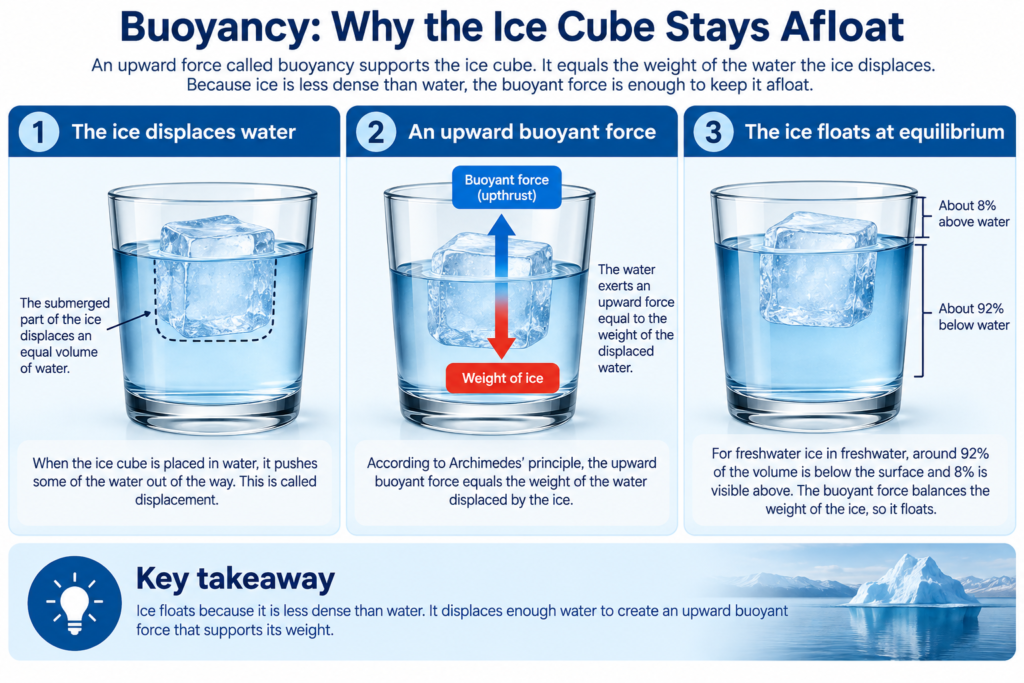
When an object enters water, it displaces some of the surrounding liquid.
The water exerts an upward force on the object, known as buoyancy. The force arises because water pressure increases with depth.
According to Archimedes’ principle, this buoyant force equals the weight of the displaced liquid.
An ice cube initially sinks slightly into the water. As it displaces more liquid, the upward buoyant force increases until it balances the cube’s weight. The cube then settles at the depth where these forces balance.
At that point, the ice floats in equilibrium.
Because ice is less dense than water, it does not need to become completely submerged to displace enough water to support its weight.
For ordinary freshwater ice floating in freshwater near 0°C, approximately 92% of its volume lies below the surface. Only about 8% remains visible above it. That follows from the ratio of ice density to water density: roughly 0.917 divided by 0.9998.
This is the science of buoyancy and the displacement of water by floating ice.
The same principle helps explain why enormous icebergs can float despite weighing millions of tonnes. Their submerged portions displace enough seawater to support their weight, although the exact proportion submerged depends on the densities of the ice and surrounding water. As a quick demonstration, place an ice cube in a clear glass and observe how little of it rises above the waterline. For a further explanation of the underlying science, see Britannica’s account of why ice floats on water.
For a broader introduction to physical principles, the LibreTexts introduction to the basics of physics provides useful background.
It’s another reminder that a simple observation can generate several connected questions. Even why socks seem to disappear in the washing machine can become an investigation into an everyday mystery.
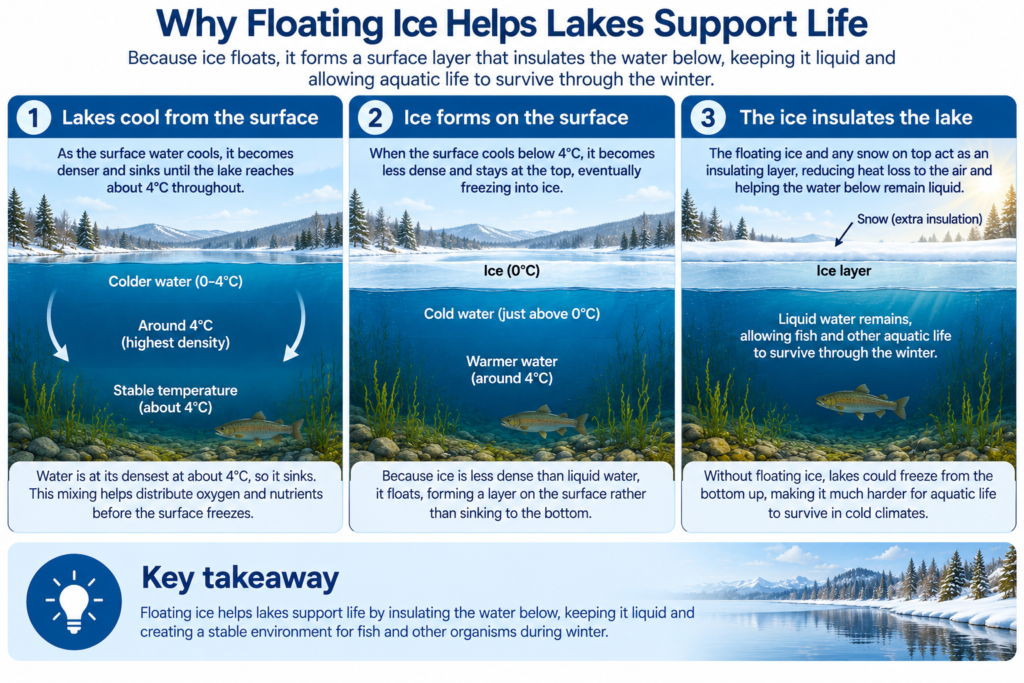
Why Floating Ice Helps Lakes Support Life
The final secret is perhaps the most remarkable: floating ice helps protect aquatic environments during winter.
As a lake cools, surface water becomes denser and sinks until much of the lake approaches 4°C. This mixing helps move heat and dissolved gases through the water. Further cooling makes the surface water less dense, so it tends to remain above the deeper water.
Eventually, the surface reaches freezing point and ice begins to form.
Because ice floats, it creates a layer across the top rather than sinking to the bottom.
That surface layer also slows heat loss from the water beneath it. Snow accumulating on the ice can provide additional insulation. Ice does not prevent all heat loss, but it makes it harder for the entire lake to freeze rapidly.
Consequently, a sufficiently deep lake may retain liquid water beneath its frozen surface, allowing fish and other aquatic organisms to survive through winter.
This protection is not absolute. Shallow ponds can freeze completely, and prolonged ice cover can sometimes reduce dissolved oxygen enough to endanger aquatic life.
Nevertheless, water’s unusual density behaviour is enormously important to freshwater ecosystems.
It also illustrates why scientific explanations must account for several interacting factors rather than relying on a single observation. Another example is why rain has such a distinctive smell, where several processes contribute to a familiar experience.
Conclusion: Why Does Ice Float on Water
The answer to the question ‘Why does ice float on water?’ is therefore a combination of molecular structure, density and buoyancy. Hydrogen bonding and the open crystal structure of ice make frozen water expand and become less dense than the liquid beneath it.
Buoyancy then keeps the ice afloat, with important consequences for lakes and aquatic life. It’s a perfect example of how an ordinary observation can reveal extraordinary science. Discover more everyday mysteries in Walkeropedia’s Quirky Questions pillar article.


