

Why does your recorded voice sound so different? You have probably experienced that uncomfortable moment when somebody plays a recording of your voice, and you wonder who on earth is speaking.
Surely that cannot be you!
The voice sounds unfamiliar, perhaps higher-pitched, thinner or even slightly nasal. Yet everyone else seems perfectly happy to accept that it sounds exactly like you. People accustomed to hearing themselves through microphones may find the difference less startling.
Are they all mistaken, or have you been listening to the wrong voice your entire life?
Fortunately, science has an explanation. And it involves a rather surprising feature of your own skull. It is another of those everyday puzzles explored in Walkeropedia’s Quirky Questions.
Why Your Voice Sounds Different Inside Your Head
Whenever somebody speaks to you, sound waves travel through the air into your ears. Your brain interprets these vibrations as speech. Those waves begin when air from the lungs sets the vocal folds vibrating, while the throat, tongue and mouth help shape the resulting sound.
But when you speak, something additional happens.
You hear your voice through the air, just as other people do. However, vibrations from your vocal folds also travel through the tissues and bones of your head, providing an internal route to the inner ear.
This means you experience your own voice through two different pathways simultaneously.
The result is a familiar internal voice that nobody else hears in quite the same way.
How Bone Conduction Changes the Way We Hear Our Own Voice
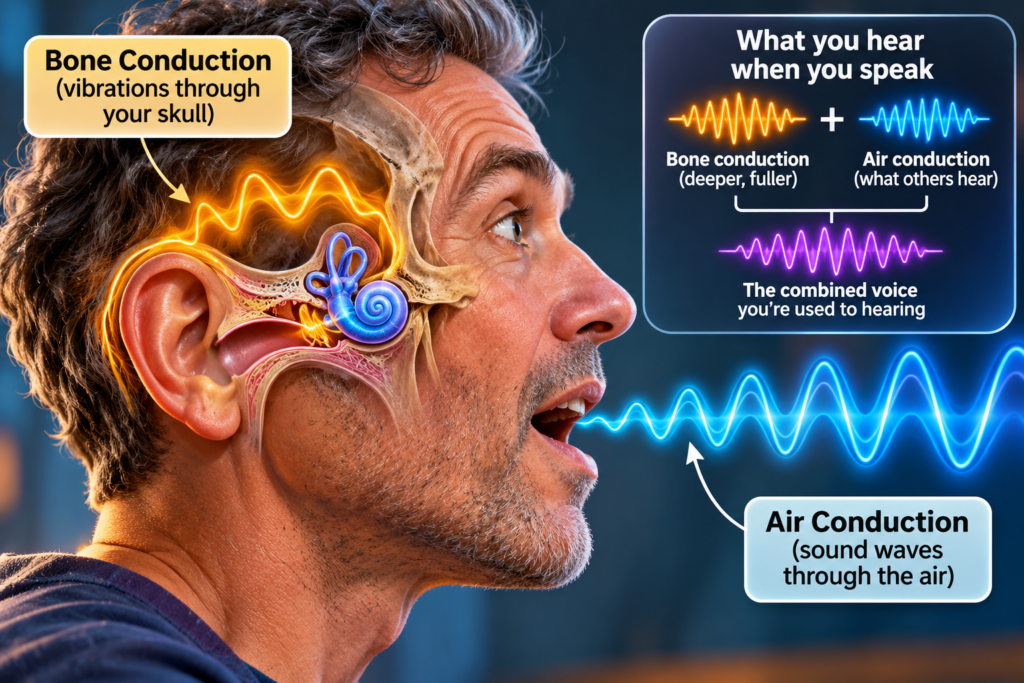
Bone conduction occurs when vibrations travel through the bones and surrounding tissues of your head towards your inner ear.
These vibrations can change the balance of frequencies you perceive, often making your voice sound fuller or deeper than it does to other people. It is largely a difference in the mixture of frequencies you hear, not evidence that a recording has changed the pitch you actually produced.
Interestingly, your skull is not simply acting as a loudspeaker. The precise way vibrations travel through your head, and how they interact with your hearing system, is more complicated. Just as the distinctive smell of rain has a physical explanation we seldom think about, the familiar sound of our own voice conceals some surprising science.
Nevertheless, bone conduction helps explain why the voice you hear while speaking differs from the one captured by a microphone or carried back to you through a PA system.
You are effectively receiving an additional version of the same sound.
And your brain has become extremely accustomed to it.
The Difference Between Air Conduction and Bone Conduction
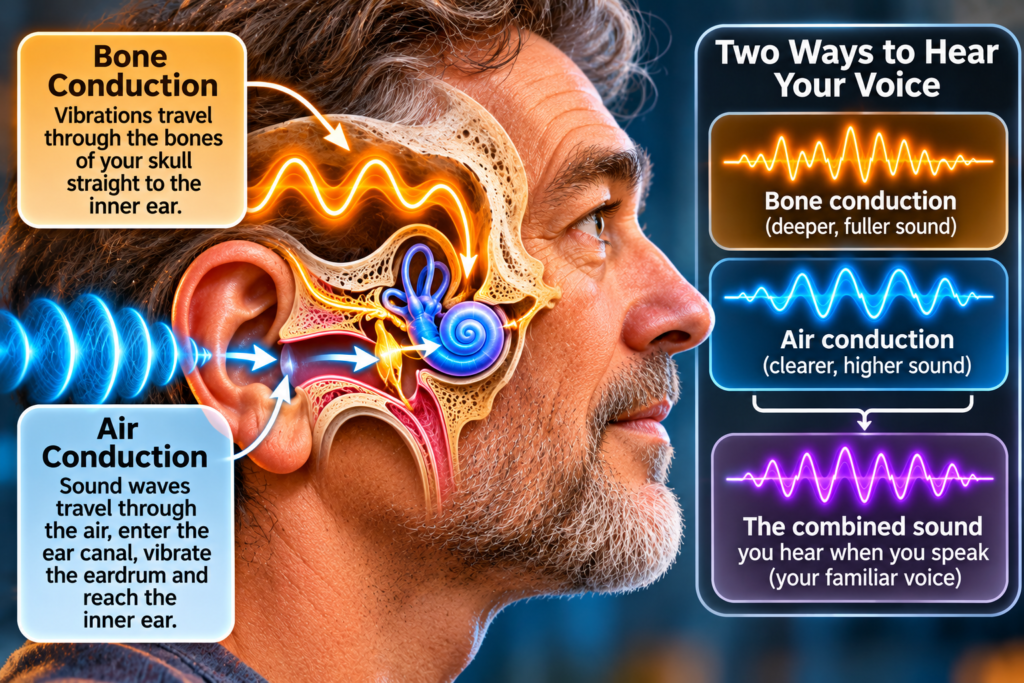
The distinction becomes clearer when we compare the two pathways.
Air conduction is how we normally hear sounds from the outside world.
Sound waves enter the ear canal, vibrate the eardrum and pass through the tiny bones of the middle ear before reaching the cochlea in the inner ear, where sensory cells help turn vibration into nerve signals.
Bone conduction takes another route.
Vibrations travelling through the head can stimulate the inner ear without following the usual pathway through the outer and middle ear.
Both pathways contribute when you hear yourself speaking.
A microphone, however, mainly captures the sound travelling through the surrounding air.
It does not capture the internal vibrations that contribute to your personal experience of speaking.
That is why a recording can seem to be missing something. Our everyday intuition can be misleading in other ways too, as the question of why toast seems to land butter-side down illustrates.
Why Recordings Sound Different from the Voice in Our Head
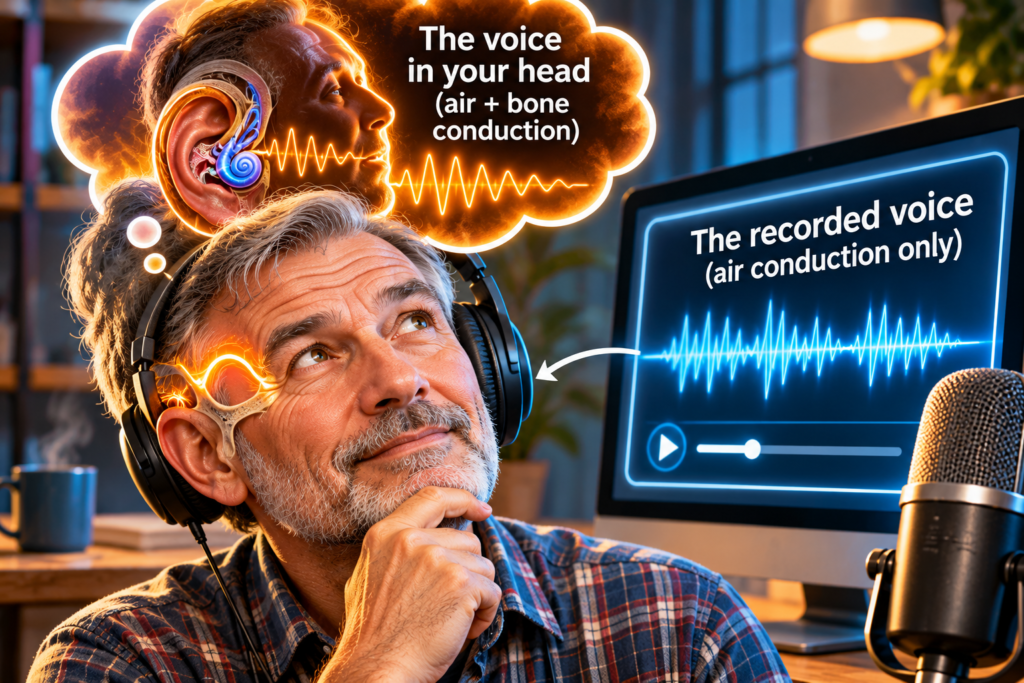
When you listen to a recording, you hear a version of your voice that is often much closer to what other people hear — although no microphone reproduces every listening situation perfectly. Hearing your voice through loudspeakers can offer a similar outside perspective.
But there is another factor.
Your brain has spent years becoming familiar with the sound of your voice while you speak. Someone who regularly speaks through a microphone may also become familiar with the amplified version.
Suddenly hearing it without the usual internal vibrations creates a mismatch between expectation and reality. It can feel like discovering that a familiar part of your identity has a different sound to everyone else.
The result can be surprisingly unsettling.
Why Your Own Voice Sounds Strange When Played Back

Psychologists sometimes describe the discomfort of hearing your recorded voice as voice confrontation. It is not simply a question of sound quality: our voices are closely tied to how we recognise ourselves. The BBC’s exploration of why we dislike hearing our own voices examines this unsettling mismatch.
Part of the experience involves unfamiliar sound. Another part may involve recognising that the voice you associate with yourself is not quite the voice other people recognise.
And, naturally, we can be rather critical of ourselves. Research discussed by an ear, nose and throat specialist in Popular Science found that patients tended to rate recordings of their own voices less favourably than clinicians did. Familiarity with amplified speech may reduce the surprise, although it does not eliminate the physical difference in how we hear ourselves.
You might notice an accent, an unusual pronunciation or a vocal habit that nobody else considers particularly remarkable. Hearing these details without the familiar internal sound can make them seem more conspicuous than they really are.
There is also a technical complication.
Microphones, recording equipment, speakers and headphones can alter the sound. Distance from the microphone, room echoes and background noise all make a difference. Hold a microphone almost against your mouth and the result may become boomy, distorted or difficult to understand, particularly if the sound system is not adjusted for it.
That is something sound engineers learn quickly: a clear voice depends on technique as well as equipment. Even a good microphone cannot compensate for every change in distance or angle, and a compressed telephone recording may be a particularly poor representation of your natural voice. Airflow can also create unexpected effects elsewhere, including a shower curtain that clings to you.
Can You Hear Your Voice the Way Other People Do?
Not perfectly, but you can get closer.
Listening to a good-quality recording through decent headphones or speakers can give you a better impression of your externally heard voice.
For a fairer comparison, try recording in a quiet room, keeping a consistent distance from the microphone and playing it back without exaggerated sound effects. A few inches can make a noticeable difference, although the best distance depends on the microphone and the sound system.
You might also notice that your recorded voice becomes less surprising after repeated listening. Presenters, singers, sound engineers and people who regularly use PA systems often become more comfortable with the externally heard sound.
Familiarity changes our expectations.
There is no need to retrain your vocal folds or attempt to sound like the person you hear inside your head. If you are making recordings or using a PA system, sensible microphone placement and a quieter environment are usually more useful than trying to force an unfamiliar speaking voice.
That person is already you.
You have simply been listening through a different combination of sound pathways. It is a reminder that everyday experiences can have hidden mechanical causes, rather like supermarket trolleys that insist on pulling to one side.
Conclusion: Why Does Your Recorded Voice Sound So Different?
So, why does your recorded voice sound so different?
Because you normally hear yourself through a combination of air conduction and internal vibrations, while a recording mainly captures sound travelling through the air.
Your brain also expects the familiar voice you have heard throughout your life, making the recorded version seem unusually strange. That sense of surprise can be amplified by self-consciousness, not just by the physics of sound. Repeated exposure to your voice through speakers can make the difference feel less dramatic.
The surprising part is that other people have been hearing something closer to that recorded voice all along.
Perhaps the real mystery is not why your recorded voice sounds different.
It is why everybody else has managed to recognise you so easily!