

Why do we say Look after the Pennies? It is one of those familiar British expressions that many of us have probably heard since childhood without giving much thought to where it came from.
Strictly speaking, “Look after the pennies” is only part of the proverb. The fuller version is commonly rendered as “Look after the pennies and the pounds will look after themselves.” An older recorded form is “Take care of the pence and the pounds will take care of themselves.” Both express the same idea, although their wording reflects different periods and habits of speech.
Whichever wording you encounter, the message is much the same: pay attention to the small amounts of money and the larger amounts have a better chance of taking care of themselves.
Like many traditional sayings, however, there is more behind those few words than first appears.
What Does Look After the Pennies Mean?
At its simplest, “look after the pennies” means do not dismiss small amounts of money as unimportant.
One penny is hardly going to transform your finances today. Yet the purchasing power of a penny has changed enormously. There was a time when even a very small coin could buy a modest treat; now a single penny buys almost nothing on its own. But spend a small amount unnecessarily every day and those individual transactions begin to accumulate.
The same principle works in reverse. Saving a small amount regularly may feel insignificant at first, but repetition can gradually turn those small savings into a much larger sum.
This is how small savings accumulate into larger amounts.
Imagine putting aside £5 every week. After one week, you have £5. Hardly life-changing. Keep doing it for a year, however, and you have saved £260.
The proverb is therefore less about the value of an individual penny and more about accumulation. Its message has outlived the purchasing power of the coins that originally made it memorable.
That idea appears in other familiar expressions too. We often use ordinary objects and experiences to explain something larger. Even saying that somebody is under the weather makes little literal sense until we look at the story behind the expression.
Small Financial Habits Matter Over Time
The proverb also describes something we now tend to call a habit.
A single decision to save 50p probably makes very little difference.
Repeating that decision hundreds of times does.
Likewise, an unnecessary £2 purchase may be irrelevant on its own. Make the same purchase every working day and it could amount to hundreds of pounds over a year.
This does not mean we should become obsessed with every penny while ignoring major expenses. Saving 20p on a loaf of bread will not compensate for routinely overspending hundreds of pounds elsewhere.
That would risk becoming ‘penny-wise and pound-foolish’: attentive to tiny costs but careless about important financial decisions.
The useful part of the proverb is simpler: small financial habits matter over time because they are repeated.
That principle has survived remarkably well, even though the way we handle money has changed beyond recognition.

Where Did the Penny Proverb Come From?
Pinning down the exact origin of an old proverb can be difficult because sayings often circulate in speech long before somebody writes them down. In this case, however, eighteenth-century letters provide unusually helpful evidence.
One early documented appearance comes from a letter written on 6 November 1747 by Philip Dormer Stanhope, 4th Earl of Chesterfield, to his son. Chesterfield recalled a man who habitually advised taking care of the pence so that the pounds would take care of themselves. He then applied the same principle to minutes and hours: small portions of time also add up.
Chesterfield returned to the expression in a letter dated 5 February 1750, attributing it to William Lowndes, a former Secretary of the Treasury.
Another 1750 letter, by Bishop Edward Synge to his daughter, associated the saying with Judge Daly. Those differing attributions are a useful warning: an early written example does not prove who first invented a proverb.
The older ‘take care of the pence’ form and the now-familiar ‘look after the pennies’ version illustrate how sayings are repeated, shortened and altered over time. The phrase was already in circulation before the Victorian era, even if later generations made it feel like a quintessentially Victorian lesson. The full proverb and its variant wording can also be compared in a dictionary entry.
That is why the origins of the penny proverb and its meaning are best considered together. Its documented history reaches back at least to the mid-eighteenth century, while its appeal rests on a much broader observation: repeated small decisions can have substantial consequences.
Thrift Became a Familiar Virtue
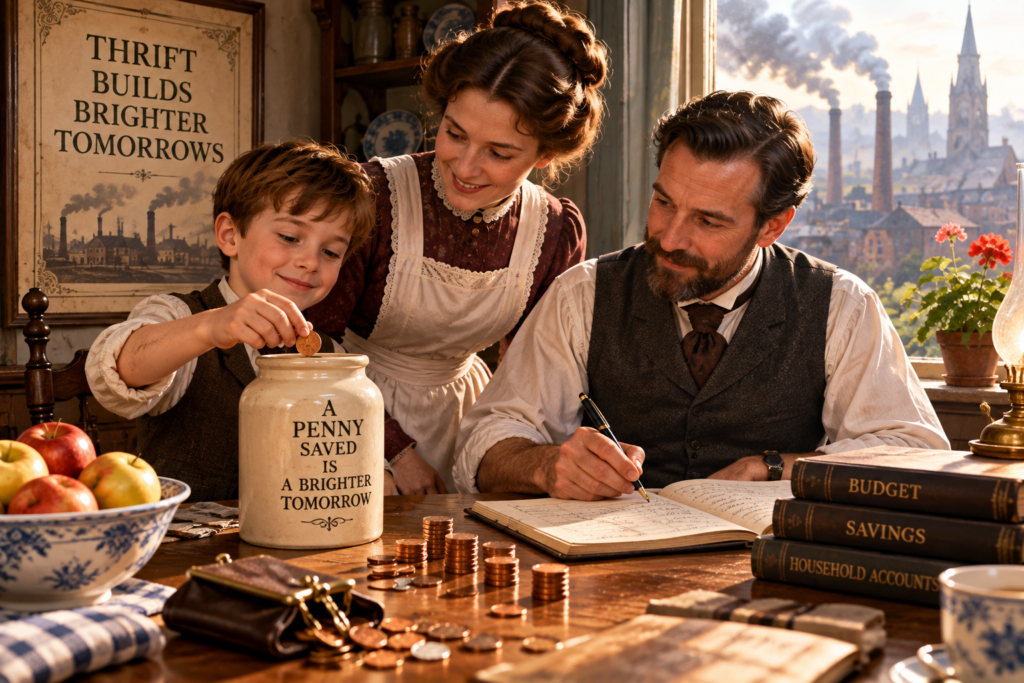
Although forms of the saying pre-date Queen Victoria’s reign, it fits comfortably with the thrift and careful spending often associated with Victorian Britain. The Victorians inherited the proverb rather than inventing it.
Saving, avoiding waste and living within one’s means were widely promoted as respectable virtues. Industrialisation, growing towns and changing working lives helped make household budgeting an enduring concern. Yet thrift was not equally easy for everyone: for households with little income, there might be very few pennies left to save.
Victorian attitudes towards thrift and careful spending therefore helped keep an older proverb culturally familiar. Its message could be encouraging, but it should not be mistaken for proof that every financial difficulty can be solved by cutting small expenses.
The currency itself made the comparison particularly effective. For people who handled coins every day, the difference between a penny and a pound was not merely abstract arithmetic.
Before decimalisation in 1971, Britain used pounds, shillings and pence.
Changing to decimal currency was more than a new calculation on paper: prices, pocket money, bus fares and everyday purchases had to be understood in a different system.
There were 12 pennies in a shilling and 20 shillings in a pound, meaning 240 old pennies made one pound.
The pound really was built from a great many pennies. Small denominations mattered in daily life, including coins that have since vanished from circulation. The farthing, worth a quarter of an old penny, ceased to be legal tender at the end of 1960; the old halfpenny disappeared with decimalisation, although a new decimal halfpenny was introduced and remained in use until 1984.
That old monetary system has disappeared, but the expression remains. People who remember the changeover may also remember how much more an individual small coin could once buy.
Much like wondering why songs get stuck in our heads, the interesting question is often not simply what happens, but why something persists.
Why small financial habits matter over time becomes clear when modest savings or expenses gradually accumulate into surprisingly large amounts. The proverb is about the effect of repetition, not a guarantee of prosperity.
Why Does Look After the Pennies Still Make Sense?
We live in a very different financial world from the people who first used the proverb.
Even the change to decimal currency in 1971 now belongs to living memory rather than everyday experience for younger generations.
Many purchases no longer involve coins at all. We tap a card, use a phone or click a button and the money quietly leaves our bank account. A penny itself buys very little. The proverb’s continued appeal shows how a phrase can retain its meaning even when the money and shopping habits behind it have changed.
Yet the underlying principle has not disappeared.
Small digital purchases can actually be remarkably easy to overlook. A modest subscription, an inexpensive app or a few pounds spent regularly may barely register at the time.
Together, those amounts can become substantial.
The same principle also reaches beyond money.
Read ten pages of a book every day and you can finish a substantial book within a few weeks. Practise a new skill for fifteen minutes each day and those short sessions eventually become hours of experience.
Large projects work in much the same way. Writing 200 words does not produce a book, but regularly writing 200 words can eventually produce thousands.
Small actions do not guarantee spectacular results, of course. The proverb is not promising that saving pennies will automatically make somebody wealthy. Income, essential costs and major decisions also matter; the sensible lesson is to notice small expenses without losing sight of the larger picture.
It simply reminds us that large outcomes are often composed of much smaller parts.
Perhaps that is why old sayings stay with us. A familiar expression can become surprisingly interesting once we stop to examine its history, the assumptions behind it and the way its wording has changed.
For those who remember pre-decimal coins, it can also summon memories of childhood purchases and a very different sense of what a penny was worth. That feeling of familiarity is different from the curious experience explored in why we get déjà vu, but both invite us to question what we take for granted.
Conclusion: Why do we say Look after the Pennies?
So, why do we say Look after the Pennies? Because the shortened saying preserves a practical lesson from the fuller proverb: small amounts and repeated choices can become significant when they accumulate. Written evidence places versions of the saying in the eighteenth century, before the Victorian enthusiasm for thrift with which it is often associated.
The coins may have changed, some denominations have vanished, and our spending habits certainly have. But the principle remains recognisable. It is another example of an everyday phrase hiding a surprisingly interesting explanation, and you can discover plenty more in Walkeropedia’s Quirky Questions.