

Why is eleven not called onety-one? After all, we have twenty-one, thirty-one and forty-one. Surely the number after ten should follow the same pattern?
Instead, English gives us eleven.
Then, just to make matters worse, twelve arrives instead of onety-two.
Oneteen and twoteen might seem more consistent with thirteen and fourteen, although those would follow a different pattern from twenty-one.
By the time we reach thirteen, the language seems to have remembered that numbers ought to follow some sort of system.
It might appear that someone made a terrible mistake when naming the numbers. But the explanation lies in the history of English, long before anyone thought of making counting straightforward for schoolchildren.
The Old English Origins of the Word Eleven
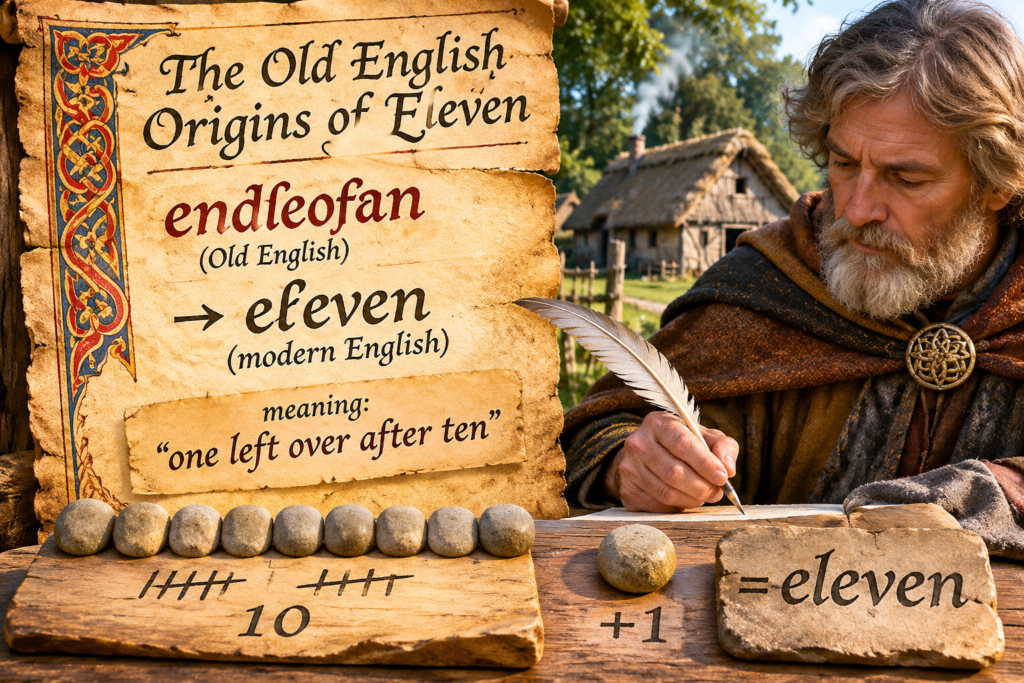
The Old English origins of the word eleven take us back more than a thousand years.
In Old English, eleven was written endleofan, while twelve was twelf.
These words developed from much older Germanic number names.
Linguists reconstruct forms resembling ainlif for eleven and twalif for twelve, with elements associated with one or two being left over after ten.
In other words, eleven originally expressed something rather like one left over after ten.
Twelve followed the same principle, meaning approximately two left over after ten.
The exact historical development is complicated, and the precise interpretation of the ancient ending is reconstructed rather than recorded directly. But the traditional explanation is remarkably simple.
People already had ten fingers, making ten a natural reference point for counting. That doesn’t prove exactly how the names arose, but it helps explain why quantities beyond ten could be described as leftovers.
Rather than inventing something like onety-one, speakers of early Germanic languages used distinctive names for the next two numbers.
English later inherited those names.
Those words survived as English changed around them.
How Number Names Evolved in the English Language
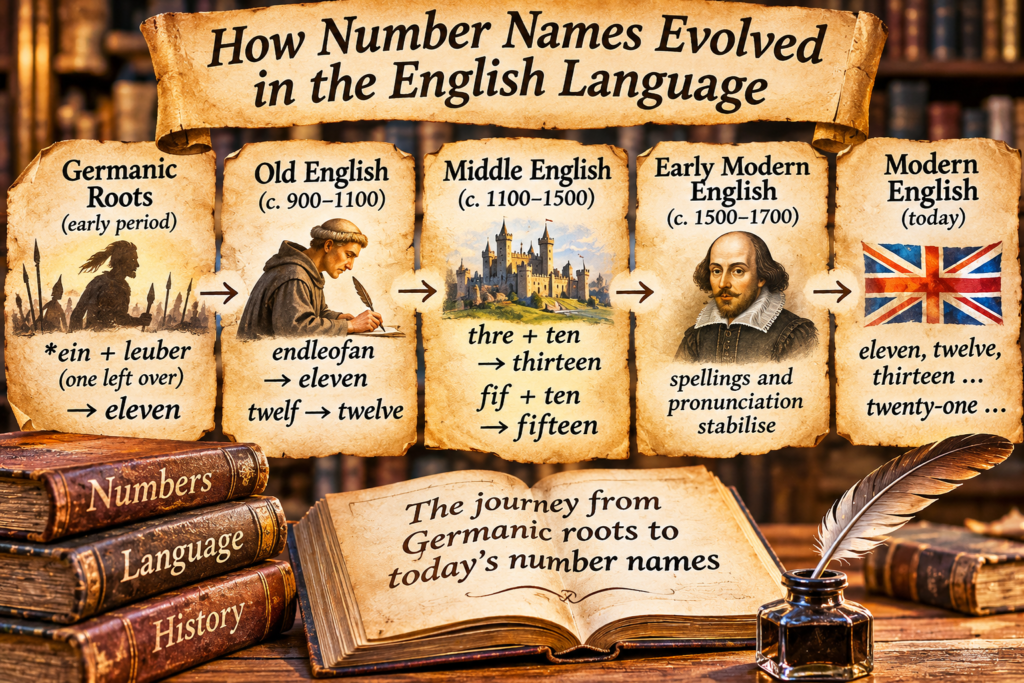
Understanding how number names evolved in the English language reveals why counting isn’t always as logical as mathematics.
Numbers themselves follow consistent mathematical rules.
Their names, however, are products of human history.
English developed from the languages spoken by Germanic peoples who settled in Britain during the early medieval period.
Over centuries, pronunciation changed, spellings evolved and different linguistic influences shaped the vocabulary. English remained a Germanic language at its core, while Old Norse, French and Latin contributed words and other influences. The history of everyday expressions offers another example, as explored in why we say someone is under the weather.
Yet frequently used words often retain ancient features. Linguists sometimes describe this as the tendency for common expressions to resist being replaced by newer regular patterns.
We use numbers constantly, so familiar number names can survive even when their original structure becomes difficult to recognise.
That helps explain why eleven and twelve remain part of modern English.
They weren’t deliberately designed as exceptions to a modern numbering system.
They were already established long before the modern forms of twenty-one and thirty-one emerged. Even those apparently regular names conceal older changes: twenty is not twoty, thirty is not threety and fifty is not fivety. Similar surprises appear in why the plural of mouse is mice but the plural of house is houses.
Why Eleven and Twelve Differ from Other Teen Numbers
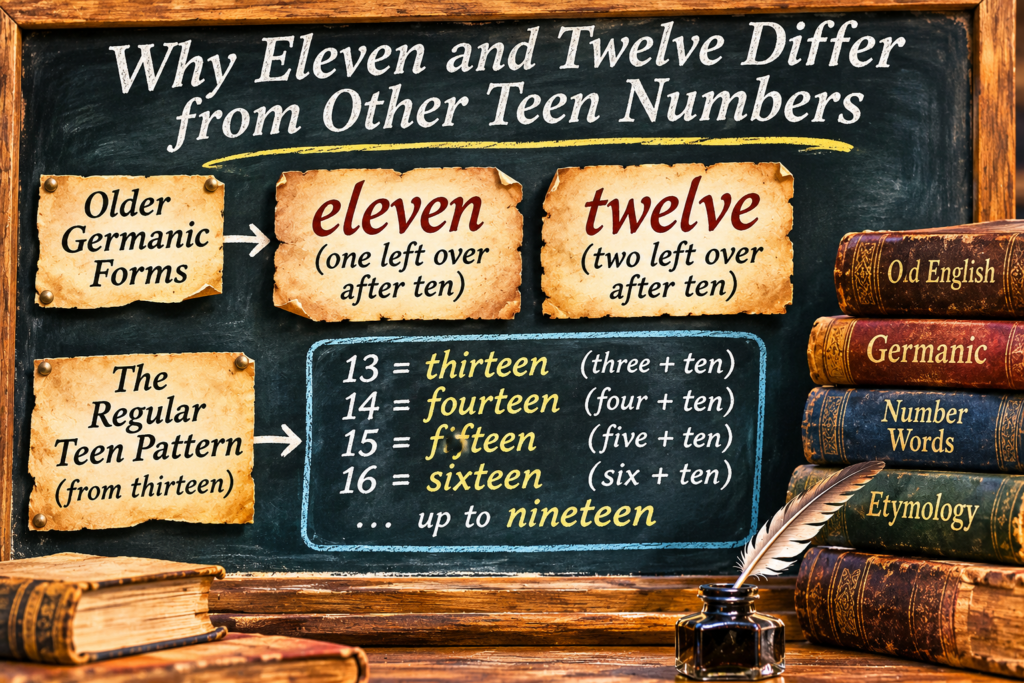
Why eleven and twelve differ from other teen numbers becomes clearer when we examine thirteen onwards. Mathematically, eleven and twelve belong in the same group of numbers from ten to nineteen; it is their names that refuse to join the pattern.
Thirteen developed from an Old English expression meaning three and ten.
Fourteen followed a similar pattern, as did fifteen and the remaining teen numbers.
The modern suffix -teen is historically related to the word ten.
So thirteen effectively preserves the idea of three added to ten. Notice that the order differs from twenty-three: thirteen places the smaller number first, while twenty-three puts the tens first.
Eleven and twelve, however, belong to an older naming pattern.
Their unusual forms were retained rather than replaced with something more consistent. One plausible explanation is that eleven and twelve were useful and frequent enough to keep their inherited names. Twelve also became particularly handy for counting and measuring because it divides evenly by two, three, four and six. Neither observation proves why the words survived.
Even the teen numbers aren’t perfectly regular.
Thirteen isn’t pronounced three-teen, and fifteen isn’t five-teen. Perhaps they started out that way.
English has a habit of changing the pronunciation of words while preserving their underlying historical relationships.
The result is a number system that works perfectly well mathematically but looks rather untidy linguistically. That gap between tidy expectations and real usage also appears in why we drive on a parkway but park on a driveway.
The Influence of Germanic Languages on English Number Words
The influence of Germanic languages on English number words becomes obvious when we compare English with its linguistic relatives.
German uses elf for eleven and zwölf for twelve.
Dutch uses elf and twaalf.
These similarities aren’t coincidences.
English, German and Dutch share a Germanic ancestry, and their number words preserve traces of that common history. That doesn’t make Dutch a version of German: they are separate languages with related histories.
Other languages have developed different naming patterns.
French uses onze and douze, inherited from Latin forms, while Spanish uses once and doce. The resemblance between some number words across languages reflects their different family histories, not a universal rule for naming numbers.
Neither language calls eleven the equivalent of onety-one.
Some languages, however, use more transparent decimal expressions.
Mandarin Chinese uses shí yī for eleven, literally ten-one, and shí èr for twelve, meaning ten-two. Its regular pattern offers a useful comparison with English, although languages are not obliged to name numbers in the same order.
This demonstrates that number naming conventions are cultural and historical rather than mathematical necessities. Similar-looking words can hint at shared ancestry, but treating one modern language as merely a variation of another would miss the history.
Would Onety-One Actually Make More Sense?
From a purely logical perspective, onety-one sounds rather reasonable.
If twenty-one means twenty plus one, why shouldn’t onety-one mean ten plus one? There is a subtle snag: English calls the first group of ten simply ten, not onety. A completely regular system might therefore say ten-one, while oneteen would imitate thirteen and fourteen. Borrowing bits from other languages might produce entertaining inventions, but they would be new coinages rather than authentic historical forms. For another exploration of this puzzle, see Silly Linguistics on why English doesn’t use onety-one.
The difficulty is that languages don’t develop according to a single carefully designed rulebook.
They evolve through generations of everyday use.
People inherit words, adapt pronunciations and occasionally preserve expressions that no longer fit the wider pattern. The result can be bewildering to learners, but those irregularities also reveal the encounters and changes that shaped the language. Even familiar sayings carry their own histories, as with why we say look after the pennies.
There’s also a practical problem.
Changing eleven to onety-one would require everyone to agree to abandon a word they’ve known since childhood.
And if we changed eleven, we’d presumably have to change twelve too.
Then perhaps thirteen would become onety-three—or ten-three, depending on which system we chose. There isn’t just one possible way to make the names more regular.
Before long, we’d be redesigning the entire numbering vocabulary simply because two ancient words refused to behave themselves. Perhaps it is easier to learn the exceptions than to persuade the English-speaking world to start counting again.
Conclusion: Why Is Eleven Not Called Onety-One?
So why is eleven not called onety-one?
Because English inherited the word from its Germanic ancestors, whose number names for eleven and twelve are traditionally explained as quantities left over after ten. Their precise early formation and the reasons those names endured are matters of linguistic reconstruction, not a documented decision to reject onety-one.
Those words survived centuries of linguistic change.
The apparent inconsistency isn’t a mathematical error. It’s a reminder that language carries its history within it.
Eleven may not follow the pattern we’d expect today, but it has been doing its job perfectly well for more than a thousand years.
And perhaps that’s the real curiosity.
Mathematics is logical.
The English language, on the other hand, has never felt particularly obliged to be. Its quirks can make learning it difficult, but they also preserve clues to the people and languages that shaped it. For more puzzles like this, visit Walkeropedia’s Quirky Questions collection.


