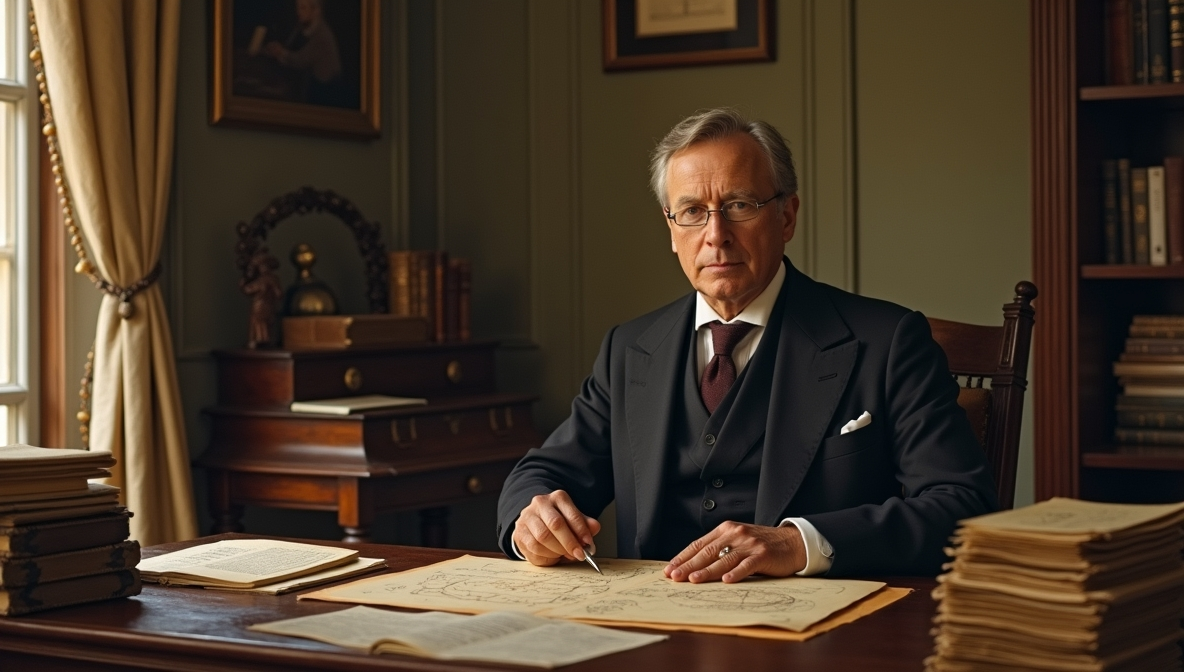
Augustus de Morgan was one of the nineteenth century’s most influential mathematicians and logicians. Born in Madurai, India, in 1806 to a British family, he spent most of his life in Britain and became an important figure in the development of mathematical reasoning.
Today, his name is most familiar through De Morgan’s laws, rules describing relationships between logical operations. Yet his contribution was much broader. As a pioneer of mathematical logic, he helped transform logic from a largely philosophical discipline into something that could be expressed and analysed mathematically.
Those ideas would eventually become important far beyond Victorian mathematics. Modern computer programming, digital circuits, databases and search systems all depend upon forms of logical reasoning that developed from foundations established by mathematicians such as De Morgan and his contemporaries.

Augustus de Morgan and the Rise of Mathematical Logic
De Morgan studied at Trinity College, Cambridge, where he demonstrated considerable mathematical ability. However, he refused to take the religious tests then required for certain university privileges and consequently did not proceed to a Master of Arts degree.
In 1828, at only 22, he became the first professor of mathematics at the newly established University College London.
His career was distinguished not simply by mathematical calculation but by a fascination with reasoning itself. What does it mean for an argument to be logically valid? Can relationships between statements be represented systematically? Could logic be treated with something resembling the precision of algebra?
These questions placed De Morgan at the centre of a transformation explored more broadly in 19th century science, when mathematics was becoming increasingly important as a language for describing both physical phenomena and abstract relationships.
1. Turning Logic into Mathematics
Traditional logic was heavily influenced by the ideas of Aristotle and concentrated largely on syllogisms: structured arguments involving categories and propositions.
De Morgan sought more general methods.
His 1847 book Formal Logic explored the mathematical treatment of reasoning and relationships between terms. Published in the same year as George Boole’s The Mathematical Analysis of Logic, it belonged to an intellectual movement that eventually produced modern symbolic logic.
As a Victorian logician, De Morgan therefore occupied an important transitional position. Logic was beginning to move beyond verbal philosophical argument towards systems capable of symbolic representation.
This development became fundamental to the relationship between logic and algorithms that would later underpin computer science.
De Morgan’s Laws and the Foundations of Formal Logic
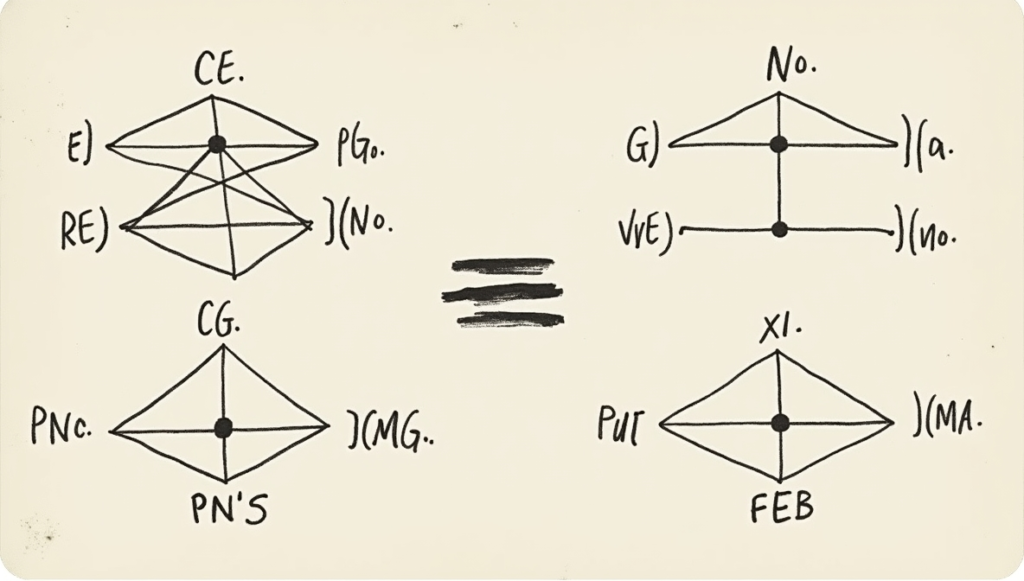
De Morgan is most widely remembered for two principles now called De Morgan’s laws.
In simple terms, they explain what happens when a logical statement containing “and” or “or” is negated.
Suppose we say:
“It is not true that Alice has both a book and a pencil.”
Logically, this means that Alice does not have the book, or she does not have the pencil, or she has neither.
Similarly:
“It is not true that Alice has either a book or a pencil.”
This means she has neither the book nor the pencil.
2. Why De Morgan’s Laws Matter
These relationships might initially appear obvious, but expressing them formally makes them extremely powerful.
De Morgan’s laws can be represented symbolically and applied consistently regardless of the particular subject being discussed. They also work within set theory, where they describe relationships involving unions, intersections and complements.
This ability to separate logical structure from the subject matter of an argument was an important step towards the foundations of formal logic.
3. From Victorian Logic to Digital Computers
The significance of De Morgan’s ideas became even greater with the emergence of electronic computing.
Digital computers ultimately operate through combinations of binary states commonly represented as 1 and 0, or true and false. Logic gates perform operations such as AND, OR and NOT, making De Morgan’s laws directly relevant to the design and simplification of digital circuits.
The same principles appear in programming conditions and database searches.
For example, a search excluding items that satisfy two conditions can sometimes be reformulated by applying De Morgan’s laws. Programmers regularly encounter these relationships when manipulating Boolean expressions.
De Morgan obviously did not design electronic computers, but the mathematical treatment of logic to which he contributed helped create an intellectual framework upon which computing could later develop.
That progression forms part of the early history of programming.
Why Augustus de Morgan Still Matters
De Morgan lived among an extraordinary generation of British mathematicians, scientists and inventors.
He knew Charles Babbage and corresponded with Ada Lovelace. Most significantly, he helped Lovelace develop her advanced mathematical knowledge.
De Morgan recognised her ability but also understood the difficulty of mastering higher mathematics without the systematic education routinely offered to male students.
Augustus de Morgan’s approach to mathematical reasoning reflected the rigorous principles of the scientific method.

4. Teacher and Mathematical Mentor
De Morgan’s correspondence with Lovelace provides insight into both her education and the intellectual environment surrounding Babbage’s proposed computing machines.
Lovelace’s later work on the Analytical Engine required an understanding of mathematical processes and symbolic relationships. De Morgan’s teaching helped strengthen the mathematical foundation from which she approached those ideas.
His influence therefore connects several strands of Victorian intellectual history: mathematics, symbolic reasoning, education and the earliest concepts of programmable computation.
De Morgan died in London in 1871, the same year as Babbage. The ideas associated with his name, however, became increasingly important as mathematical logic developed during the following century.
Frequently Asked Questions
Conclusion: Augustus de Morgan and the Logic Behind Computing
Augustus de Morgan belonged to an age before electronic computers, yet his work became remarkably relevant to the digital world.
By treating logic as something that could be expressed systematically and mathematically, he contributed to a profound change in how reasoning was understood. His famous laws demonstrated that logical relationships could be manipulated according to consistent rules rather than depending solely upon ordinary language.
Those principles now appear in Boolean algebra, digital electronics, computer programming and information retrieval.
De Morgan could hardly have imagined the billions of logical operations performed by today’s computers. Yet beneath that extraordinary technology lies a deceptively simple idea that his work helped establish: reasoning itself can be represented through mathematics.
A complicated system spends most of its life explaining itself.
– Stephenism
🎵 Soul from the Solo Blogger — Tunes from Túrail.