

One woman stands as one of the most quietly influential figures in nineteenth-century science, a scholar whose work helped translate complex mathematics into ideas the wider scientific world could use. Working largely outside formal institutions, Mary Somerville became a crucial intellectual bridge between disciplines at a time when knowledge was becoming increasingly specialised. Her writings connected mathematics, astronomy, physics, and philosophy, shaping how science was communicated and understood. In doing so, she helped define the emerging modern scientific mindset while navigating — and gently challenging — the rigid social constraints of Victorian Britain.
Mary Somerville and the art of scientific connection
To ask “who was Mary Somerville” is to encounter a mind defined by synthesis rather than spectacle. Born in 1780 in Jedburgh, Scotland, a young woman grew up with little formal education and even less encouragement to pursue mathematics. What she possessed instead was intellectual persistence. Through self-directed study, she mastered advanced mathematics and astronomy at a level few women — or men — of her era reached.
A Mary Somerville biography often emphasises her role as a translator of ideas, and rightly so. Her most influential work, On the Connection of the Physical Sciences (1834), did not present original experiments but something arguably more important: it demonstrated that disparate scientific domains were deeply interconnected. This unifying vision resonated powerfully with a scientific community grappling with rapid expansion and fragmentation.
In this sense, Mary Somerville Victorian science represents a turning point. She helped shape science as a coherent intellectual system rather than a collection of isolated pursuits. Her influence extended into the same intellectual circles occupied by Charles Babbage and Ada Lovelace, figures whose mechanical and computational ambitions depended on precisely the kind of mathematical clarity Somerville championed.
Her work forms a natural part of the wider Ada Lovelace knowledge cluster:
Mary Somerville as a scientific interpreter and enabler
From mathematics to machines
Although not an engineer, Mary played an essential role in the intellectual ecosystem that made early computing conceivable. Her clear explanations of higher mathematics helped normalise abstract thinking at a time when such ideas were still viewed with suspicion outside elite circles.
A Mary Somerville scientist in the fullest sense, she provided conceptual groundwork that figures like Babbage could build upon. The mathematical confidence underpinning projects such as the Difference Engine and the Analytical Engine emerged within a culture of abstraction that Somerville helped legitimise:
Her influence extended indirectly into symbolic reasoning and algorithmic thought, areas that later became central to computing theory:
A Mary Somerville biography beyond titles
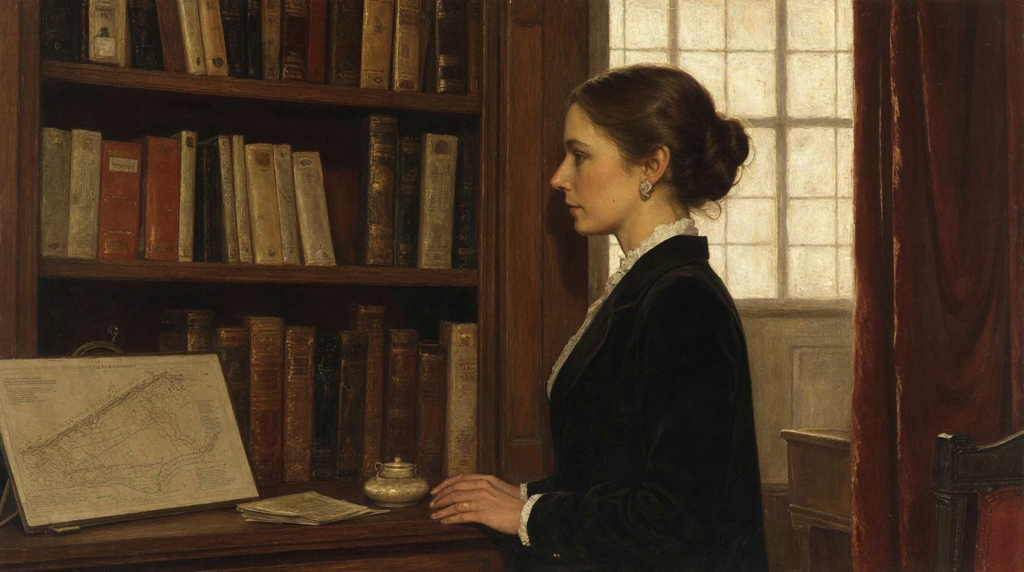
Despite her intellectual stature, she remained institutionally marginal. She was barred from universities and scientific societies for much of her life, yet her reputation transcended these limitations. She became one of the first two women elected as honorary members of the Royal Astronomical Society — a symbolic but significant recognition.
Understanding who was Mary Somerville also means recognising her role as a cultural intermediary. She corresponded with leading scientists across Europe, translating not just language but conceptual frameworks. In a period when scientific specialisation threatened mutual intelligibility, Somerville acted as a connective tissue.
Her career unfolded against the backdrop of broader social change explored here:
Women in knowledge
No discussion of Mary Somerville Victorian science is complete without acknowledging gender. She did not position herself as a campaigner, yet her life became an argument in itself. By excelling publicly in intellectual domains deemed unsuitable for women, she quietly undermined prevailing assumptions.
The term “scientist” itself was coined during her lifetime, partly in response to the difficulty of categorising thinkers like Somerville. As a Mary Somerville scientist, she embodied a new kind of intellectual identity — interdisciplinary, theoretical, and explanatory.
Her legacy is now rightly placed within the wider historical narrative of women in science:
For a concise biographical overview from a modern perspective, see this BBC feature: BBC on Science.
Frequently Asked Questions
Conclusion
Mary Somerville occupies a unique position in scientific history: not as an inventor or experimentalist, but as a unifier of knowledge. Her work helped science mature into a disciplined, interconnected enterprise at a critical moment in its development. By translating complexity into clarity, she influenced thinkers, machines, and methods that followed — including the early foundations of computing. In doing so, she proved that intellectual authority does not require institutional power, only rigour, patience, and the courage to think across boundaries.