
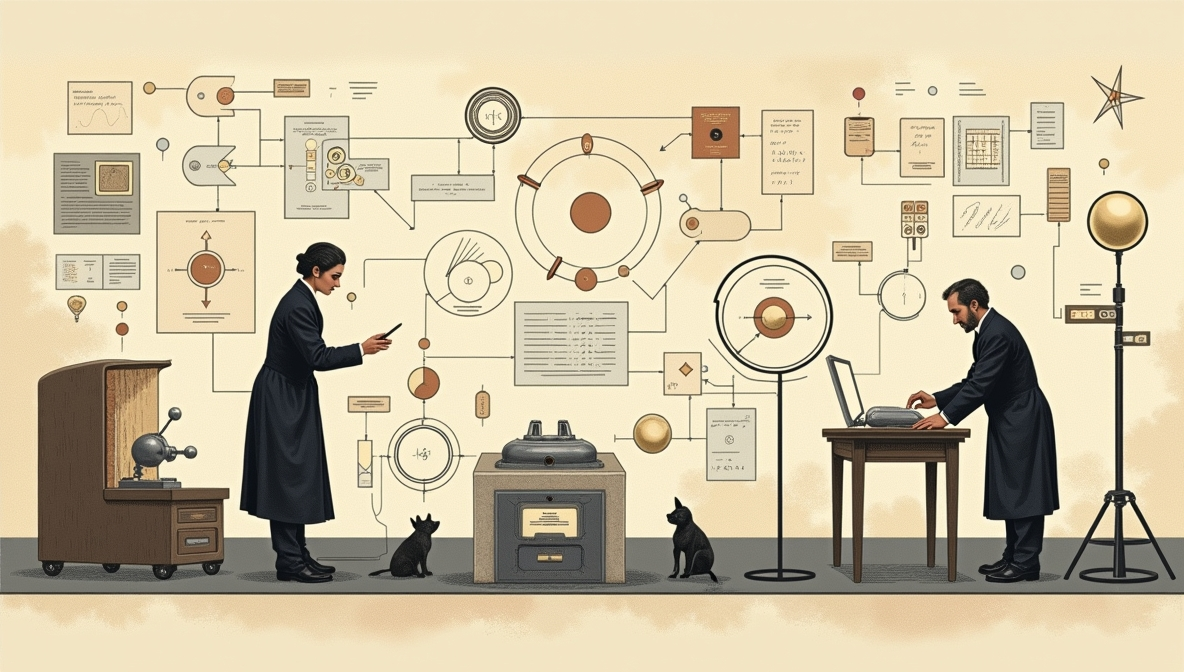
Symbolic Processing is the manipulation of symbols, expressions and abstract concepts by computers rather than the calculation of numerical values alone. This distinction helped transform computers from sophisticated calculating machines into general-purpose systems capable of representing language, logic, relationships and knowledge.
The concept has roots in mathematical logic and the earliest ideas about programmable machines. Long before electronic computers existed, thinkers were exploring whether operations normally associated with human reasoning could be expressed as systematic procedures.
From Numerical Calculation to Symbolic Processing
Early calculating machines were primarily designed to manipulate numbers. Charles Babbage’s Difference Engine, for example, was conceived to automate the production of mathematical tables.
Babbage’s later Analytical Engine represented a much more ambitious idea.
Babbage and the General-Purpose Machine
The Analytical Engine was designed around concepts recognisable in modern computing: stored information, instructions, conditional operations and repeated sequences of operations. The work of Charles Babbage therefore pointed beyond mechanical arithmetic towards general-purpose computation.
The crucial conceptual development was recognising that a machine could potentially operate upon representations rather than simply quantities.
Ada Lovelace and Meaning Beyond Numbers
Ada Lovelace recognised this wider possibility with remarkable clarity. In her notes on the Analytical Engine, she considered how entities other than conventional numerical quantities might be represented and manipulated if their relationships could be expressed appropriately.
This idea provides an important conceptual bridge between mechanical calculation and the early history of programming.
How Symbolic Computation Works
In symbolic computation, the computer works with representations according to formal rules.
A mathematical expression such as x² + 2x + 1, for example, can be stored as a structured symbolic expression. Instead of immediately converting everything into numerical values, software can manipulate the expression itself.
Symbols, Rules and Relationships
The manipulation of symbols by computers allows software to represent variables, words, logical propositions and relationships between objects.
This approach is closely connected with logic and algorithms. Once rules can be formally defined, a computer can apply those rules systematically to symbolic representations.
A computer algebra system might simplify an equation. A compiler can interpret symbols in programming code. A reasoning system can apply a logical rule such as: if all mammals are animals and a dog is a mammal, then a dog is an animal.
Foundations of Computer Algebra
Symbolic manipulation became one of the foundations of computer algebra. Systems such as Mathematica, Maple and SymPy can manipulate equations, differentiate expressions, simplify formulae and solve certain mathematical problems symbolically.
The same principle extends far beyond mathematics. Non-numerical information processing allows computers to work with grammatical structures, program instructions, logical statements and representations of knowledge.
Why Symbolic Processing Matters Today
Symbolic techniques became particularly influential in artificial intelligence. Traditional symbolic AI attempts to represent knowledge explicitly through symbols, facts and rules and then use logical procedures to reason about them.
This approach differs significantly from many modern machine-learning systems, which learn statistical patterns from large quantities of data. A useful overview of the traditional approach can be found in symbolic artificial intelligence.
From Victorian Ideas to Modern AI
Modern computing is vastly removed technologically from the mechanical machines imagined during Victorian science and society, but an important intellectual connection remains.
Computers are useful because information can be represented in forms that machines can manipulate according to defined procedures. Whether those symbols represent algebra, programming instructions, words or logical relationships, the principle allows computation to extend beyond arithmetic.
Symbolic Processing therefore represents one of the fundamental conceptual steps in computing history: the realisation that machines can manipulate representations of ideas as well as numbers.
Frequently Asked Questions
Conclusion
Symbolic Processing helped redefine what computers could achieve by extending computation beyond numerical calculation into the manipulation of ideas, expressions, rules and relationships. From the pioneering concepts explored by Charles Babbage and Ada Lovelace to computer algebra, programming languages and artificial intelligence, symbolic techniques have played an important role in the development of modern computing.
Although today’s AI increasingly incorporates statistical and machine-learning methods, the ability to represent and manipulate structured knowledge remains valuable. Symbolic Computation therefore stands as an important bridge between the earliest concepts of programmable machines and the sophisticated information-processing systems we use today.
“True engineers are lazy good-for-nothings — because they design once, and let the system do the rest.”
Stephenism
🎵 Soul from the Solo Blogger — Tunes from Túrail.