
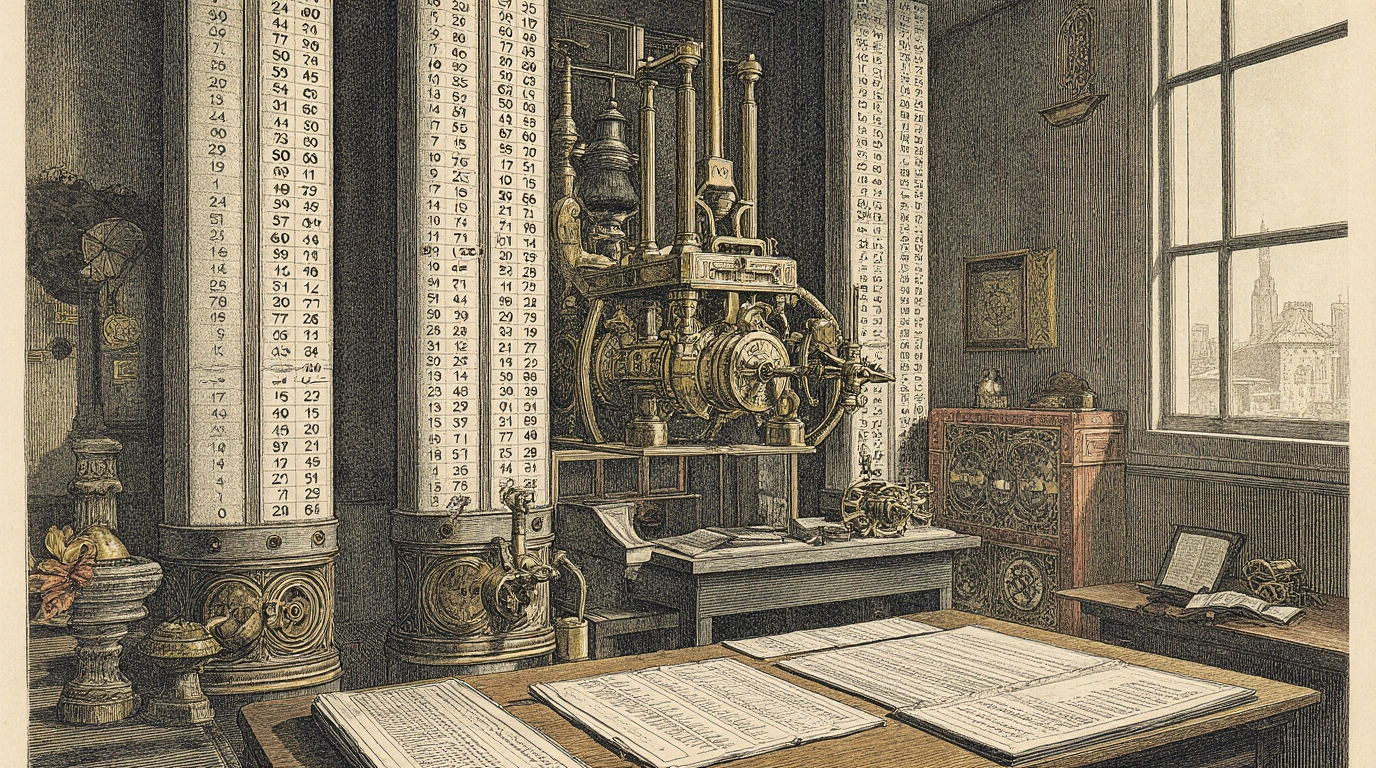
The Difference Engine was one of the most ambitious technological ideas of the nineteenth century. Conceived by Charles Babbage during the 1820s, it was designed to perform mathematical calculations automatically and produce accurate numerical tables without relying on the repetitive manual arithmetic that was then prone to human error.
It was not a computer in the modern sense. It had no software, stored program or general-purpose processor. Yet its importance reaches far beyond the task for which it was designed. Babbage demonstrated that a machine could follow a predetermined mathematical procedure and transform numerical inputs into reliable results.
That principle made the Mechanical calculator an important precursor to automated computing and provided Babbage with experience that would eventually lead him towards the much more ambitious Analytical Engine.
Difference Engine and the Problem of Human Calculation
During the early nineteenth century, numerical tables were essential to navigation, astronomy, engineering, banking and scientific work. Producing them was laborious.
Teams of human “computers” performed calculations by hand. Every additional calculation created another opportunity for an error to creep into the finished table. Worse still, errors could be introduced when results were copied, typeset and printed.
Babbage recognised that much of this work followed predictable mathematical rules. If the rules could be embodied mechanically, calculation could become both faster and more dependable.

Why Babbage Wanted to Automate Mathematics
The underlying concept was finite differences, a mathematical technique that allows certain functions to be evaluated through repeated addition rather than more complicated multiplication and division.
This mattered because addition was comparatively practical to implement mechanically.
The proposed machine would contain columns of numbered wheels representing decimal digits. Through a carefully organised sequence of movements, the mechanism could calculate successive values automatically.
This was mechanical calculation of numerical tables rather than mathematical reasoning in the human sense. Nevertheless, the distinction was revolutionary: the procedure itself was being transferred from a person to a machine.
Babbage’s broader intellectual development is explored in Charles Babbage: The Visionary Engineer, while the mathematical thinking behind his machines connects naturally with Logic and Algorithms in Babbage and Lovelace.
How Charles Babbage’s Mechanical Calculator Worked
The Charles Babbage mechanical calculator was an extraordinary engineering proposition for its time. Instead of electronic components, everything depended upon gears, shafts, levers and precisely manufactured metal parts.
Numbers were represented mechanically in decimal form. As wheels turned, values could be transferred between columns and carries propagated from one decimal position to another.

Automatic Mathematical Calculation
The important innovation was not simply that the machine could calculate. Mechanical calculators already existed in various forms. Babbage wanted a system capable of carrying out an organised sequence of operations with minimal human intervention.
The operator would establish the initial values, but the machine would then proceed through the required calculation.
This concept of automatic mathematical calculation represents an important transition in the history of technology. Machinery was no longer being considered solely as a means of amplifying physical strength. It could also automate aspects of intellectual labour.
The Difference Engine therefore belongs within the wider story of 19th-Century Science and the remarkable technological culture described in Victorian Science and Society.
The scientific environment that produced Babbage also produced experimental innovators such as Michael Faraday: The Great Experimentalist, although their methods and fields were very different.
A useful technical overview of Babbage’s machine can also be found in the Britannica guide to the Mechanical Calculator.
Why the Original Difference Engine Was Never Completed
In 1823, the British government agreed to support Babbage’s project financially. What initially appeared to be a promising technological programme gradually became expensive and difficult.
Precision engineering was one problem. Thousands of mechanical components had to interact reliably, and nineteenth-century manufacturing techniques made producing them consistently a formidable challenge.
Cost was another.
As development continued, expenditure increased dramatically. Babbage also had a difficult working relationship with engineer Joseph Clement, whose workshop was responsible for constructing much of the machinery. Their cooperation eventually broke down.
The government finally withdrew support in 1842.

From Difference Engine to Analytical Engine
Failure to complete the original machine did not end Babbage’s ambitions. Instead, his thinking expanded.
The Difference Engine was designed for a specialised mathematical purpose. The proposed Analytical Engine was fundamentally different: Babbage envisioned a general-purpose programmable calculating machine.
This transition is one of the most significant developments in the Early History of Programming.
It also created the intellectual environment in which Ada Lovelace recognised that such machinery might manipulate more than quantities. Her insights are explored through the Ada Lovelace Knowledge Cluster and in Symbolic Processing and Lovelace’s Babbage.
The distinction is crucial. The Mechanical calculator automated a particular mathematical procedure; the Analytical Engine proposed machinery whose behaviour could be changed through instructions.
Difference Engine 2 and Babbage’s Lasting Legacy
Babbage did not abandon the original idea. Between 1847 and 1849, he designed an improved version now known as Difference Engine No. 2.
It was more elegant than its predecessor and benefited from lessons Babbage had learned while designing the Analytical Engine. Yet Difference Engine No. 2 was never constructed during his lifetime.
More than a century later, the Science Museum in London decided to test whether Babbage’s design was genuinely workable.
Construction of a full calculating section was completed in 1991, around the bicentenary of Babbage’s birth. A matching printing mechanism was subsequently completed in 2002. The successful machine demonstrated that Babbage’s underlying engineering principles were sound.
A Precursor to Automated Computing
The importance of the Mechanical calculator lies less in the calculations it could perform than in the principle it demonstrated.
A mathematical procedure could be broken into defined operations, embodied within machinery and executed automatically.
That concept stands close to the foundations of modern computing.
The Mechanical calculator was not programmable in the way later computers would be, but it helped establish the intellectual path from mechanical arithmetic to automated information processing. The later collaboration and intellectual exchange surrounding Babbage and Lovelace pushed those ideas much further, particularly towards algorithms and symbolic manipulation.
That wider history also explains why Women in Science and Technology History is essential to understanding the development of computing rather than merely an additional chapter in it.
Babbage’s machine therefore occupies an unusual place in technological history. The original project was never completed, yet the idea behind it succeeded. It showed that reliable calculation could be mechanised and helped change what engineers and mathematicians believed machines might eventually accomplish.
Frequently Asked Questions
Conclusion: The Difference Engine Changed What Machines Could Do
The Difference Engine occupies a remarkable place in the history of computing. Although Charles Babbage never saw his complete machine constructed, its significance lies in the idea it proved possible: a mechanical device could follow a defined mathematical process and produce accurate results automatically.
That principle was more important than the machine itself. Babbage moved calculation away from being an exclusively human activity and towards something that could be delegated to machinery. His later Analytical Engine would take the concept much further, introducing ideas associated with programmability and general-purpose computation.
Seen from the perspective of modern computing, the Mechanical Calculator was therefore more than an ingenious Victorian machine. It was an important bridge between mechanical arithmetic and automated computation — an early demonstration that machines could be designed not merely to assist human thought, but to carry out structured processes on our behalf.