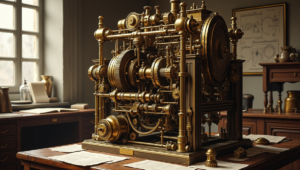

Charles Babbage (1791–1871) was an English mathematician, inventor and mechanical engineer whose remarkable designs anticipated fundamental principles of modern computing. Often called the father of the computer, he attempted to replace laborious human calculation with reliable mechanical processes.Charles Babbage
As the inventor of the Difference Engine, Babbage sought to eliminate errors from mathematical tables. His ambitions soon expanded far beyond automated arithmetic. The proposed Analytical Engine incorporated separate systems for processing and memory, programmable instructions and punched-card input. Although never completed, it established Babbage as a genuine Victorian computing pioneer whose ideas were decades ahead of available engineering technology.
Charles Babbage and the Problem of Human Calculation
Early nineteenth-century Britain increasingly depended on accurate numerical information. Navigation, astronomy, engineering, finance and scientific research all relied upon mathematical tables, yet these were calculated, copied and typeset by people.
Errors could enter at every stage.
Babbage believed machinery offered a solution. Mathematics followed rules, so he reasoned that a machine designed to execute those rules could calculate results consistently without the lapses associated with repetitive human work.
His approach reflected a wider transformation in Victorian science. Researchers were increasingly interested in systematic observation, measurement and reproducible processes. The principles underlying the scientific method provided an intellectual environment in which accuracy and repeatability became increasingly important.
Babbage belonged to a remarkable scientific era. Figures such as Michael Faraday and experimental science demonstrated what carefully designed experiments could reveal, while Mary Somerville’s scientific work helped communicate complex mathematical and scientific ideas to wider audiences.
The Inventor of the Difference Engine
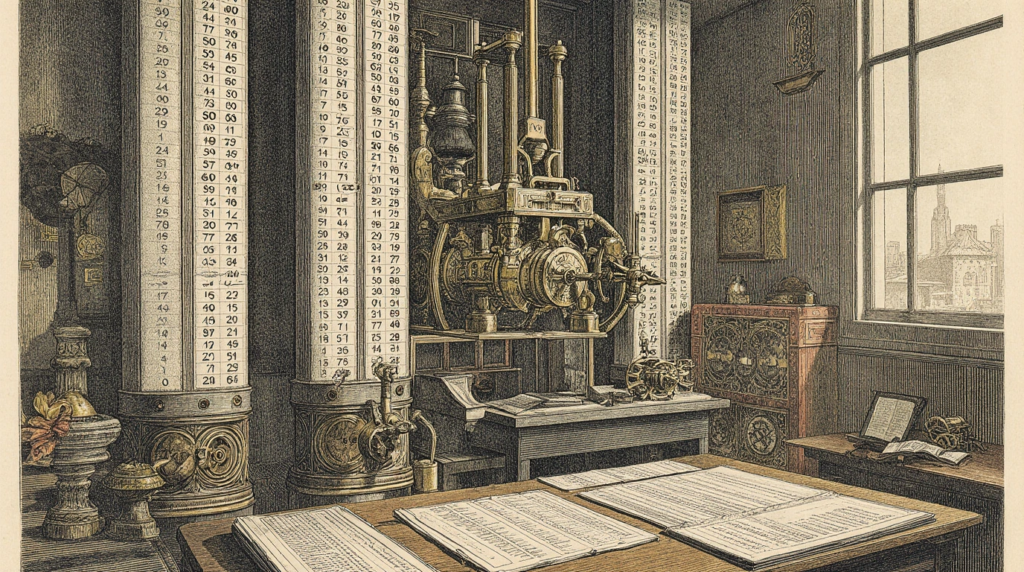
In the 1820s, Babbage began developing the Difference Engine, a mechanical calculator designed to produce mathematical tables automatically using the method of finite differences.
The British government recognised its potential and provided financial support. If successful, the machine could produce accurate tables useful for navigation, astronomy and engineering while reducing dependence on error-prone manual calculation.
Its construction proved extraordinarily difficult.
The Difference Engine required thousands of precision-made mechanical components. Engineering techniques of the period were capable of remarkable workmanship, but manufacturing such a complicated machine consistently and economically presented enormous challenges. Costs increased, disagreements developed and the original machine was never completed.
Yet the project was far from a meaningless failure. It demonstrated that complex calculation could be conceived as a sequence of mechanical operations.
More importantly, it encouraged Babbage to think beyond a machine designed for one specialised mathematical purpose.
Charles Babbage and the Analytical Engine
Babbage’s next design transformed his place in computing history. The Analytical Engine was intended not merely to calculate predetermined tables but to become a general-purpose programmable machine.
This distinction is crucial.
The machine would contain a “mill” where mathematical operations were performed and a “store” where numbers were retained. In broad conceptual terms, these resemble the processor and memory of a modern computer.
Instructions and data would be entered using punched cards, inspired partly by the punched-card systems used to control patterns in Jacquard looms.
As the Analytical Engine creator, Babbage was therefore proposing something much closer to programmable computing than a conventional mechanical calculator.
Ada Lovelace and the Possibilities of Programming
Babbage’s association with Ada Lovelace and early computer programming became one of the defining intellectual partnerships in computing history.
Lovelace recognised that the Analytical Engine represented something more profound than an automated calculator. Her extensive notes accompanying a translation of Luigi Menabrea’s description of the machine included a method for calculating Bernoulli numbers.
This is frequently described as an early published computer algorithm intended for execution by a machine.
More significantly, Lovelace understood that a programmable machine could potentially manipulate symbols according to rules. The significance of the Analytical Engine therefore extended beyond arithmetic.
Babbage had designed the architecture; Lovelace helped articulate its wider possibilities.
Seven Ideas That Anticipated Modern Computing
Several features of Babbage’s designs now appear strikingly familiar:
- Automated calculation reduced dependence on repetitive human arithmetic.
- Programmability allowed instructions to determine the operations performed.
- Memory provided a way of retaining information for subsequent operations.
- Processing occurred separately within the proposed mill.
- Punched-card input provided instructions and numerical data.
- Conditional operations allowed future calculations to depend upon previous results.
- General-purpose computation meant one machine could potentially perform many different mathematical tasks.
These principles explain why Babbage’s unfinished machine became more historically significant than many successfully constructed calculators of his period.
Why Charles Babbage Became the Father of the Computer
Calling Babbage the father of the computer does not mean that he built the first electronic computer. Electronics did not exist during his lifetime, and even his mechanical Analytical Engine remained unrealised.
His importance lies in architecture and ideas.
Babbage recognised that calculation could be separated into information storage, processing and instructions. He envisaged machinery capable of changing its operations according to a programme rather than merely repeating one predetermined calculation.
His work also belongs within a wider nineteenth-century scientific revolution. Later Victorian researchers such as James Clerk Maxwell and mathematical physics similarly demonstrated how mathematical structures could reveal underlying principles that were not immediately visible in the physical world.
Babbage’s designs were eventually tested in a particularly convincing way. Beginning in the twentieth century, the Science Museum in London constructed working versions based on his plans, including Difference Engine No. 2. Their successful operation demonstrated that the underlying mechanical concepts were sound.
Babbage therefore occupies an unusual position in technological history. He did not witness the completion of his greatest invention, yet he imagined essential characteristics of computing long before technology could make them practical.
Frequently Asked Questions
Conclusion
Babbage never saw the computing revolution his ideas anticipated. Nevertheless, the Difference Engine demonstrated his determination to mechanise accurate calculation, while the Analytical Engine revealed a much larger vision: a programmable machine capable of storing information and following instructions. That extraordinary conceptual leap ensures Charles Babbage remains one of the foundational figures in the history of computing.
A complicated system spends most of its life explaining itself.
– Stephenism
🎵 Soul from the Solo Blogger — Tunes from Túrail.