
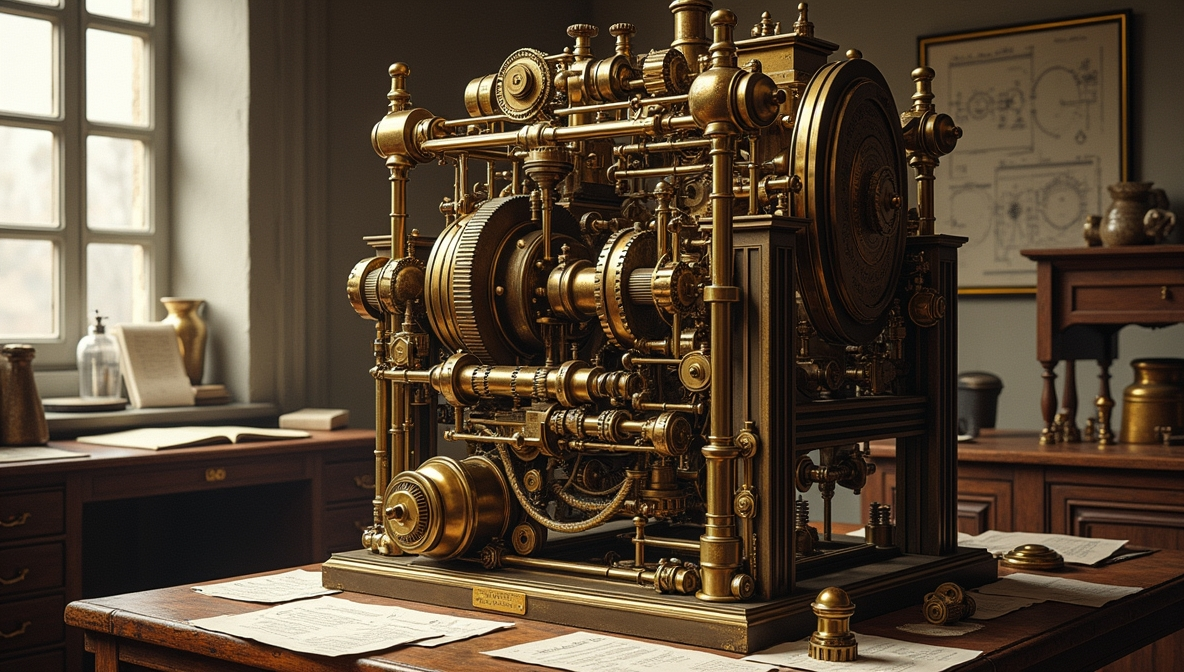
The Analytical Engine was a revolutionary mechanical computing machine designed by Charles Babbage during the nineteenth century. Conceived during the 1830s, it represented an extraordinary intellectual leap from machines performing fixed calculations towards the idea of a programmable, general-purpose computer.
Unlike Babbage’s earlier Difference Engine, the Analytical Engine was designed to perform different calculations according to supplied instructions. It contained concepts recognisable in modern computers: processing, memory, input, output and programmable control.
The machine was never completed, but its architecture established it as a remarkable precursor to modern computing. Its story also connects Charles Babbage and his computing vision with Ada Lovelace’s pioneering insights into what programmable machines might ultimately accomplish.
The Charles Babbage programmable computer concept anticipated many of the fundamental principles that would later define modern computing.
From the Difference Engine to a Programmable Machine
Babbage’s first major calculating-machine project was the Difference Engine. It was designed to automate the production of mathematical tables, reducing the human calculation and transcription errors that could affect navigation, astronomy and engineering.
The project was ambitious, but its purpose remained specialised. The machine would perform a predetermined mathematical process.
Babbage subsequently imagined something far more flexible.
The Analytical Engine would be a mechanical general-purpose computer capable of performing different operations depending upon the instructions supplied to it. This distinction transformed the machine from an automated calculator into the conceptual ancestor of programmable computers.
Its development belonged to a remarkable period of 19th-century science and innovation, when mathematics, engineering and experimentation were rapidly changing people’s understanding of what machines could accomplish.

How the Analytical Engine Would Have Worked
Babbage divided his machine into several functional components.
The “mill” would perform arithmetic operations. Numbers and intermediate results would be retained within the “store”. In modern terminology, these broadly resemble a processor and memory.
Instructions and data would be provided through punched cards, drawing inspiration from the Jacquard loom, which used cards to control complex textile patterns. Different cards could therefore direct the machine through different sequences of operations.
The design also included mechanisms for producing results.
These ideas meant that Babbage was not simply proposing a bigger calculator. His programmable computing machine separated instructions, processing and stored information in ways that anticipated later computer architecture.
The Britannica overview of the Babbage creation provides further historical background on Babbage’s proposed machine and its significance.

Seven Powerful Ideas Inside the Analytical Engine
The importance of the Analytical Engine becomes clearer when its individual concepts are considered.
- Programmability – punched cards could determine which operations were performed.
- General-purpose calculation – the machine was not restricted to one mathematical procedure.
- Processing – the mill provided a dedicated mechanism for carrying out calculations.
- Memory – the store retained numbers and intermediate results.
- Input – instructions and information could be supplied to the machine.
- Output – results could be produced after calculations were completed.
- Conditional and repeated operations – sequences could potentially be controlled according to previous results and repeated when required.
Together, these features make the Analytical machine strikingly different from most calculating devices that preceded it.
The conceptual transition also forms an important chapter in the early history of programming. Once a machine could follow different sequences of instructions, the question was no longer simply what a machine could calculate, but how people could instruct it to perform those calculations.
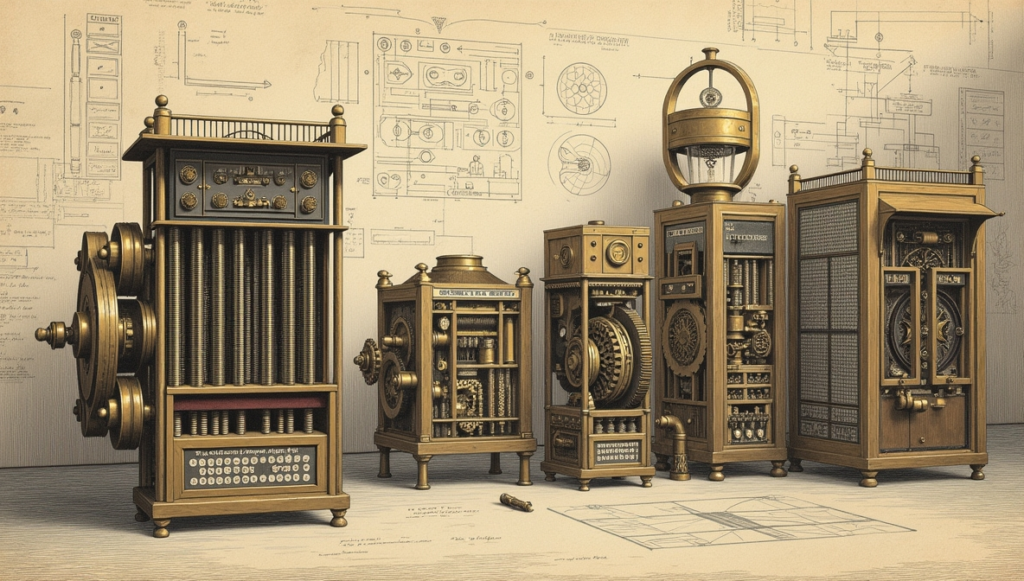
Ada Lovelace and the Meaning of the Analytical Engine
Babbage designed the machinery, but Ada Lovelace and her computing legacy helped reveal the broader implications of his invention.
Lovelace studied the Analytical machine and recognised that its potential extended beyond ordinary arithmetic. Her notes accompanying a translation of Luigi Menabrea’s description of the machine included a detailed procedure for calculating Bernoulli numbers.
This has become closely associated with the origins of computer programming.
From Numerical Calculation to Symbolic Processing
Lovelace’s deeper insight concerned what numbers could represent. If information could be expressed symbolically and governed by formal rules, a programmable machine might theoretically manipulate things other than quantities.
This connection between calculation and representation is explored further through symbolic processing in the work of Lovelace and Babbage.
The Analytical machine therefore occupies an important position between mechanical calculation and modern ideas about information processing.
Its proposed operations also connect naturally with the development of logic and algorithms in early computing. Programming ultimately depends upon expressing problems as ordered logical procedures that a machine can execute.
Lovelace’s contribution is particularly significant within the wider history of women in science and technology, where access to formal scientific institutions was often severely restricted.
Why the Analytical Engine Still Matters
The Analytical Engine was never completed during Babbage’s lifetime. Its enormous mechanical complexity required thousands of precision components, making construction technically difficult and extremely expensive.
Babbage also continually developed his ideas rather than freezing the design for production. Funding difficulties and disputes surrounding his earlier Difference Engine further reduced the chances of the Analytical Engine being constructed.
Nevertheless, judging the project solely by whether a finished machine existed misses its historical importance.
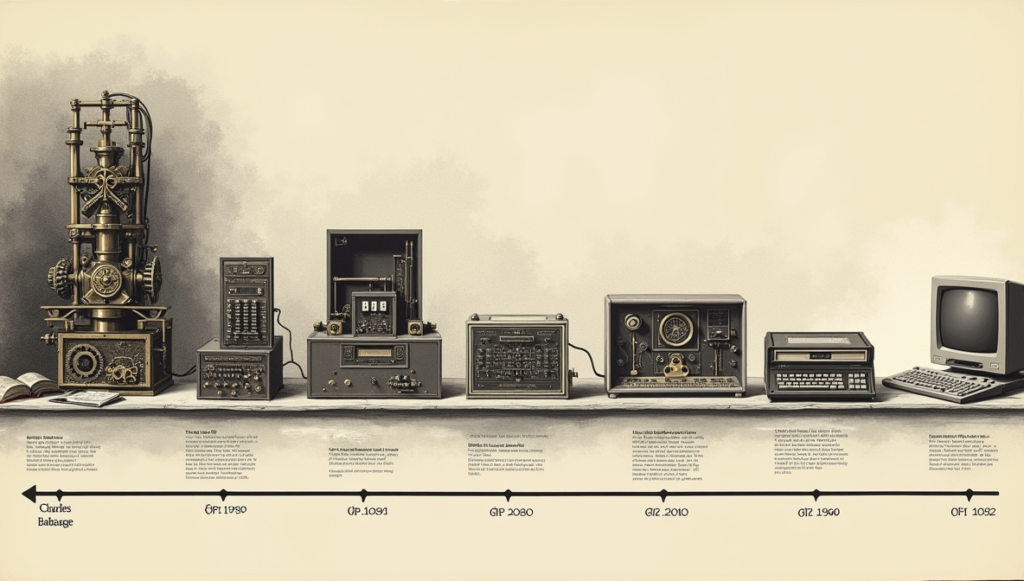
The Analytical machine demonstrated that a calculating machine could theoretically be programmable, store information and perform different operations according to instructions. Those concepts eventually became central to electronic computing.
It also emerged from a broader culture of Victorian science and society, in which industrial engineering increasingly interacted with mathematical and scientific investigation. Contemporary figures such as Michael Faraday and experimental science were transforming other fields through equally fundamental discoveries.
Babbage’s machine therefore matters not because it resembles a modern computer physically, but because its organisation resembles one conceptually.
Frequently Asked Questions
Conclusion
The Analytical Engine remains one of the most remarkable unrealised inventions in technological history. Babbage’s separation of processing and storage, combined with programmable instructions and general-purpose operation, anticipated principles that would become fundamental more than a century later. Together with Lovelace’s insights, the Analytical Computer helped establish the conceptual foundations upon which modern programmable computing would eventually be built.