
Ada Lovelace is widely recognised as the first computer programmer, but her greatest contribution may have been recognising what computers could eventually become. Long before electronic machines existed, she imagined a programmable device capable of manipulating symbols and even composing music.
Born Augusta Ada Byron on 10 December 1815, she was the daughter of poet Lord Byron and Anne Isabella Milbanke. Her parents separated shortly after her birth, and her mother encouraged her education in mathematics and science.
Ada later became Countess of Lovelace through marriage. Her unusual combination of mathematical ability and creative imagination would help her recognise possibilities that extended far beyond the technology of Victorian Britain.
How Ada Lovelace Became a Computing Pioneer
Ada’s mathematical education was unusual for a woman in nineteenth-century Britain. Among her teachers was Mary Somerville, a respected scientist and writer who encouraged her intellectual development and introduced her to Charles Babbage in 1833.
Somerville’s influence demonstrates why scientific progress rarely happens in isolation. Explore her contribution in Mary Somerville: The Scientific Mentor.
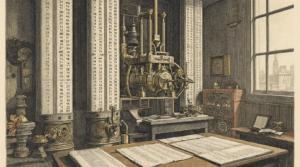
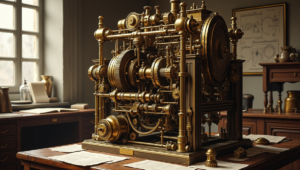
Babbage was developing the Difference Engine, a mechanical calculator designed to produce mathematical tables. His subsequent proposal, the Analytical Engine, was considerably more ambitious: it could follow different instructions using punched cards.
Lovelace recognised its possibilities and became an enthusiastic collaborator. Her story also provides a fascinating example of the opportunities and restrictions explored in Victorian Science and Society.
The Analytical Engine and the First Published Program
In 1843, Lovelace published an English translation of an article about the Analytical Engine by Italian engineer Luigi Federico Menabrea.
She added seven extensive notes of her own, substantially expanding the original work. Her final note contained a detailed procedure showing how the machine could calculate Bernoulli numbers, a mathematical sequence.
This established her reputation as an Analytical Engine programmer and a pioneer of computer programming.
There is an important historical distinction. Babbage had previously drafted unpublished algorithms, so the title of first computer programmer remains debated. Lovelace’s achievement was publishing an influential early description of a computational procedure.
Her contribution belongs within the wider early history of programming , which traces the development of instructions that allow machines to perform different tasks.
Why Her Vision Extended Beyond Mathematics
Lovelace understood that numbers could represent information other than quantities.
If musical notes could be expressed mathematically, she reasoned, a suitable machine might manipulate them according to programmed rules and produce music.
The same principle suggested possibilities involving symbols and other forms of information.
This insight distinguished a general-purpose computer from a calculator designed for limited operations.
It also demonstrated the value of combining imagination with mathematical reasoning. The scientific method provides a useful framework for understanding how ideas can be developed, examined and tested.
Lovelace’s vision could not be fully tested because the Analytical Engine was never completed during her lifetime.
Lovelace’s Legacy and Lasting Influence
Lovelace died on 27 November 1852, aged just 36. Her work received limited recognition during her lifetime but gained greater attention as electronic computing developed in the twentieth century.
Her lasting contribution was not simply an algorithm. She recognised that programmable machines might manipulate information in ways extending far beyond arithmetic.
She also considered their limitations, arguing that the Analytical Engine could perform operations specified by humans but could not independently originate knowledge. Her observations later became relevant to debates about artificial intelligence.
Today, the Victorian computing pioneer is celebrated as an important figure in computing history and an inspiration within the broader story of women in science and technology.
Frequently Asked Questions
Conclusion
Ada Lovelace’s remarkable legacy demonstrates that technological progress requires more than mechanical invention. It also depends on people capable of imagining what an invention might eventually make possible.
A complicated system spends most of its life explaining itself.
– Stephenism
🎵 Soul from the Solo Blogger — Tunes from Túrail.