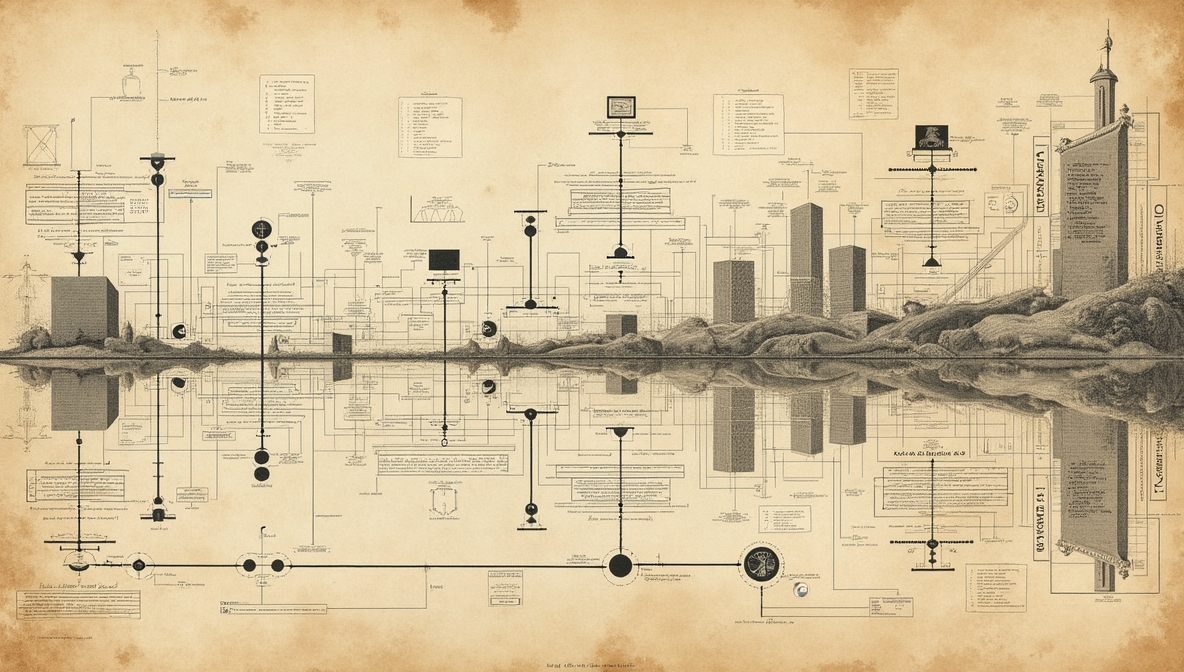
History of Programming
History of Programming traces the development of the ideas, methods and languages that allow humans to give instructions to machines. Although computer programming is often associated with the electronic revolution of the twentieth century, its origins reach much further back, beginning with mechanical automation, mathematics and attempts to make machines follow predetermined sequences of instructions.
One important early step came from Joseph Marie Jacquard, whose automated loom used punched cards to control complex weaving patterns. The principle demonstrated that instructions could be encoded and supplied to a machine, an idea that would later become fundamental to computing.
The nineteenth century brought a major conceptual breakthrough through the work of Charles Babbage and Ada Lovelace. Babbage’s proposed Analytical Engine was designed as a programmable mechanical computer, while Lovelace recognised that such a machine might manipulate symbols as well as perform numerical calculations. Her detailed notes included an algorithm for calculating Bernoulli numbers, leading to her frequent description as the world’s first computer programmer.
During the twentieth century, the History of Programming accelerated dramatically as theoretical ideas became working electronic computers. Alan Turing’s research helped establish the mathematical foundations of computation, while early programmers developed practical ways of instructing increasingly powerful machines.
From Machine Code to Modern Programming Languages
Early electronic computers were programmed using machine code and physical configurations that were difficult and time-consuming to create. Assembly languages made programming more manageable, followed by higher-level languages such as FORTRAN, COBOL and BASIC. These allowed programmers to express instructions in forms increasingly removed from the underlying hardware.
The History of Programming continued through structured programming, object-oriented languages and the rise of personal computers. Languages including C, C++, Java, Python and JavaScript helped programming expand from specialist scientific and military applications into business, education, entertainment and everyday digital technology.
This Walkeropedia category explores the people, inventions, programming languages and breakthrough ideas that shaped software development. By following the History of Programming, we can see how the simple concept of giving instructions to a machine evolved into the software-driven world that surrounds us today.
The history of programming traces how abstract ideas about logic and procedure evolved into formal computer programming languages capable of directing machines. From early algorithmic thinking to modern symbolic systems, programming reflects changing ways humans have learned to describe, structure, and solve problems.