
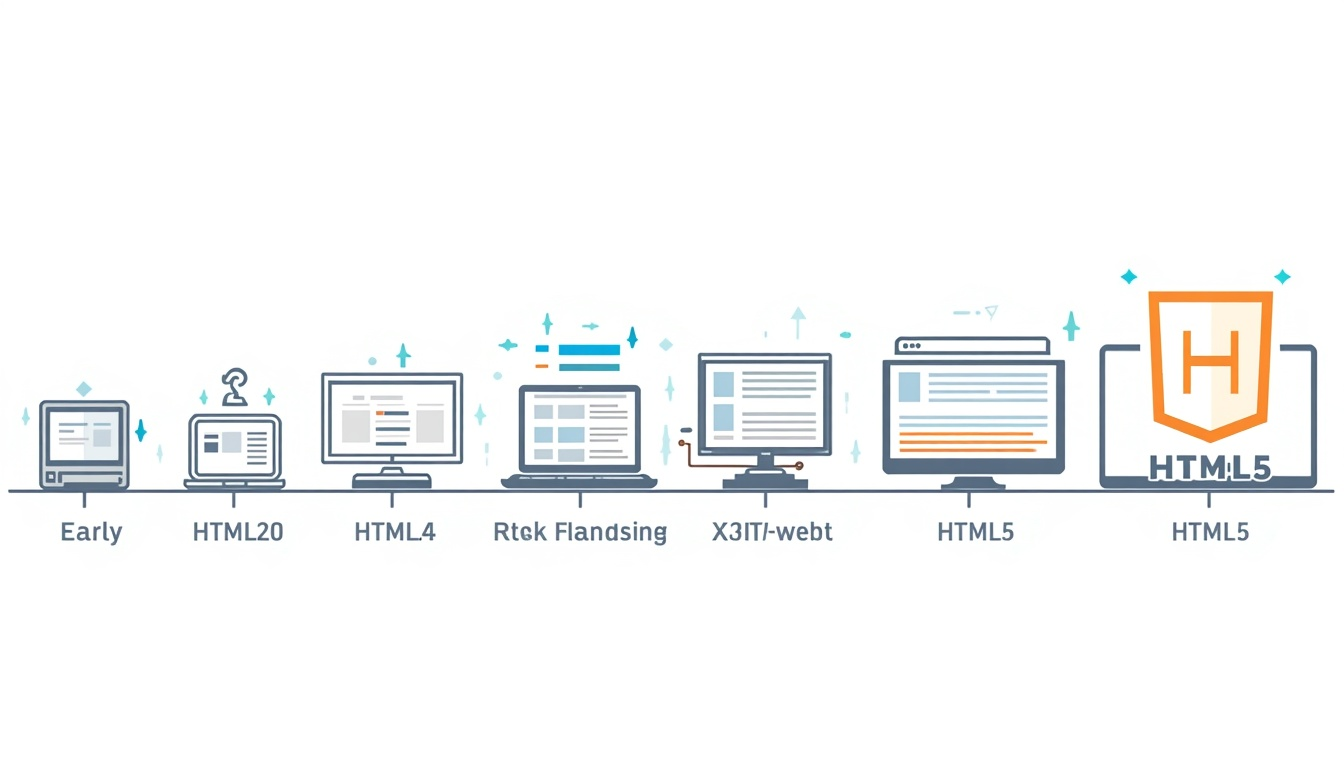
The story of HTML evolution is closely tied to the growth of the World Wide Web itself. What began as a simple way to organise and connect documents has developed into the foundation of modern websites, supporting multimedia, interactive content and semantic structure.
Today, HTML is so familiar that it is easy to forget how much it has changed. The language used to create early web pages contained only a small collection of tags, yet it eventually grew into the sophisticated standard that powers billions of pages worldwide.
Understanding this journey helps explain the history of HTML and web development and why modern websites work the way they do.
From Simple Documents to a Global Standard
The origins of HTML can be traced to 1989 when Tim Berners-Lee proposed a system for sharing information across connected computers. His vision became the World Wide Web, and HTML was created as the language used to structure and connect documents.
The name itself stands for Hypertext Markup Language. If you are new to the subject, Hypertext Markup Language Explained provides a useful introduction, while What Hypertext Means explores the concept of linked information that inspired the web.
The Earliest Version of HTML
The first version of HTML appeared in the early 1990s. It was remarkably simple compared to modern standards.
Early HTML supported:
- Headings
- Paragraphs
- Lists
- Hyperlinks
- Basic document organisation
The primary goal was not visual design. Instead, HTML focused on describing information and allowing users to move between documents through hyperlinks.
This simple concept laid the foundation for how HTML changed the World Wide Web. Information was no longer isolated within individual computers or printed documents. It became part of a connected network.
HTML 2.0 and the Rise of Standards
As the web expanded, developers needed consistency. Different browsers were beginning to interpret pages differently, creating confusion and compatibility problems.
HTML 2.0 emerged in 1995 as the first formal standard. It defined how browsers should interpret HTML documents and helped ensure that web pages behaved more predictably.
This marked an important stage in the development of HTML standards over time. Rather than being controlled by individual browser vendors, HTML increasingly became a shared standard for the web community.
During this period, web pages remained relatively simple, but the groundwork was being laid for more advanced features.
The Browser Wars and Rapid Growth
The late 1990s saw intense competition between browser companies. Netscape Navigator and Microsoft Internet Explorer competed aggressively for users.
Each browser introduced its own proprietary features, often before standards bodies could evaluate them. While this encouraged innovation, it also created compatibility issues.
Developers frequently had to create separate versions of websites for different browsers.
Some of the innovations introduced during this era eventually influenced future HTML standards, while others disappeared entirely.
For a deeper understanding of how browsers interpret HTML today, see How Browsers Read HTML.
HTML 4 and Better Structure
HTML 4 became a major milestone in 1997.
This version encouraged greater separation between content and presentation. Instead of using HTML for visual styling, developers increasingly relied on Cascading Style Sheets (CSS).
This shift improved accessibility, maintainability and consistency across websites.
If you’re unfamiliar with the distinction, CSS and HTML: What’s the Difference? explains how the two technologies complement one another.
HTML 4 also introduced improved support for internationalisation, scripting and accessibility, helping the web become more inclusive and globally accessible.
XHTML and the Search for Precision
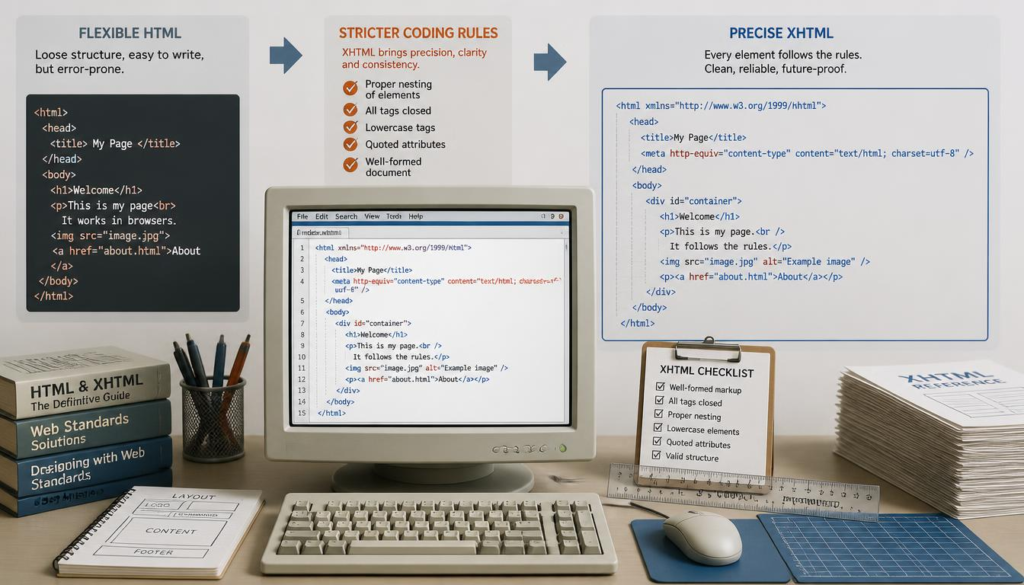
Around the turn of the century, XHTML attempted to combine HTML with the stricter syntax rules of XML.
The goal was to create cleaner, more structured documents. Developers were required to follow stricter coding practices, including properly closing all elements.
While XHTML influenced web development practices, many developers found its rigid requirements difficult to maintain.
Eventually, the web community shifted towards improving HTML itself rather than replacing it entirely.
HTML5 Transforms the Modern Web
The arrival of HTML5 marked one of the most significant stages in HTML evolution.
Instead of treating the web primarily as a collection of documents, HTML5 recognised that websites were becoming platforms for applications, multimedia and interactive experiences.
HTML5 introduced:
- Native audio support
- Native video support
- Semantic elements
- Improved forms
- Canvas graphics
- Better support for mobile devices
These additions reduced dependence on external plugins and made websites faster, safer and more accessible.
Readers interested in the technical details can explore Key HTML5 Features.
Semantic elements such as <header>, <article>, <section> and <footer> also improved document structure. These additions support accessibility and search engine understanding, a topic covered further in Semantic HTML Explained.
HTML Today and Beyond
Modern HTML continues to evolve through a collaborative standards process involving browser vendors, developers and standards organisations.
Unlike earlier periods, new features are generally introduced incrementally rather than through dramatic version changes. This approach allows browsers to adopt improvements more smoothly.
JavaScript now plays a major role in creating dynamic experiences, but HTML remains the foundation upon which those experiences are built. To see how these technologies interact, visit JavaScript and HTML Working Together.
Resources such as HTML History and W3Resource HTML History provide additional historical context for readers wishing to explore further.
The story of HTML versions from early web to HTML5 demonstrates how a simple markup language adapted to meet the demands of a rapidly changing internet. From a small collection of tags designed to link academic documents, HTML grew into a sophisticated standard that supports modern websites, applications and multimedia experiences. Understanding HTML evolution not only reveals the history of the web but also highlights why HTML remains one of the most important technologies in the digital world.