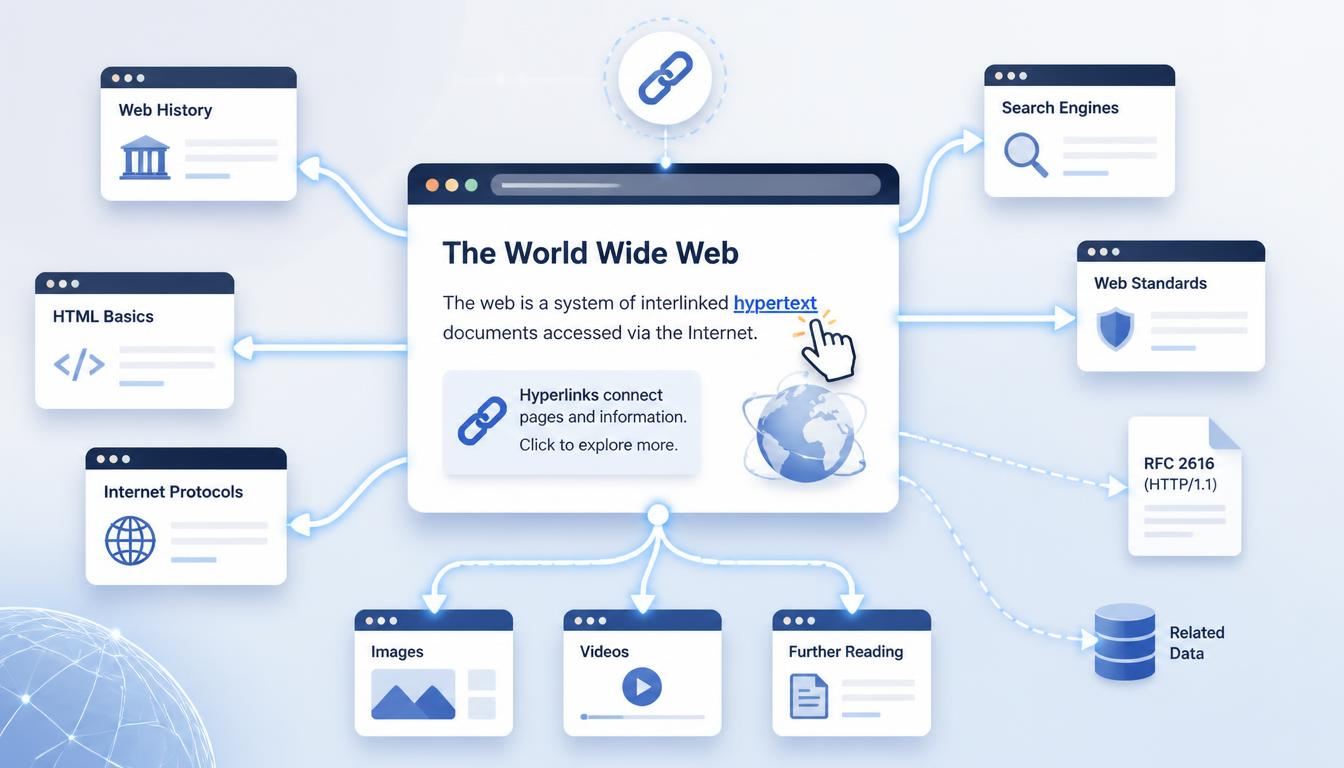
Understanding hypertext meaning helps explain one of the fundamental ideas behind the World Wide Web. Hypertext allows pieces of information to be connected so that you can move from one document to another simply by selecting a link.
You use hypertext constantly. Click a link in a news article, select a result from a search engine or follow a link from one Walkeropedia article to another, and you are using it.
The idea seems ordinary today, but it changed how we find and explore information. Instead of forcing readers to follow a fixed path from beginning to end, hypertext lets them choose where to go next.
1. What Does Hypertext Actually Mean?
At its simplest, hypertext is text containing connections to other information. Those connections are normally presented as hyperlinks that can be selected by the reader.
2. Hypertext Versus Ordinary Text
Traditional printed text is generally linear. You start at the beginning of a book or article and progress through it in a sequence determined by the author.
Hypertext doesn’t have to work that way.
Imagine reading an article about the Moon. Within it you might find links to pages about the Apollo missions, Neil Armstrong or the Solar System. You can continue reading the original article or follow one of those connections.
This illustrates hyperlinks and non linear digital information. The reader has some control over the route taken through the material.
Britannica provides a broader overview of hypertext and hypermedia, including their role in linking related information electronically.
3. Hypertext and Hyperlinks Are Not Quite the Same
The terms hypertext and hyperlink are closely related but don’t mean exactly the same thing.
Hypertext describes the system or concept of interconnected information.
A hyperlink is the actual connection that takes you from one resource to another.
For example, the words “learn about HTML” might appear as clickable text. The clickable connection is the hyperlink; the wider system of connected information is hypertext.
A Simple Way to Remember the Difference
Think of a road network.
Hypertext is the network. A hyperlink is one of the roads.
This distinction helps explain the meaning of linked text on the web without introducing unnecessary technical terminology.
4. How Hypertext Meaning Became Fundamental to the Web

The concept of linked information existed before the World Wide Web. The term hypertext is generally credited to American technology pioneer Ted Nelson, who used it during the 1960s while developing ideas about interconnected electronic documents.
The history of hypertext stretches even further back through earlier concepts for organising and connecting information.
5. From Hypertext to the World Wide Web
The breakthrough came when Tim Berners-Lee developed the World Wide Web around a system in which documents could be identified and connected using hyperlinks.
This meant information stored on different computers could form part of an enormous interconnected collection.
Rather than needing to know where every document was stored, users could simply follow links.
That principle remains central to how hypertext connects information online today.
6. Where HTML Fits In
Hypertext is also where the H and T in HTML come from.
HTML stands for Hypertext Markup Language, the markup language used to describe the structure of web pages. You can find a beginner’s introduction in Hypertext Markup Language Explained.
HTML creates hyperlinks using the <a> element. A simple link might look like:
<a href="https://example.com">Visit Example</a>The href attribute specifies the destination, while the words between the tags provide the clickable text.
For a broader introduction to the building blocks used in HTML, see HTML Tags Explained.
7. Why Hypertext Still Matters
Hypertext can seem almost invisible because following links has become such a normal part of using the internet. Yet without it, browsing the web would be a very different experience.
Hypertext Gives Readers Choices
A well-designed website doesn’t force every visitor to follow exactly the same route. Links allow people to explore subjects according to their interests.
A beginner reading about HTML, for example, might decide to investigate HTML Document Structure, while another reader might want to understand How Browsers Read HTML.
That freedom is one of hypertext’s defining characteristics.
Hypertext Creates Connections Between Ideas
Hypertext isn’t merely a convenient way of moving between pages. It can establish relationships between ideas.
A useful hyperlink can provide background information, explain an unfamiliar term, supply evidence or lead the reader towards a related subject.
This helps explain how hypertext shaped the World Wide Web. Instead of behaving like a collection of isolated electronic documents, the web became a network of interconnected information.
Understanding hypertext meaning therefore reveals something fundamental about how the web works. Every time you select a hyperlink and move from one piece of information to another, you are using the principle that helped transform separate digital documents into the interconnected World Wide Web.